He Filled a Cave With Wool and Firewood — It Saved His Family From the Harshest Winter
The Breath of the Fire
The iron stove came from an abandoned, collapsed silver assay cabin several miles away up the canyon.
It was small, heavy, and deeply scarred by years of intense use. Inside, a few cracked, incredibly dense soapstone panels still lined portions of the firebox. They were imperfect, fractured by heat, but still highly useful. The soapstone absorbed intense heat while the fire burned rapidly, and released it very slowly into the room long after the flames had faded to ash.
Most conventional settlers would have placed the stove close to the entrance of the cave, hoping to fight the cold air as it entered, or to make routing the chimney easier.
Thaddius did the exact opposite.
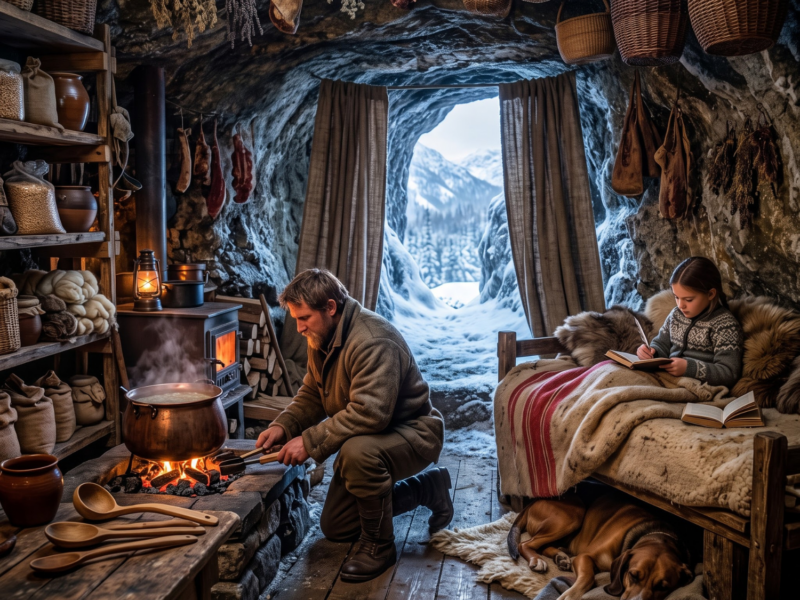
He set the heavy stove deep inside the cave, near the rear solid wall, safely away from the wooden sleeping platform to prevent fire risk. The metal stovepipe rose straight upward before passing through a small, natural opening in the rock ceiling, which he heavily reinforced with sheet iron, stacked stone, and thick wet clay to prevent the heat from cracking the surrounding rock.
A simple, heavy iron damper installed in the pipe allowed him to drastically slow the draft, keeping the heat inside the iron body without trapping deadly smoke inside the room.
The first firing trial lasted nearly two hours. The initial results looked incredibly encouraging. The temperature climbed steadily and evenly throughout the entire cave.
Then, the next morning revealed another hidden, dangerous problem.
A thin, slick film of water covered the solid stone wall directly behind the stove. Cold rock, rapidly warmed air, and hidden ambient moisture. The combination of physics had created heavy condensation on the wall.
If left ignored, the dampness would spread. Bedding would become wet and lose its insulating value. Metal tools would rust. Black mold would eventually appear and poison the air.
Thaddius shut the stove down immediately, smothering the fire with ash. He waited for it to cool, then physically dragged the heavy iron box seven inches farther away from the rock wall. He then spent the afternoon stacking a loose, dry-fitted granite rock shield directly behind the stove.
Crucially, he left small, deliberate gaps at the bottom and sides of the rock shield.
He was creating a convective loop. The air could now enter at the bottom, heat up against the stove, and rise rapidly behind the heated granite shield, circulating the warmth into the room instead of becoming trapped as a pocket of stagnant moisture against the cold cave wall.
While he wrestled with the heavy stones, Evelyn dutifully wiped the wet cave wall completely dry with old cloth scraps.
The next evening’s test produced a vastly different, triumphant result. The granite shield absorbed and held the intense warmth of the stove, but absolutely no water gathered on its surface or the wall behind it. The air circulated perfectly.
As Thaddius sat and studied the bone-dry wall, he suddenly remembered the wet, weeping logs inside his timber cabin the winter Clara died.
The difference was simple, and heartbreaking. This time, the structural problem had been discovered, analyzed, and corrected before Evelyn ever had to sleep a single night beside it.
The sleeping platform itself was a masterpiece of thermal isolation. It stood a full sixteen inches above the cold stone floor, breaking the conductive bridge. Its sturdy frame was built from peeled pine poles. Thin, flexible wooden slats formed the surface.
Above the slats came a thick, insulating layer of dry prairie grass, then two dense layers of raw, greasy wool, and finally, the beautiful, red-striped wool blanket Clara had woven years before. Beneath the foot of the raised platform, Ranger the hound claimed a space of his own on a bed of pine needles. It stayed perfectly warm from the radiant heat of the stove and the bedding above, without ever becoming uncomfortably hot.
Across the cave, near the entrance but inside the airlock, Thaddius built a raised, heavy wood rack fastened securely to stone anchors driven into the wall. The firewood rested fourteen inches above the ground, with wide gaps deliberately left between the rows to allow maximum airflow for drying.
For the first few days of November, he kept some small juniper logs right near the vestibule entrance for convenience.
That mistake revealed itself quickly.
After just three days of blowing, wet snow, the moisture rushed into the vestibule every time the outer door opened. The porous outer bark of the logs soaked the moisture up like a sponge, grew heavy, and when placed in the stove, burned poorly with thick, choking white smoke.
Failure number three.
He immediately moved the entire massive wood rack six feet deeper into the protected, dry cave. The wood was restacked in thinner, more spaced-out rows to improve airflow. Only a very small supply—just enough kindling and logs for the next day’s fire—was kept near the stove to pre-heat and dry out before burning.
Around the exact same time, the tiny, spring-fed water basin in the wall received a tightly fitted, insulated wooden cover to prevent evaporation from adding moisture to the cave air.
By early November, father and daughter could draw fresh, liquid water to drink and cook with without ever having to put on a coat or step out into the freezing, lethal wind.
The cave was no longer just a desperate hole in the hillside with a stove shoved inside.
It had been engineered. It had truly become a closed, highly efficient winter survival system.
One evening, as the wind began to howl in earnest outside, Evelyn stood on the sleeping platform. She spread her mother’s red-striped blanket meticulously across the bed and carefully, tenderly smoothed a single wrinkle from the fabric with her small hands. Ranger rested his heavy chin against the edge of the wooden platform, watching her.
Thaddius watched them from the stove. He quietly turned his face away, pretending to inspect the wood rack instead, swallowing the sudden, thick knot in his throat.









