He Filled a Cave With Wool and Firewood — It Saved His Family From the Harshest Winter
The Witness
On the fourth day of the monstrous storm, the screaming wind finally eased for a few precious, silent hours in the afternoon.
Silas Boon decided it was time to see the cave for himself. He had to know.
The climb up the ridge was agonizingly difficult. The fresh snow reached nearly chest height in places, forcing him to wade and crawl. The mercury thermometer hanging inside a wooden box on Silas’s porch had shown -31 degrees when he left.
At the entrance to the cave, Silas brushed the snow from his coat, lowered his head, and stepped cautiously through the narrow, heavy doorway into the vestibule.
One thick, greasy wool curtain brushed his shoulder. Then he stepped over the threshold and pushed through another.
The atmospheric change was immediate. It was not a blast of furnace heat; it was just… unmistakable.
The first thing that caught Silas’s attention as his eyes adjusted to the golden lantern light was not the stove.
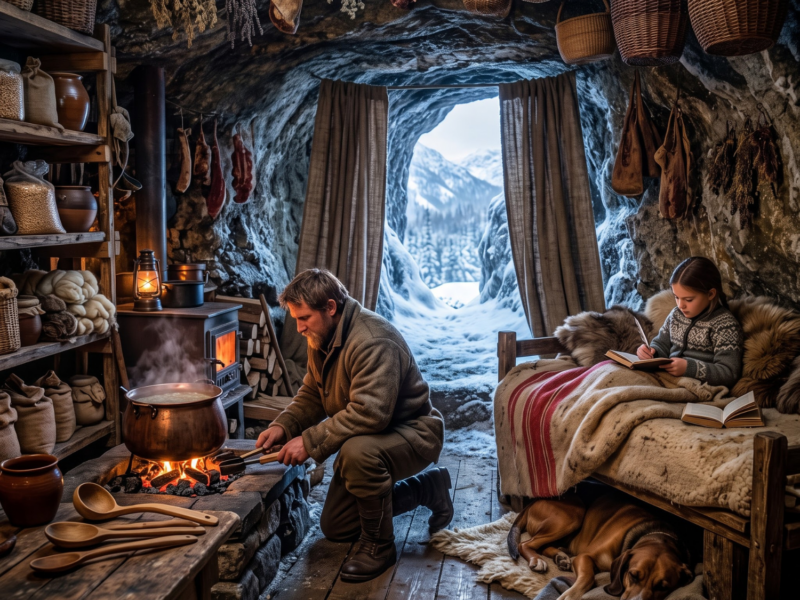
Evelyn sat cross-legged on the wooden platform, comfortably reading a book. Her heavy winter gloves were nowhere in sight. Ranger slept soundly on his back beside her feet, his paws in the air.
The air in the room was perfectly clear. It carried absolutely no trace of the white, pluming breath that defined every waking moment in Silas’s own cabin.
Only then did Silas turn his head and look toward the iron stove.
The fire had burned down to fine, gray ash hours earlier. According to Thaddius, who sat quietly at a small table mending a trap, no wood had been added to the firebox for nearly six hours.
Yet, the glass thermometer hanging near the sleeping platform still read a comfortable 54 degrees.
Silas rose slowly from his crouch and began inspecting the shelter. He did it with the exact same critical, measuring eye he would use to inspect a new barn, a fence line, or a prized stock pen.
His bare hands settled on the massive granite blocks Thaddius had stacked behind the stove.
Warm. Deeply, radiatingly warm.
The wood rack stood much farther back in the cave than Silas would have guessed. He touched the logs. Every piece remained bone dry. The covered water basin carved into the rock still held perfectly liquid water.
He inspected the vestibule. The lower edge of the outer wool curtain hung freely. There was no heavy ice, no frozen, stiff fabric binding it to the floor. The stone wall behind the stove remained completely dry as well; there was no weeping condensation.
Months earlier, the men at the trading post had loudly, confidently predicted catastrophic moisture, suffocating smoke problems, frozen curtains, damp, useless firewood, and deadly poor ventilation.
Silas, looking closely, could not find a single one of those failures.
He never offered verbal praise. That was not his nature, nor the nature of the frontier. Instead, he turned to Thaddius and asked a single, practical question.
“How much wood?” Silas rasped, his voice rough from the cold climb.
Thaddius stood up. He pointed toward the dense cluster of charcoal tally marks covering one section of the stone wall. Then, he reached over to the table and handed Silas the leather ledger.
Silas studied the wall, and then he studied the pages.
The numbers written in Thaddius’s neat hand required absolutely no explanation to a man who had been burning fuel in a panic for three days.
Nearly an hour passed in the quiet warmth of the cave before Silas finally stood up to leave. Before heading out into the vestibule and down the snow-covered slope, he paused and looked back at the room.
The low, half-buried vestibule that Caleb Roar had mocked as a “sheep pen” looked crude from the outside, yes. But Silas now fully understood the exact, meticulous, life-saving effort hidden beneath the canvas.
His pale eyes drifted back to Evelyn, lingering for a moment on the bright red-striped blanket covering her bed. He remembered Clara Mercer’s funeral. He remembered the sound of Thaddius’s shovel hitting the frozen dirt.
For a long moment, neither man spoke. The only sound was the faint whistle of the wind outside the rocks.
Then, Silas asked the absolute only question that still mattered to a father.
“Does she wake up cold?” Silas asked quietly.
Thaddius glanced over at his daughter. A page in her book turned. Ranger shifted comfortably in his sleep, sighing.
“No,” Thaddius said.
Silas nodded once, a sharp, definitive movement. When he pulled his hat low and started back down the mountain to the freezing basin, he carried much more than just proof that the cave worked.
He carried a fundamentally changed mind.









