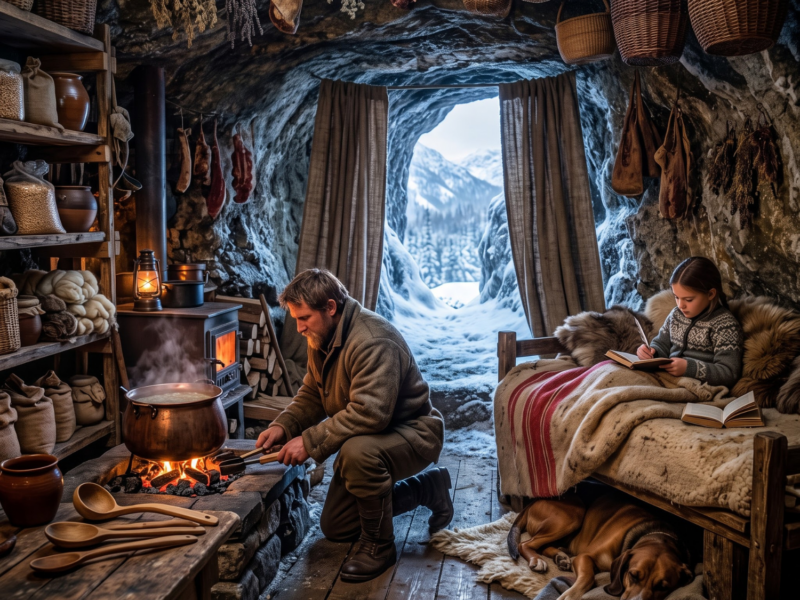
He Filled a Cave With Wool and Firewood — It Saved His Family From the Harshest Winter
The Empty Cup
In early October 1888, the chokecherry brush in Pine Hollow Basin had just begun to shed its dry, red leaves when Thaddius Mercer made his first, deliberate climb up the steep east slope.
He was not carrying a felling axe. He was not carrying stone-mason tools. He was not hauling cabin timber.
He carried two massive rolls of raw, unwashed sheep’s wool, still greasy, heavy, and pungent with natural lanolin. Behind him, a stubborn mule hauled a sledge loaded with dry pinyon pine and juniper—dense, slow-burning wood he had cut back in the heat of July and stacked strictly for the hard cold.
Evelyn Mercer, his ten-year-old daughter, followed close behind her father, quietly carrying a heavy coil of hemp rope over her thin shoulder. Ranger, their scarred, gray-muzzled hound, trotted ahead, stopping abruptly at the black, yawning mouth of the cave set deep into the limestone ridge.
No one down in the basin below understood what Thaddius was doing. Not yet.
The reason behind Thaddius Mercer’s strange, seemingly primitive decision to abandon a perfectly good timber cabin for a hole in the dirt traced back to the brutal winter before.
At forty-one years old, having spent eleven unforgiving winters trapping, hunting, and guiding in the Wyoming Territory, Thaddius knew ice and snow better than most men knew their own wives. He also knew that most frontier families passively accepted freezing, drafty cabins as a miserable given of their existence. Every winter looked exactly the same to them: mix more mud chinking, chop more firewood, push the beds dangerously closer to the iron stove, and accept that men would wake three times before dawn to feed another log into the fire just to keep the water bucket from freezing solid.
For years, Thaddius had done exactly the same. He had lived in the cabin he had raised with his own calloused hands. The log structure itself was not poorly built. The corners were tight, the roof pitched correctly.
But then came the long, devastating stretch of cold the winter before.
The temperature dropped to thirty below zero and stayed there for three weeks. The dry air caused the mud chinking between the logs to shrink and crack. The relentless wind slipped through the walls like invisible knives. Moisture from boiling pots and human breath gathered heavily on the inner surface of the freezing timber, freezing into white rime ice during the night, and running down the walls onto the dirt floor when the stove flared in the morning.
In early January, Clara Mercer began coughing.
It was a dry, shallow, persistent sound that Thaddius tried to ignore at first. Then came the fever.
Thaddius fought the sickness the only way the frontier knew how. He burned more wood. He stoked the stove until it glowed a terrifying cherry-red. He hung heavy wool blankets against the drafty walls and dragged their heavy bed directly next to the radiating heat of the iron.
Yet, the cruel physics of the cabin betrayed them. The hotter he made the stove, the more aggressively the freezing drafts ripped across the floor to feed the fire. The more he heated the air, the more condensation clung to the freezing outer timber, keeping the room perpetually damp.
By late February, the pneumonia had settled deep into Clara’s lungs. She no longer had the strength to sit upright.
After she was gone, buried under two feet of frozen earth on the hill behind the cabin, three tin cups remained on the wooden shelf above the stove.
Only two were ever used.
Each morning, long before Evelyn woke, Thaddius would quietly, deliberately turn the handle of Clara’s cup toward the wall, pushing it to the back of the shelf, so his daughter would not reach for it by mistake and break her heart all over again.
Thaddius never directly, vocally blamed the cabin for his wife’s death. But from the day he buried her, he began noticing the physical realities of the structure that he had previously ignored as normal hardships.
He noticed the fine, crystalline powder snow creeping silently beneath the heavy oak door. He noticed how the frozen dirt floors actively pulled heat downward from their boots and bedding like a magnet. He stared at the tin chimney, realizing it was a massive, open hole constantly carrying his hard-earned, life-saving warmth straight up into the indifferent Wyoming sky.
He remembered the constant, sickly smell of damp, rotting wood in the corners. He remembered feeding the fire relentlessly through the night, his eyes stinging with smoke, and still seeing Evelyn’s breath hanging in the air in a thick white plume at dawn.
Winter had taken one vital member of his family. He had absolutely no intention of giving it the opportunity to take another.
He was not searching for a strange, eccentric idea to prove a point to his neighbors. He was simply no longer willing to repeat a structural system that had already fatally failed the people he loved.
One evening in May, sitting alone at the table, he opened an old trapping ledger. He took a pencil and wrote three words across the top of a blank page:
Wood. Wind. Damp.
Finding a way to definitively defeat all three of those elements meant entirely leaving the logic of the timber cabin behind. The answer he found did not come from an architect, a catalog, or a builder.
It came from a memory.









