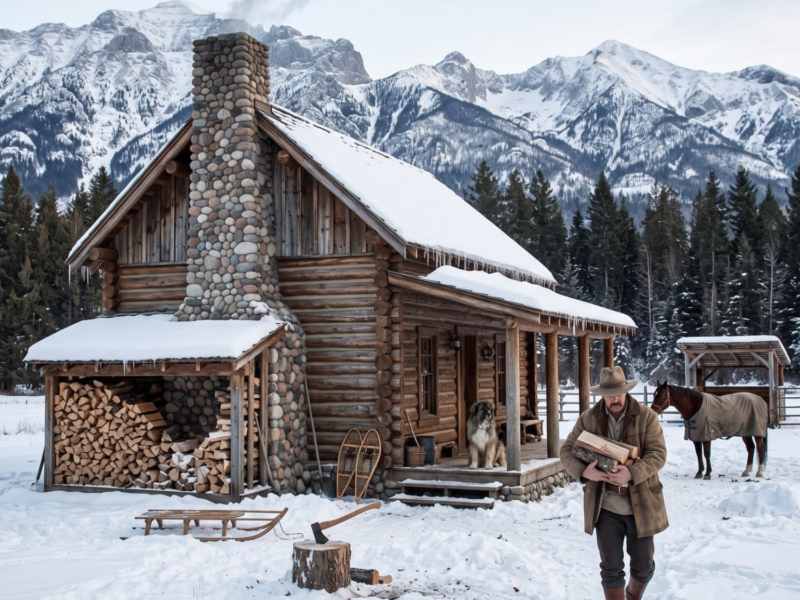
They Called His Wall Design Crazy—Then His Cabin Stayed 32°F Warmer
The Full House
The second run brought her to a larger cluster: seven people from three separate households who had found each other in the timber and moved together, which was the right instinct.
Among them was a woman named Kora Tibbits, who was in her seventies and had been supported the entire walk from town by two younger men she barely knew, one holding each arm, the three of them moving as a single organism because that was the only way she could move at all. Kora Tibbits had lived in the Montana Territory for thirty years. She had outlasted two husbands and a drought that had driven her neighbors off their land. She was not going to die because she lacked the strength to walk three miles in cold weather. She was going to survive on the strength of strangers’ arms and on whatever Dela had built at the end of this dark flat.
Loading seven people onto a sledge built for cargo rather than passengers required the kind of creative geometry that the cold made simultaneously urgent and difficult. She got four seated inside the buffalo robes, Kora Tibbits at the center.
The two young men who had carried her stood on the sledge’s rear runners, holding the rail, their combined weight pushing the sledge’s back end down in a way that made the steering heavier, but did not make it unworkable.
The seventh person, a man in his forties named Garrett, whom she recognized as one of the Hargrove hands, was steady enough to walk the rope.
They made the run. She unloaded in the cabin, which now held eleven people in a space designed for one, and felt the temperature inside register the change: a fractional drop from the addition of cold-soaked bodies that would reverse itself as those bodies warmed and began contributing their own heat to the enclosed space.
Dr. Cook had found his professional footing. He was moving through the crowded space with his bag, checking for frostbite, for the signs of hypothermia that persisted past the initial warming, for the respiratory issues that came from extended exposure to air at these temperatures. He was doing what he did best, and doing it in a space that was warm enough to allow the body’s own recovery mechanisms to function.
Dela watched him work for a moment and felt something complicated—not forgiveness, which was not what the moment called for, but something adjacent to it: the recognition that people were capable of being more than the worst version of themselves when the situation required it.
She went back out.









