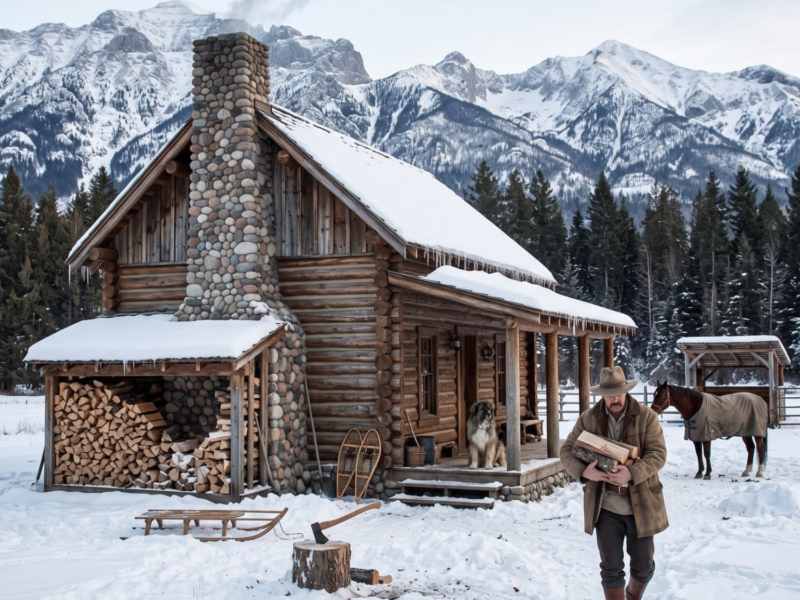
They Called His Wall Design Crazy—Then His Cabin Stayed 32°F Warmer
The Warmth of Stone
Three miles north of town, on a property that sat at the edge of the pine timber where the flat grazing land began its gentle rise toward the foothills, a woman named Dela Foss had been awake for two hours.
She had not been awakened by the cold. The cold did not penetrate the walls she had built. She had risen because she always rose before dawn: because the livestock needed tending before the light came, because the work of the land did not wait on comfort or on darkness.
She moved through her cabin with the ease of someone who knew every board by feel. The interior was warm—not the desperate, scorched warmth of a room where a fire is battling against an invading enemy and barely holding, but genuinely warm. The kind of warmth that fills a space so completely it seemed to come from the walls themselves rather than from any single source.
The temperature inside that cabin sat at perhaps 50 degrees—cool by summer standards, but extraordinary given what pressed against every outer surface of the structure from every direction.
The fire in her stone hearth had been set the previous evening. She had not touched it since. The hearth did not need tending the way an iron stove did. She had built it from river granite quarried over three summers, stacked in a configuration that her grandmother’s notes described as a mass accumulator—a structure designed not to burn hot and then cool, but to absorb heat slowly and release it for hours after the fuel was consumed. The stones were warm to the touch even now. They would remain warm until mid-morning, at which point she would add fuel again, and the cycle would continue.
Dela pulled on her outer layers with practiced efficiency: wool first, then the heavy canvas work coat she had reinforced at the elbows and collar, then the fur-lined outer garment she had sewn herself from pelts traded from a trapper named Aldis Greer, who came through each autumn.
The garment was ungainly. It made her look, as Sheriff Cummings had once remarked at the general store, like a woman who had lost a fight with a bear and taken the bear home with her. The laughter that followed that remark had been the comfortable laughter of people who found her an easy target, and she had learned long ago not to waste energy on it.
She cracked the outer door open and felt the air hit her face. It was not like ordinary cold. Ordinary cold was a sensation, something that moved across skin and made the body respond. This was something more absolute. The air at the threshold of her door had qualities that suggested it was hostile to the basic processes of living tissue—that it existed in a register past discomfort, past pain, past even the body’s ability to signal damage.
She opened the door fully for three seconds, confirmed what she needed to confirm, and stepped back inside.
The animals needed water. The water in the attached shelter where her mare, Greta, lived, would be frozen solid by now, despite the structure’s connection to the main cabin’s heat. She would need to bring water from the root cellar’s secondary cistern, the one she had insulated with double-thickness straw bales specifically because she had known this morning would come.
She had known it for three years.









