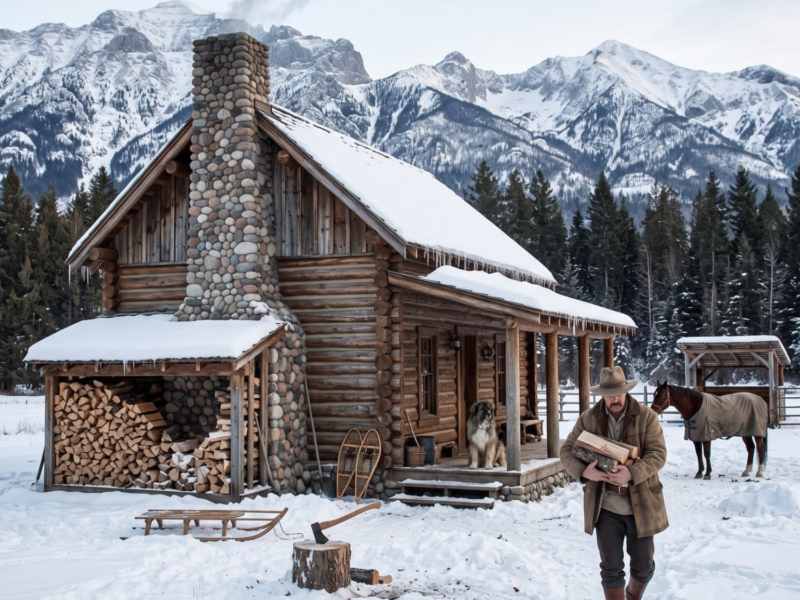
They Called His Wall Design Crazy—Then His Cabin Stayed 32°F Warmer
The Three Walls
The nickname arrived within a week. It traveled through the social channels of a small community with the efficiency of news that people find amusing. Dela Foss, the widow with the bees, the one who wanted them to prepare for the end of the world. Someone called her the doomsday widow. Someone else shortened it. By the time the phrase reached the general store, it had become simply what people said when they wanted to indicate a certain variety of harmless female eccentricity.
She heard it. She gave it no more energy than it deserved. She went home and began the first year of work.
The original cabin Warren had built was a good cabin by the standards that had governed its construction: single wall frame, decent chinking, a cast-iron stove that could heat the main room adequately in ordinary winters. Warren had been proud of it. He had been right to be proud of it for what it was. But Dela understood from her grandmother’s notes and from her own three winters of close observation that it was not built for what was coming. It was built for the winters that had already been.
She began the reconstruction in the spring of 1887. She did not tear down the original structure. She built around it, adding an outer wall at a distance of eighteen inches from the existing exterior, filling the cavity between them with sawdust packed densely enough to resist settling, creating a thermal barrier that would hold heat the way a banked fire holds coal. Then she built a third wall beyond that, adding a second cavity filled with dry straw bales she had compressed and stacked through the previous autumn.
The resulting structure was nearly three feet thick at every exterior surface. The work took most of the building season. She did it herself except for three days in June when Aldis Greer came through on his autumn trading circuit early and lent his hands to the raising of the outer wall framing. She paid him in honey and in a cured elk ham she had put up the previous fall.
He asked no questions about why she was building what she was building. Greer was the kind of man who understood preparation as a value in itself.
The stone hearth was the second major project of that first year. She had identified the granite source the previous summer: a ledge of good flat stone exposed along the creek bank two miles north. She quarried it herself, loading the wagon in small batches because Greta could not pull large ones over the rough terrain, making the trip fourteen times through the summer and early fall.
The construction of the hearth followed the specifications in her grandmother’s notebooks as closely as she could manage, with modifications forced by the differences between Pennsylvania architecture and what she was building in Montana.
The attached shelter for Greta went up in late September, connected to the main cabin’s south wall by a short passage that could be sealed with a heavy door. The shared wall between the shelter and the cabin would allow heat to migrate in both directions, keeping the animal space above freezing even in extreme cold and supplementing the cabin’s warmth with the natural heat the horse produced simply by existing.
When the work of that first year was done, Dela stood back and looked at what she had built. It did not look like the other structures in the valley. It was heavier, squatter, with walls that gave it the appearance of something designed to absorb impact rather than simply to provide shelter.
She knew what people would say when they saw it. She had stopped caring what people said some time ago.
Act III: The Great Freeze
Chapter 7: The Castle to Freeze In
The second year was food.
She had always kept a garden. She expanded it dramatically, converting the south meadow to cultivation and adding irrigation channels from the creek that let her water through the dry stretches of summer. She grew root vegetables in quantities that would have seemed excessive to anyone who did not know what she was planting: turnips, parsnips, and potatoes in particular, because they stored well and provided dense calories. She grew dry beans, dent corn, and winter squash.
She salted meat through the summer and fall, building a reserve in the root cellar that went well beyond what she alone could eat in a normal winter. The root cellar itself she deepened by four feet over the course of two weeks in July, reaching down to where the earth’s own temperature maintained a constant cool regardless of what happened at the surface. At six feet of depth, the cellar stayed above 35 degrees even in the hardest cold she had experienced.
She lined the walls with riverstones to add thermal mass. She built shelving from green timber that she knew would last. She preserved everything she could preserve: wild berries from the timber edge, chokecherries, serviceberries, and the sour wild plums that grew along the creek bottom. She rendered lard from the hog she kept and stored it in crocs sealed with their own rendered fat.
She kept a running count of her stores against her estimated needs and against the possibility that she might need to feed more people than herself. That possibility was not idle speculation. She had seen in her grandmother’s account of the winter of 1822 what happened when a community was unprepared, and what the houses that had prepared adequately were asked to absorb.
The second year also brought more watching. The bees in 1887 did something she had not expected: they swarmed in late July, producing a secondary colony, something healthy hives occasionally do. But the swarm did not go far. It settled in a hollow oak at the edge of the timberline thirty yards from the original hives and immediately began the same intensive propolis-sealing behavior she had seen the year before.
Two colonies now, both behaving as though they were bracing for something. She noted it. She added the observation to the growing record she was keeping in her own notebooks, the ones that were beginning to develop the same density and cross-referencing character as her grandmother’s.
The squirrels in 1887 were beyond anything she had seen. She counted cache sites on her property until the number exceeded her ability to track them without a systematic grid, which she then built, marking trees and noting locations until she had something approaching a map of where the squirrels thought the food needed to be. The woolly bear caterpillars she found crossing the dirt track were solid black—every one of them. No brown band, no variation.
The Canada geese moved through in late August. Dela did her calculations again: two years of consistent signals pointing in the same direction. One more winter to prepare. The winter of 1888 to 1889, or possibly the one after, would be the one.









