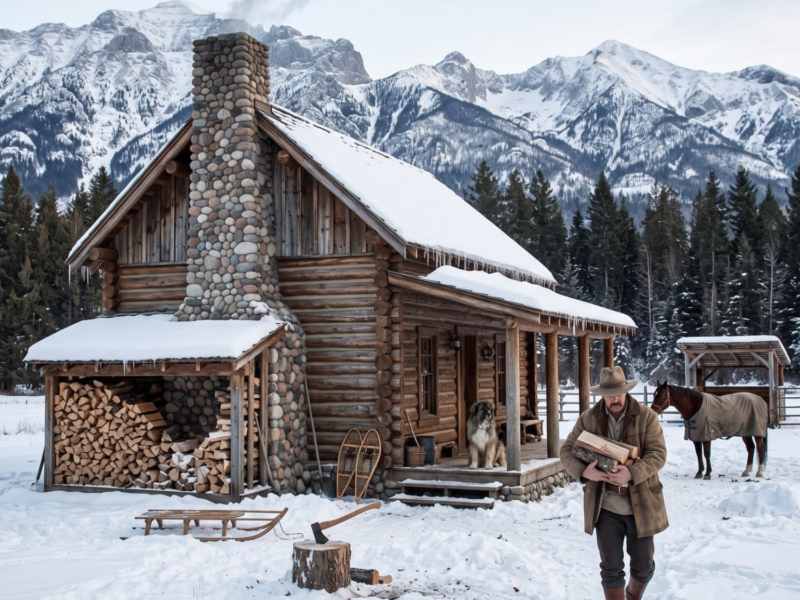
They Called His Wall Design Crazy—Then His Cabin Stayed 32°F Warmer
The Meeting in the Barn
The cold broke on the fifth day.
It did not break dramatically. There was no single moment when the temperature swung upward and the crisis resolved itself into relief. It retreated the way it had arrived, with the indifference of a natural force that had never been interested in human response.
The temperature outside the cabin’s three-layer walls moved from whatever unmeasurable depth it had occupied for five days back up through the minus-thirties, then the minus-twenties, and settled at seventeen below zero—which was still a temperature that could kill an unprepared person, but which felt to the forty-one people packed inside Dela’s cabin like the first day of spring.
She watched them emerge into it. Not all at once; she organized the departures in groups the way she had organized everything else through the crisis, with attention to the practical realities of moving large numbers of cold-damaged people through conditions that remained dangerous even in their relative improvement.
The strongest went first: men who could break trail through the drifted snow that had accumulated over five days of wind. Then the families with older children. Then the elderly, assisted the way they had arrived.
Dr. Cook went with the last group, his bag in his hand again, his professional bearing restored to something approaching its ordinary form, though with a quality around the eyes that had not been there before the crisis and would not leave.
Ida Pelum was carried by her son on his back for the first quarter-mile until they reached the packed trail the earlier groups had made. Then she walked slowly with her son’s arm as a rail, her hip negotiating each step with the stubbornness of a woman who had decided the hip was not in charge.
Old Cutter’s feet were wrapped in the padding Dr. Cook had constructed from material Dela provided from her stores. He could walk after a fashion with two men supporting him. He would walk differently for the rest of his life. He knew this. He walked anyway.
Dela did not go with them. She stood at the edge of the timberline as the procession moved south toward the town, watching until the last figure disappeared into the white distance.
Forty-one people alive, returning to a place that had tried to kill them.
She turned back to the cabin. The interior, with everyone gone, had the quality of a space that had held something enormous and now held its echo: the rotation marks worn into the floor around the hearth, the body impressions left in the blankets stacked against the back wall, the smell of forty-one people living in close quarters for five days—which was not a bad smell, exactly, but was unmistakably the smell of human survival in its most compressed form.
She opened the cabin door wide, let the cold air move through for thirty seconds, then closed it again.
She spent the first day alone doing inventory. She needed to know what the five days had consumed against what she had stored—not because she was worried about her own supplies (what remained was more than adequate for her needs through the rest of winter), but because the numbers would be useful. She had been thinking during the five days of the crisis about what came next. Not just for herself, for the community that had just learned something about the gap between what they had built and what the climate was capable of asking of them.
The food consumption had been significant, but not catastrophic. Her stores were drawn down by roughly thirty percent, which meant she had entered the crisis with more than she needed and exited it with enough.
The fuel was the tighter number. The hearth’s twice-daily schedule had held through five days of continuous operation with forty-one bodies contributing heat, but the woodpile she had considered four winters’ worth of supply was now closer to two-and-a-half.
She noted this. It went into the record she had been keeping since the crisis began—the one that was already in its first week of existence, denser with specific information than most of what she had found in the territory’s official records.
She spent the second day cleaning the cabin and thinking. On the third day, she went to town.









