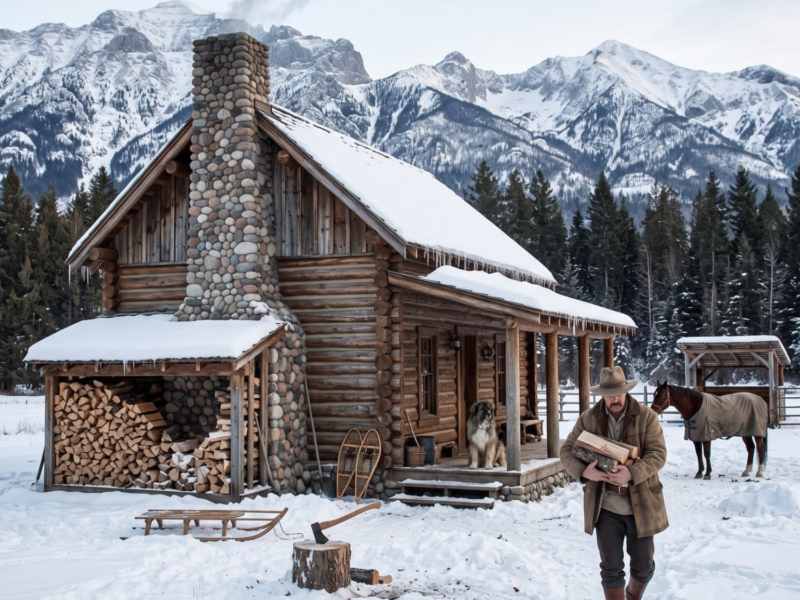
They Called His Wall Design Crazy—Then His Cabin Stayed 32°F Warmer
The New Architecture
The spring reconstruction of Caldwell Crossing began on the first workable day, which arrived in late March when the ground had softened enough to allow excavation.
Dela was at Pelum’s hardware store before the sun was fully up, and she found seventeen men already there waiting with the focused energy of people who had arrived early because they did not want to be late for the thing they had decided mattered.
She taught them everything. She started with the theory, because without the theory, the technique was just imitation—and an imitation without understanding fails at the first variation from the expected.
She explained thermal mass. She explained why stone held heat differently than iron. She explained the mathematics of wall thickness against temperature differential. She explained the root cellar depth calculation: the relationship between depth and ground temperature, the minimum dimensions required to maintain a survivable temperature in the stored goods through a winter like January’s.
She explained fuel mathematics: how to calculate consumption rates against storage capacity, how to build in redundancy, how to think about worst-case scenarios rather than average scenarios when deciding how much was enough.
Then she taught them to build.
Grover Pelum’s hardware store went up first, the new outer walls rising around the existing structure with the methodical progress of work that is done correctly rather than quickly. Dela moved between the crews correcting technique, explaining the reasoning behind each correction, making sure the knowledge transferred not just as action, but as understanding. She wanted them to be able to teach their children. She wanted the understanding to outlast her involvement.
By summer, there were triple-wall structures going up across Caldwell Crossing and on the homesteads surrounding it. The granite hearth became the standard rather than the exception. Root sellers were dug to the depth she specified, which was deeper than anyone had previously thought necessary.
Wood piles reached sizes that would have seemed irrational the previous year and now seemed like basic sense. Hayes Drifus worked at her side through much of the construction season. He had the combination of practical intelligence and intellectual curiosity that made him a good student, and he was one of the few people who asked her questions—not just about the technique, but about the thinking behind it, about how to evaluate what you were seeing when you watch the natural world, about the difference between a pattern and a coincidence, about what her grandmother’s notebooks looked like and whether he might read them sometime.
She lent him the notebooks. He returned them two weeks later and said with the directness of a young man who had not yet learned to cushion honest assessments that they were the most important documents he had read in his life.
She taught him to keep his own records. He was seventeen. He had, if he was careful and lucky, sixty or seventy years of observation ahead of him. The records he started in the summer of 1889 would be, if he kept them faithfully, a document of extraordinary value by the time he was an old man.
“What if I don’t see anything unusual for years?” he asked. “What if the winters are ordinary for the rest of my life and the bees never do what they did in 1886?”
“Then you will have kept excellent records of ordinary winters,” she told him. “Those are also useful. You cannot know what’s unusual until you know what’s ordinary. And you cannot know what’s ordinary until you’ve watched long enough to establish the baseline.”
She looked at him. “The watching is not wasted if nothing dramatic happens. The watching is the work. Whatever comes of it is secondary.”
He wrote that down. She noticed him writing it down, and noticed that she did not mind.









