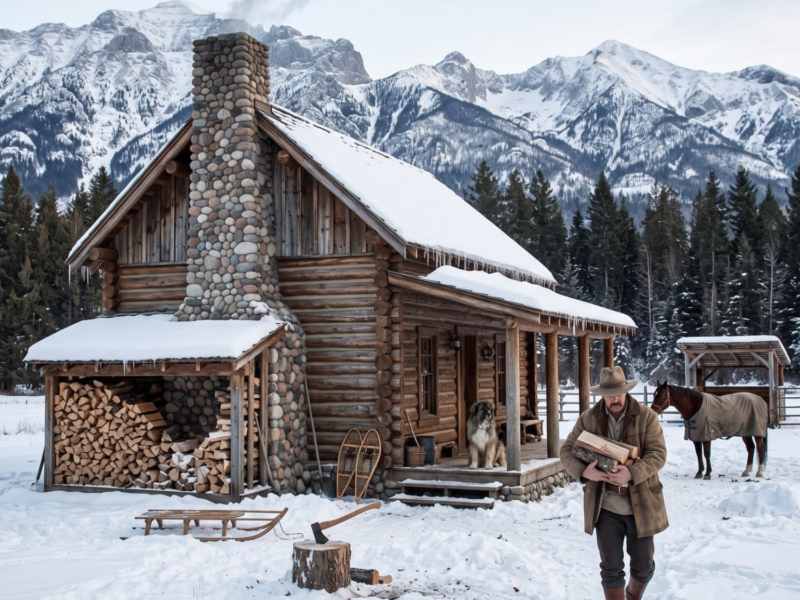
They Called His Wall Design Crazy—Then His Cabin Stayed 32°F Warmer
The January Line
The cold arrived on January 7th. Not gradually, not in the way of a system building over days that gives experienced people time to recognize and respond.
It arrived the way a door opens: a defined boundary between one condition and a categorically different one. On the 6th, the temperature dropped to 23 below. The people of Caldwell Crossing stoked their fires and said to each other that it was a hard cold, but they had seen hard cold before.
On the 7th, it dropped further and further, and the instruments began to fail.
Dr. Cook’s thermometer shattered at 38 below on the morning of the 9th. But that was not the first failure. The instrument at the feed barn failed on the evening of the 7th. The one at Grover Pelum’s hardware store gave out the following morning. By the time Dr. Cook’s exploded on his porch, the town of Caldwell Crossing had lost its ability to measure what was happening to it.
The cold had moved into territory that existed beyond the reach of the tools the community trusted to tell them what to do.
The first death was Emmett Price, who lived alone in a single-room cabin at the south end of town. His iron stove burned through his woodpile by midnight of the 8th. He had enough wood by any ordinary standard for a Montana winter. This was not an ordinary winter. He burned his chairs. He burned the boards from his floor. The cold came in anyway, patient and geometric, finding every crack in the single-wall construction that had been adequate for every other winter of his life.
He was found on the morning of the 9th in his bed, two blankets pulled over him, the fire cold for hours.
Inside the three-walled cabin on the rise north of town, the temperature remained at 51 degrees. Dela heard nothing of what was happening in Caldwell Crossing. She had no reason to go to town and every reason to stay where she was. She tended Greta in the attached shelter. She heated water from the insulated cistern. She kept the granite hearth fed on its twice-daily schedule.
She ate from her stores. She kept her face and hands covered whenever she stepped outside for the necessary brief tasks that could not be done from within. She thought about the people in town. She thought about them in a way that was neither satisfying nor comfortable—the way you think about a consequence you tried to prevent and could not.
She had told them. She had stood at the front of that room in Grover Pelum’s hardware store and told them exactly what she believed was coming, and when, and what it would require to survive it. Mayor Drifus had provided the community with its permission to dismiss what she said, and they had taken the permission and walked away from it, relieved.
She did not know how many were already dead.









