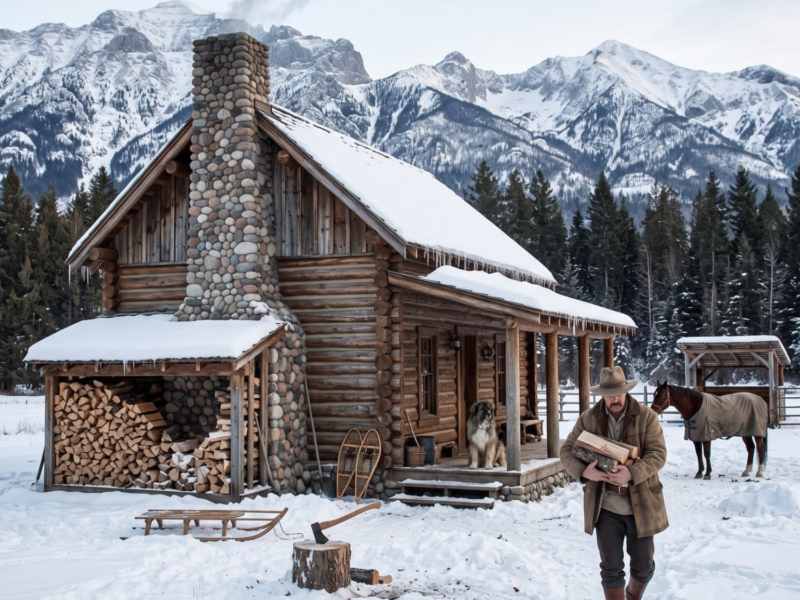
They Called His Wall Design Crazy—Then His Cabin Stayed 32°F Warmer
The Seduction of Wood
The third year was fuel.
She had been cutting wood since Warren died, maintaining the kind of woodpile that a single woman in a Montana winter required to stay alive. Now she cut with an entirely different purpose. She hired two men from the homesteads to the east—brothers named Cal and Pete Dunore—paying them in cash she had saved by not spending money on things that were not her three years of preparation.
They worked with her through the summer and fall of 1888, cutting, splitting, and stacking cord after cord of hardwood from the timber above the property. The woodshed she built to house the fuel was constructed with the same three-wall logic as the cabin, protecting the stacked wood from moisture that would reduce its burning efficiency.
When the shed was full, she stacked additional rows under a lean-to on the cabin’s north side. When the lean-to was full, she began a third storage area against the woodshed’s east wall.
By October, she had fuel enough by her estimate for four full winters of the two-daily-fire routine the granite hearth required.
The Dunore brothers asked her on their last day of work what she thought was coming. Cal Dunore was a practical man in his thirties with a practical man’s respect for labor that exceeded what the immediate situation seemed to demand. He had spent three months working for her. He had seen the cabin, the cellar, the fuel stores. He understood that this was preparation on a scale that implied a belief he had not been given permission to question.
“Something the valley hasn’t seen before,” she told him. “Something the instruments won’t be able to measure.”
তিনি looked at her for a moment, then he looked at the woodpile. Then he went home and told his brother they ought to cut a bit extra for their own place just in case. It was the closest thing to a convert she had made.
In town, the commentary had evolved. The early mockery had the spontaneous quality of people discovering that something was funny. By the third year, it had the slightly tired quality of a joke told past the point where it was fresh, but which served a social function that kept it in circulation.
Mayor Drifus made a remark at the harvest gathering in October of 1888 about how Dela Foss would probably be disappointed if winter turned out ordinary again. The laughter was polite rather than genuine. People had watched her work for three years. Whatever else they thought about her predictions, they had seen the cabin she had built, and some of them had begun to wonder in the private way that people wonder about things they cannot afford to say aloud, whether she was building towards something they did not understand.
Act III: The Freezing of the Mercury
Chapter 9: The Silence of the Hives
The winter of 1888 began gently.
November was cold, but not exceptional. December was almost mild by Montana standards, with temperatures hovering around zero rather than the brutal negatives that characterized a hard December in the territory. People who had watched Dela’s preparations with something approaching unease found reassurance in the mild weather and said that the doomsday widow’s predictions were failing. Three years of extraordinary work built toward an ordinary winter.
There was, in the way people talked about it at the general store and at the feed barn, a quality of relief that expressed itself as laughter. She was not watching the human community. She was watching her hives.
Through December, the bees did something she had never seen them do: they went entirely silent. Not the reduced activity of ordinary winter when bees cluster in the center of their hive and generate heat collectively, emerging on mild days to take brief cleansing flights. Absolute silence. No movement at all on the three warm days that broke through in the second week of December, when other years would have shown a few scouts exploring the hive’s exterior.
The colonies had sealed themselves completely. They were waiting.
Dela spent Christmas Eve alone in her cabin. She added a log to the hearth fire, not because the temperature required it, but because the act of tending the fire felt like the right thing to do on a quiet evening. She ate a good meal from her stores. She checked the attached shelter and confirmed that Greta was settled and warm.
She went to bed with the notebook she had been keeping for three years open on the table, the final entry written in her careful, unhurried hand: The bees have not moved in eleven days. Whatever is coming, it is close now.









