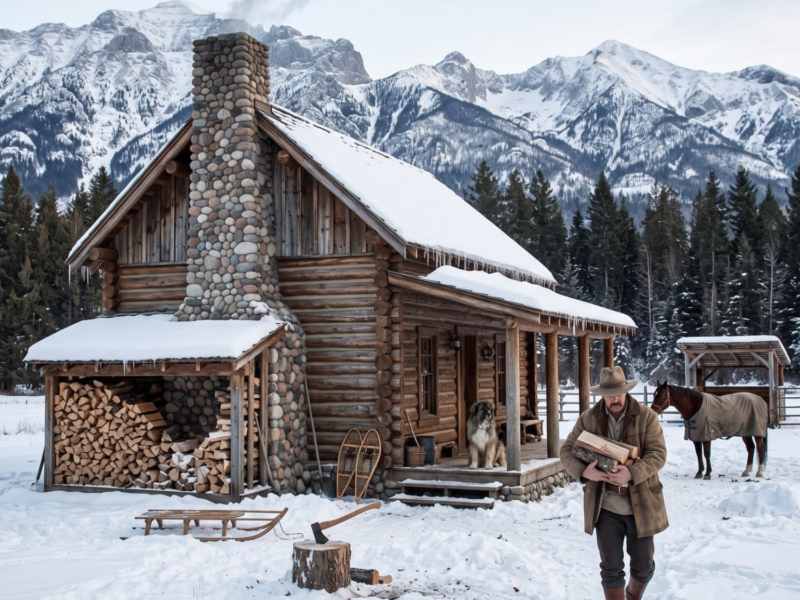
They Called His Wall Design Crazy—Then His Cabin Stayed 32°F Warmer
The Keeper of the Record
The summer of 1889 was the summer she decided to write the manual.
Not the notebooks, which were records, observation, data, cross-reference. The manual was something different—something she had not intended to create, but which the spring’s teaching made clearly necessary.
She could be in one place at a time. She could teach the people who came to her, the ones who showed up at Pelum’s hardware store in the early morning or came out to her property on weekday afternoons when the regular work allowed it. But there were homesteaders further out who had not made it to the community meeting in March. There were settlements to the north and east where people were living in the same single-wall structures with the same iron stoves that had failed in Caldwell Crossing, who did not know what January had demonstrated.
She wrote the manual in the evenings after the outdoor work was done, at the same preparation table where she had served broth to Hayes Drifus in the first hours of the crisis. She wrote it as she had always written everything: specifically, practically, with the assumption that the reader was intelligent but had not been given the information before.
She described the wall construction in dimensions and materials. She described the hearth in the detail required to build it correctly. She addressed the root cellar, the fuel storage, the food stores. She included the observational indicators her grandmother had documented—the bee behavior, the caterpillar coloring, the bird migration timing—presented as systematic observation rather than folk prediction.
She sent copies to the settlement she knew about. She sent one to the Montana Territorial Government’s office in Helena, addressed to the official responsible for agricultural and rural affairs, with a cover letter that described the January event and its consequences and made a specific proposal: that the territory establish a system for collecting and collating natural observations from settlers across the region, building the kind of distributed record that no single observer could create alone.
The territorial government did not respond quickly. This did not surprise her. She had not expected the manual to change the official view of what constituted reliable meteorological data within the year she wrote it. She had expected it to circulate.
It did circulate, more widely than she had anticipated: passed from settlement to settlement through the networks of exchange that connected isolated homesteaders across the territory, trading horses and tools and knowledge in the informal economy that official institutions rarely tracked.
Dela Hartwell lived on her property north of Caldwell Crossing for forty-one more years after the winter of 1889. She never remarried. She maintained the hives, expanded them over time to seven colonies, and watched them each summer with the same attention she had given them since 1886.
She kept her records continuously, the notebooks accumulating in the cedar chest alongside her grandmother’s, the two sets of documents spanning nearly eighty years of combined observation by the time she was an old woman. The winters that followed 1889 were for the most part within the range of ordinary Montana severity. There were hard years and easier years, cold spells that tested the new construction and confirmed its adequacy.
There was one winter in the late 1890s that produced a cold event significant enough to require the community to draw on the protocols they had developed. But the community was prepared by then. The walls were built, the stores were full, and the crisis was managed before it became a catastrophe.
Hayes Drifus became the mayor of Caldwell Crossing when Amos Drifus resigned in the spring of 1889, handing the position to his son—not as inheritance, but as the judgment of a man who had forfeited his own authority. Hayes was young for the position and remained young-seeming in it for years. But he governed with a quality of attentiveness that the community recognized as something different from what they had had before: a willingness to hear information from all its sources, to take observations seriously regardless of who was doing the observing, to treat the natural world as a source of data rather than an obstacle to human plans.
He consulted Dela regularly through the decades on questions that ranged from the practical to the philosophical. When he was in his forties, he told her that the most important thing he had learned from the winter of 1889 was not any specific technique of construction or preparation.
“It was the understanding that certainty was expensive,” he said. “That the cost of being certain you were right was paid not by you, but by everyone around you who deferred to your certainty.”
He paused. “I used to think my father was a strong man. Now I think he was just comfortable. You’re the only strong person I’ve ever known who didn’t need to make a show of it.”
Dela looked at him. The boy who had stumbled across her threshold with ice-masked eyes was gone, replaced by a man with silver at his temples and lines of deep thought around his mouth.
“Build the next generation differently,” she said. “That’s the whole work.”
Epilogue: Build Accordingly
The hives outlasted her.
When she died in the winter of 1930 at the age of sixty-eight, the seven colonies she had tended for decades were taken on by a woman named Ruth Alcott, who had been one of the children deposited under the buffalo robe on the sledge in January 1889—too young then to do anything but survive and remember.
Ruth was in her late forties by the time she took the hives. She knew what she was inheriting. She watched the bees each summer with the same systematic attention Dela had taught her mother to pay, recording behavior in notebooks that followed the format Dela had established, adding her observations to the accumulating record.
The cedar chest in the cabin held notebooks from Hester Algate’s fifty years in Pennsylvania, from Dela’s forty-five years in Montana, from Hayes Drifus’s decades of settlement records, from Ruth Alcott’s careful annual reports on the behavior of seven hives through seasons that ranged from unremarkable to important.
By the time the historical society of Caldwell Crossing cataloged the chest in the 1960s, it held one of the longest continuous records of ecological observation in the Montana Territory’s history. Researchers from the state university came to study it. They found it more accurate as a predictor of severe winter events than the official meteorological records that had been kept since the territory became a state.
Above the door of Dela’s cabin—which still stood on the rise north of town, maintained by the historical society as a record of what had happened there—a piece of timber was mounted with two lines cut into it. She had put it there herself in the year after the crisis, when the work of teaching and rebuilding had settled into the steadier work of maintaining what had been built.
The lines read in plain letters, cut with the same tools she used for everything else:
THE COLD DOES NOT CARE WHAT YOU BELIEVE ABOUT IT. BUILD ACCORDINGLY.
It was not the summary she would have chosen for everything the winter of 1889 had taught the community, or everything her grandmother’s notebooks had taught her, or everything that lived in the fifty-year record of a woman in Pennsylvania who had watched the natural world with enough patience to hear what it was saying.
But it was the truth that fit above a door.
The truth a person could carry in their chest when they walked out into a Montana morning in November with a winter coming that might be ordinary or might be something beyond what the instruments could measure.
Build accordingly.
Watch the bees. Write it down. Pass it on.
The cold does not care what you believe about it. The only answer it has ever understood is the wall between itself and the living—built thick enough, built deep enough, built by someone who was paying attention when the signs were given.
The signs are always given. The question is always the same: Whether anyone is listening.









