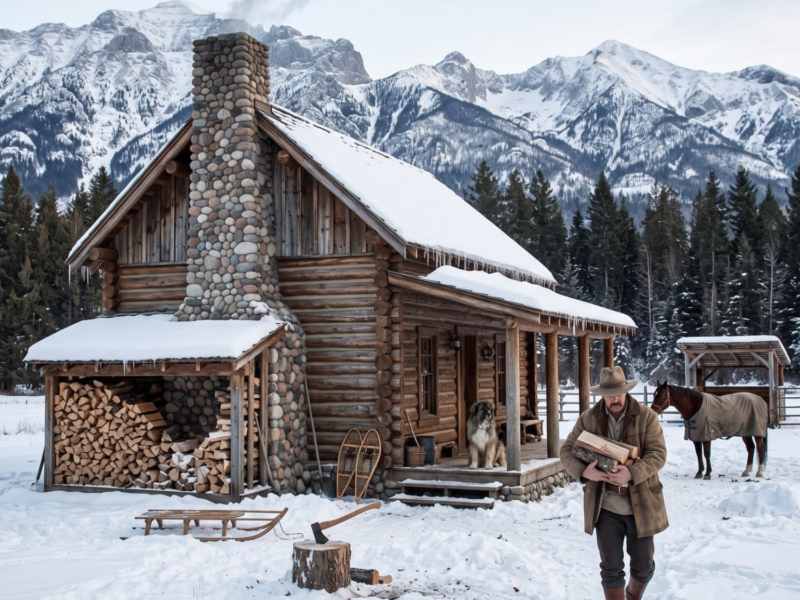
They Called His Wall Design Crazy—Then His Cabin Stayed 32°F Warmer
The Approach at Dawn
On the afternoon of January 9th, a figure appeared at the edge of her treeline.
She saw it from the cabin’s south window, which she had fitted with a second interior pane of glass specifically to allow observation without opening the exterior. The figure was moving, which meant it was alive, but moving badly—the kind of movement that spoke not of travel, but of the final expenditure of reserves that were already spent.
It had come from the south, from the direction of town, three miles through cold that should have been unserviceable.
She was at the door before the figure reached it. He fell across her threshold.
A young man she recognized as Hayes Drifus, the mayor’s son, seventeen years old, wearing three coats layered over each other and a scarf wound around his face that had become a mask of ice from his own frozen breath. His skin had gone past the red of exposure into the pale and waxy territory that signaled something more serious.
She pulled him inside, kicked the door closed, and got him to the hearth before she did anything else. She stripped the outer coat. She pulled the ice scarf away from his face with careful hands. She wrapped him in the heavy blanket she kept folded on the bench beside the fire and put a pot of broth on the cooking surface of the hearth—the pot that was always there, always partially full, always sitting in the residual heat of a fire that never went entirely cold.
His teeth stopped chattering after perhaps ten minutes. The color came back to his face, slowly starting at the cheeks and moving outward—the body’s thermostat reasserting control as the ambient temperature gave it something to work with.
He stared into the fire. “My father sent me.”
The words came out in pieces, separated by the effort of producing them. “He didn’t want to ask. He… he didn’t want to need to.”
He stopped. The shame in his voice was not his shame, or not entirely. It was the shame of a family, of a man who had stood in a public room and made someone small, and was now sending his son through killing cold to the person he had diminished.
“But people are dying,” Hayes whispered. “Emmett Price is dead. The Tilman baby…” His voice broke on the second name. “They don’t know how many more.”
Hayes looked at her. “Can you come?”
The cabin was warm around her. Her stores were full. The hearth was radiating the steady, deep heat of stone that had been doing its work for hours. Outside, the cold that she had spent three years preparing for was doing what she had known it would do to the people who had not prepared. And she had told them, and they had laughed.
And fourteen months ago, Mayor Drifus had stood in the warm room at Pelum’s hardware store and given the whole community permission to disregard what she was communicating.
She thought about the Tilman baby. She thought about the other children in Caldwell Crossing, the ones who had never stood in any room and said anything about her, or to her, who were at this moment in houses with walls that were failing them, with wood piles that had already run out, who were going to die before the cold broke unless someone with adequate shelter and adequate stores made a decision.
She ladled broth into a cup and handed it to the mayor’s son. “Drink this,” she said. “All of it.”
Act IV: The Hearth of Caldwell Crossing
Chapter 12: The Sledge in the Snow
She did not wait for him to finish the cup before she began pulling on her layers, working through the sequence she had rehearsed in her mind through three years of preparation: the wool base, the canvas work coat, the heavy fur outer garment, the face covering she had constructed from doubled rabbit pelt that left only her eyes exposed.
She did it without hurry, which was its own kind of urgency. Hurry produces mistakes. Mistakes in this cold produce the same outcome as no preparation at all.
“How many can walk?” It was not quite a question. She was calculating as she spoke, running numbers against the capacity of a structure that had been built for one person.
Hayes set the cup down. “Maybe twenty, maybe less. Some of the families have children who can walk, but shouldn’t be out in this. The Hargrove place has six people, and I think their stove is still going, but the wood is almost gone.” He stopped. “Mrs. Pelum can’t walk—her hip. Old Cutter from the feed barn—he’s got frostbite on both feet already. Dr. Cook said he shouldn’t move him, but the doctor’s house is failing, too.”
Dela pulled the face covering into position and looked at him over the top of it. “Go back. Tell everyone who can move to start north along the timberline. The trees will break the wind. Tell them to stay in the trees, not out on the open flat. Tell them to keep moving no matter what they feel. If the cold starts to feel like warmth, tell them that is the most dangerous moment and they must not stop.”
Hayes stood. He was steadier now, the broth and the warmth having done what they could do in a short time. He looked at her with an expression that carried something complicated in it—something that was not quite gratitude because gratitude felt too small for what he was looking at.
“My father…”
“Your father can walk,” she said. She turned toward the passage that led to Greta’s shelter. “Tell him to walk.”
She heard the cabin door open and close behind her. She was already in the passage, her hands on Greta’s halter, speaking to the mare in the low, even tones that kept a horse calm when the world outside had turned into something no horse’s instincts were designed to process.
Greta shifted her weight, ears moving. The attached shelter was warm enough that the horse had been comfortable, but she was not calm. Animals felt the quality of what was outside even when they could not see it. Something about the cold at that extreme registered on the mare’s nerves as a category of threat distinct from ordinary winter.
“Easy,” Dela said. “You know this work. We’ve done this.”
They had not, in fact, done this. They had practiced elements of it. Greta was accustomed to the sledge, accustomed to being harnessed in cold, accustomed to Dela’s commands in conditions that would have unnerved a less experienced horse. But they had not done this specific thing: which was to go out into cold that could stop a horse’s heart if she was pushed too hard for too long, to make multiple runs through a darkness that carried temperatures below anything Dela could measure, hauling people who might be too far gone to hold on.
She harnessed Greta with the care of someone who understood that every buckle and strap mattered, that a harness failure in the open flat would mean the end of the run. She loaded the sledge with the items she had set aside for exactly this contingency: the two thick buffalo robes she had acquired from a trader in Helena three years prior, the heated stones wrapped in canvas that she had been warming on the hearth’s cooking surface, and the extra rope coiled on the sledge’s rear rail.
The rope was important. She had thought about the rope more than almost anything else in the planning. In whiteout conditions and disorienting cold, people lost direction within twenty feet of safety. The rope would be the difference between found and lost.
She led Greta out through the shelter’s exterior door into the cold that hit the horse like a physical barrier. Greta flinched, her muscles went rigid for one moment—the instinctive response to a threat assessment—then Dela’s voice found her again, steady, without fear in it, because fear traveled down a lead rope the way electricity traveled down a wire. And what Greta needed from her was certainty.









