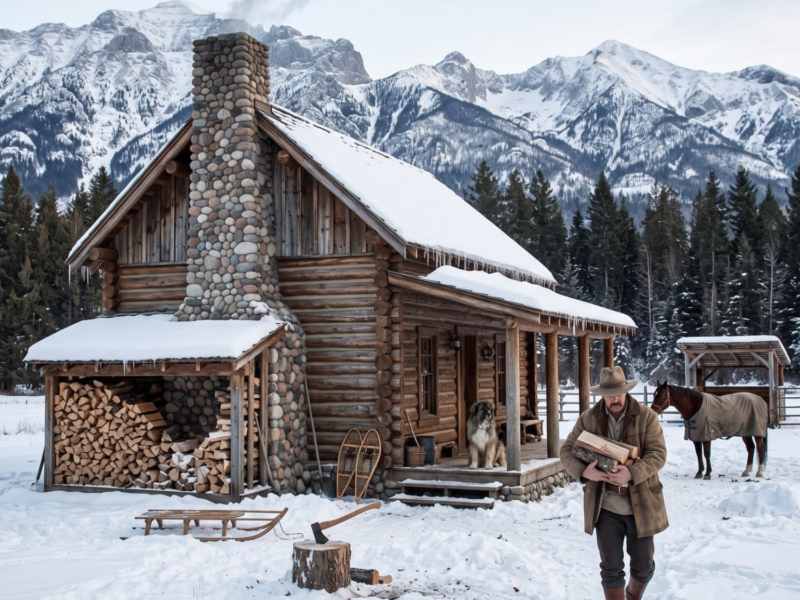
They Called His Wall Design Crazy—Then His Cabin Stayed 32°F Warmer
The Hardware Store
The fifth run was for the people who could not come to her.
Hayes had told her about Ida Pelum’s hip. He had mentioned old Cutter from the feed barn, frostbitten feet unable to walk. He had not mentioned everyone because he had not known about everyone, since the crisis had unfolded faster than information could travel through a community in the process of freezing.
She drove the sledge into Caldwell Crossing itself, which she had not done on the previous runs, keeping to the timber route where people were coming out to meet her.
The town was not what she had last seen it. The buildings were the same buildings, the streets the same streets, but something had been stripped from them by the cold: some quality of inhabitedness that she had not noticed until its absence made itself felt. Several structures had fires visible through their windows—fires burning with the high, desperate brightness of iron stoves pushed to their limits and still losing.
One house showed no light at all. She did not stop there. There was nothing she could do for a house that had gone dark.
She found Ida Pelum at the hardware store, which Grover Pelum had apparently determined was the most structurally sound building in the immediate vicinity of their house. Grover had moved his wife there along with their two adult children and a neighbor woman named Sadie Urks, who had come to them when her own house began to fail.
The hardware store was better than the houses around it—more material in the walls, a larger iron stove—but it was still losing the battle. The temperature inside was perhaps 28 degrees: cold enough to kill slowly, not cold enough to kill quickly. Grover Pelum had the man’s expression of someone who has been doing everything right by every standard he knows and cannot understand why it is not working.
“The walls,” Dela said. She did not say it with satisfaction. She said it as a diagnosis, because that was what it was. “Single construction throughout. The heat is going straight through.”
Grover Pelum looked at his walls as though he was seeing them for the first time in thirty years of knowing them. “I built this place myself,” he said quietly. “I thought it was good.”
“It is good,” she told him. “For ordinary winters. This is not an ordinary winter.”
She loaded the sledge with everything it could carry. Ida Pelum went in first, positioned carefully because her hip made every movement a negotiation between need and pain. Old Cutter, the feed barn manager, went in beside her with his feet wrapped in the padding Dr. Cook had constructed from material Dela provided from her stores.
Sadi, the two Pelum adult children, and Grover himself went last, climbing onto the runners the way a man gets on a train that is already moving—committing to a departure he had not fully accepted until the moment of boarding.
Greta pulled this load with the effort of an animal that had already given more than could be reasonably asked and was giving more. Still, Dela felt the reins vibrate with the strain. She kept her voice on the mare the whole way north, not words exactly, just the tone of someone who believed in what they were asking for and was asking with full awareness of what it cost.
They made it.
She brought Greta inside the shelter immediately, did not ask for another run, and stood with her hands on the horse’s neck while the mayor’s trembling gradually diminished in the warmth of the enclosed space. Greta turned her head and pressed her nose against Dela’s shoulder.
It was not a gesture of affection, exactly—or not only that. It was the gesture of an animal that had been pushed to the edge of what it could do and was communicating the fact of the edge.
“I know,” Dela said. “I know. Rest now.”
Act V: The Rebuilding
Chapter 16: The People in the Walls
The cabin held forty-one people.
The temperature inside sat at 39 degrees—the lowest it had reached since the first person arrived, but still survivable, still functioning, still demonstrating what three-wall construction and a granite hearth with twelve hours of thermal mass could accomplish against a cold that had shattered every instrument in a town three miles south.
Forty-one people in a cabin built for one, organized by the Vance father’s rotating system into something that was not comfortable, but was alive.
Dr. Cook held a twice-daily medical assessment that he conducted as efficiently as the space allowed, moving through the packed bodies with the focused attention of a man who had decided that whatever mistakes he had made in dismissing Dela’s warnings would not be compounded by any failure of professional diligence.
Now, he came to her on the third day with a report about Phyllis Garrett’s hand that was not the worst possible outcome, but was not a good one either. Two fingers, he told her, he believed he could save the rest if the conditions held as they were. She told him the conditions would hold. The walls were doing what she had built them to do. The hearth was maintaining the temperature she had designed it to maintain. His patient would have what she needed in terms of warmth.
He looked at her with the expression of a man doing a specific kind of arithmetic. “Three years,” he said. It was half a sentence—the half that contained the question without quite asking it.
“Three years,” she confirmed.
He nodded slowly, not in agreement with anything she had said, but in the way a person nods when they are adjusting to a truth they cannot accommodate all at once. He went back to his patients.
On the morning of the fourth day inside the cabin, Dela was the first to notice the change: not in the temperature, which remained brutal outside the walls, but in the quality of the light coming through the south window. Something in the angle of it, something in the way it lay across the frost pattern on the interior pane, suggested a shift that was not dramatic, but was real.
She went to the window and looked south toward the open flat, and then looked up at the sky above the timberline. The cloud cover was changing. The thick, pressure-filled ceiling that had sat over the Montana Territory for days was beginning to develop a texture—faint variations of lighter and darker. That meant the system was not a permanent condition, but a passing one, however slowly it passed.
She did not announce this to the room. The change was not close enough to matter yet. She noted it in the notebook she had been keeping since the crisis began—a new record added to the one she had maintained for three years.
She added a line that she did not know at the time would be repeated in conversations across the territory for years after the winter was over: The cold does not apologize. It simply moves on to the next place. What we build between it and ourselves is the only answer it understands.
She closed the notebook. She added a log to the hearth. She checked on Greta in the attached shelter, found the mare calm, and fed her trembling, long resolved into the ordinary warmth of an animal at rest.
She went back to the main room where forty-one people were living inside the margin she had spent three years building. And she began making breakfast from her stores because people needed to eat, because the work of staying alive was not dramatic, because it was mostly this: the next necessary thing, done with the care that necessity deserved.









