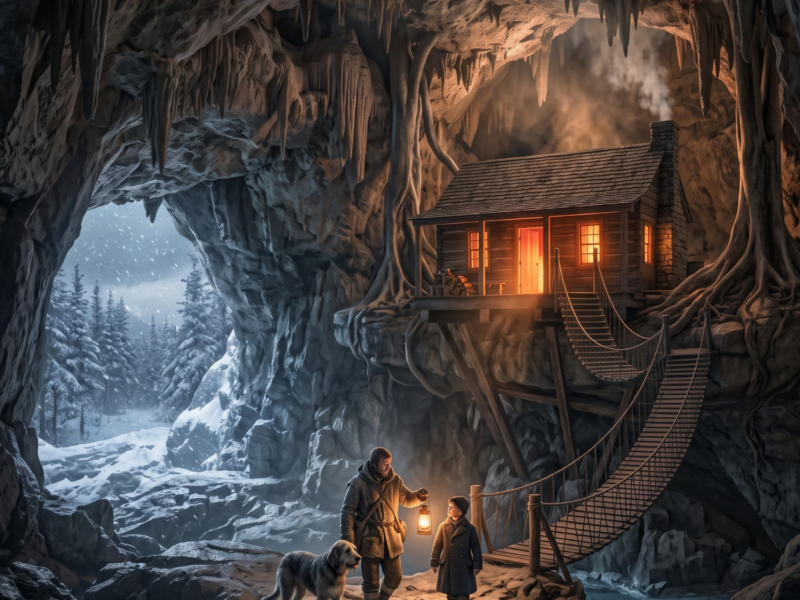
Forced Out With Nowhere to Go, Two Sisters Found a Hidden House Inside a Giant Cave
The Fever and the Architect
The morning the fever finally found June was in the third week of March.
It arrived overnight, announcing itself not with dramatic coughing or shivering, but with the small, terrifying factual evidence of a child who was burning hot to the touch when she should have been cold. Her eyes, when they fluttered open, had the slightly remote, glassy quality of someone not quite fully present in the room.
It was not a deep, agonizing fever. It didn’t change the color of her face to an alarming red or make her movements erratic. But it was real, and it required immediate attention.
Petra went directly to the kitchen drawer and took out the remaining dried herbs Agnes Pallister had left behind nine years ago.
The yarrow was nearly gone. She had a substantial amount of dried thyme left, and one good, thick bundle of dried willow bark, which was the most chemically useful of the three for treating a fever.
She stripped the bark into pieces, dropped them into a tin cup, poured boiling water over them from the pot on the trivet, and let the mixture steep until the water turned the color of pale, murky tea.
She sat on the edge of the bed and lifted June’s head. June drank the bitter tea without a word of complaint. She made the pinched face of someone tasting something that was definitively medicine, and therefore absolutely not expected to be pleasant.
“How long do I have to stay in bed?” June rasped, her throat dry.
“Until the morning,” Petra said, smoothing her hair.
June considered this sentence like a logistical problem that needed solving. “Can I have the notebook?”
Petra thought about it. The notebook had never been only hers. It had been Obadiah Morrow’s. And Agnes Pallister’s. And Caleb’s, in his careful, clumsy child’s hand at the back. It belonged to the house.
She walked to the kitchen, retrieved the book, and brought it to June along with a piece of charred wood sharpened to a fine point with her folding knife.
“What are you going to write?” Petra asked.
June settled the heavy leather notebook on her drawn-up knees. “I don’t know yet.” She opened it to the very first blank page past Petra’s last entry about Silas Drum. “Can I draw on it, too?”
“Yes.”
Petra left June with the notebook and went back to the kitchen to chop firewood.
By evening, the fever had broken as cleanly and suddenly as it had come. June was sitting up against the wooden headboard with the notebook open, working on something with an absorbed, intense concentration that meant she had completely forgotten to be aware of the passage of time.
Petra walked in quietly and looked over her shoulder.
June had drawn the cave. But not the top-down map version she had been working on the wall. This was entirely different. It was an interior view, looking from the cave entrance directly toward the house. She had captured the massive roots hanging from the ceiling above it, and the thin shafts of light piercing through the cracks in the rock.
The proportions were astonishingly nearly right. The sense of spatial depth achieved through the overlapping of the root shapes was done in a way that shouldn’t have worked for a child who hadn’t been formally taught perspective. But she had done it anyway.
Directly below the beautiful drawing, in her careful, large-lettered handwriting:
J.W. 1883. I was sick here and then I got better. The house helped.
Petra looked at that simple, profound sentence for a long moment. Her eyes burned.
“You fixed the notebook,” Petra said softly.
June looked up, her brow furrowing, not understanding.
“Morrow wrote in it,” Petra explained, pointing at the pages. “Pallister wrote in it. Now you.”
Petra straightened up, feeling a strange, overwhelming pride. “You put yourself in it. You’re part of the record now.”
June looked down at the page, reconsidering her own work with the critical, unforgiving distance she always brought to finishing things.
“I’m only nine,” June said, stating it as though this might be a legally disqualifying factor for being remembered.
“Agnes Pallister’s boy was eleven,” Petra said. “He left the carving.”









