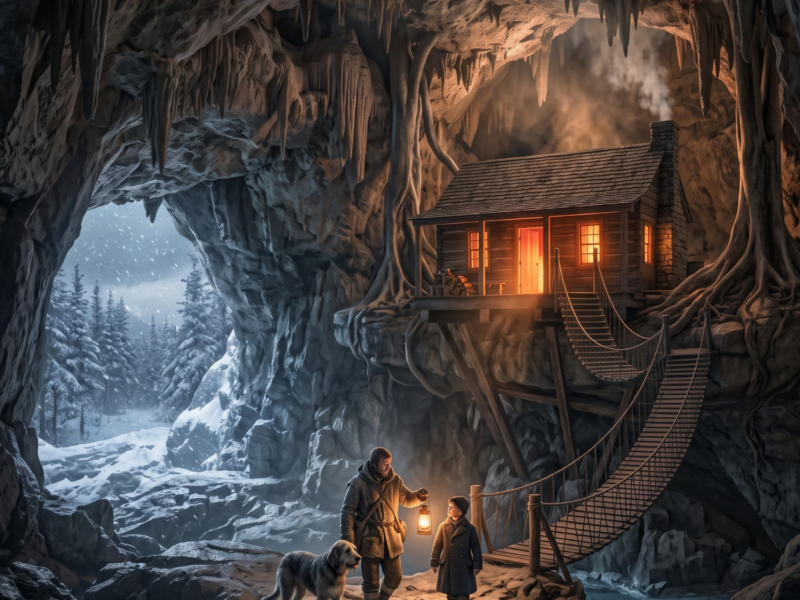
Forced Out With Nowhere to Go, Two Sisters Found a Hidden House Inside a Giant Cave
The Architecture of Survival
Dawn arrived not with sunlight, but as a subtle change in the quality of the darkness.
A thin, pearlescent gray seeped through the dirty window glass and found the surfaces of things—the dull iron of the stove, the scarred wood of the counter, the thick dust on the shelf boards—making them visible without making them warm.
Petra folded the bone-handled knife and put it deep in her pocket. June was still sleeping, a small mound under the quilt. Flint had silently moved to the front door during the night, resting his chin on the threshold. It was information of a kind; he was standing guard.
The first, absolute problem was water. She had known it would be.
They had eaten handfuls of snow during the three days outside, which was terribly inefficient, lowering their core body temperature, but functionally keeping them alive. Inside the cave, there was no snow.
There was, however, a dry sink. And there was presumably a very logical reason someone had exerted the immense effort to build a dry sink in that specific location.
She walked to the kitchen and examined it more carefully in the gray light. The thick wooden counter had a shallow channel cut along its inner edge. She hadn’t noticed it in the dark. It was a wooden trough, running on a slight downward slope toward the back wall of the house, passing through a gap in the timber fitted with a clay seal, dark and hard with age.
She followed the logic of the engineering. She traced the channel to a pipe—an actual, turned wood pipe, constructed of fitted sections sealed with hardened pine pitch—that entered the wall from the exterior of the house, out in the cave.
Someone had engineered a gravity-fed water delivery system to this kitchen. The wooden pipe was bone dry now, either frozen solid somewhere up the line or simply empty after years of disuse, but it had clearly been built with a specific, reliable source in mind.
Flint was whining softly at the front door. She opened it and stepped out onto the porch.
She followed the dog across the dusty cave floor toward the far rock wall, where the cavern curved back into a secondary, shadowed depression. The air there was noticeably colder, and it possessed a different quality of crisp freshness that the main, stagnant cave lacked.
She found the source within a minute.
It was a narrow, vertical fracture at the base of the solid rock wall, where groundwater seeped steadily through the porous stone in a thin, continuous, glittering ribbon. It collected in a natural, smooth stone basin no larger than a washbasin, and then drained away silently through a microscopic crack in the floor.
She touched it. It was shockingly cold, clear, and moving steadily. She tasted a drop from her fingertip. It was pure and clean.
She stood up and looked back at the intricate wooden pipe system running toward the house. She understood, with a sudden, profound respect, that someone had not merely stumbled into this cave and hastily built a shack to survive a winter. They had surveyed it. They had planned it. They had studied the hydrology of the rock, tracked where the water came from, and built the structure deliberately to make use of it.
This was not an accident or a desperate impulse. This was the work of someone who thought in terms of years, not days.
She filled their tin bottle from the basin and went back inside.
She woke June with a gentle hand on her shoulder. The girl sat up immediately with the startling clarity of children who sleep hard and wake completely. June looked around the room, blinking, as though she needed a moment to confirm that yesterday’s miracle had actually happened.
Petra put the cold tin bottle in her small hands. “Drink slowly.”
June drank deeply, wiped her mouth with the back of her hand, and was quiet for a moment. Then, her eyes found the dog.
“He found it,” June said. She looked at Flint with the intense gravity of an army general issuing a formal commendation. “Good dog.”
Flint’s tail thumped once against the floorboards.
Firewood was the second problem, and it was significantly more dangerous than water.
Petra addressed it that same morning. She went out through the narrow passage into the brutal cold of the forest, carrying her folding knife and a heavy length of hemp rope she had found neatly coiled on a storage room shelf.
The storm had broken and passed sometime before dawn. The world outside had that particular, blindingly bright, white silence that follows heavy snowfall. It was painful to look at directly.
She found a massive deadfall pine within two hundred yards of the cliff face. The branches had been broken and dried long ago, currently resting under a skim of new powder snow that brushed off clean.
She made four exhausting trips, dragging heavy bundles of wood tied with the rope.
On the final trip, June appeared at the cave entrance. She was still holding her faded cloth rabbit, watching her older sister work.
“You should be inside where it’s safe,” Petra scolded gently, panting from the exertion.
“I was helping in my head,” June said seriously.
This was something June said sometimes. Petra had long ago learned not to argue with the logic of it.
Lighting the first fire that afternoon provided the particular, profound satisfaction of a fire that works on the absolute first try when you desperately need it to. The dry pine kindling caught instantly from the match, the draft pulled fiercely and cleanly up the massive old stone chimney, and the smoke went exactly where it was engineered to go.
The warmth moved out from the firebox agonizingly slowly—the way warmth does in thick stone buildings—but it moved. By the time the cave’s high fractures had gone a deep amber with the late afternoon light, the main room of the house was no longer freezing. It was merely cool. And cool was a temperature Petra could work with.
Food was the third problem, and it was the hardest, because it could not be permanently solved in a single afternoon.
She searched the kitchen thoroughly while June sat at the small table, meticulously working at the cloth rabbit’s ear, which had come loose. The shelves held only ghost towns of past meals: two empty ceramic crocks, a wooden spoon with a cracked handle, a rusted tin cup without a handle, and a heavy cast-iron skillet hanging on a forged iron hook that still held strong. A low cabinet yielded three empty glass preserving jars, their metal lids rusted firmly shut.
Nothing edible. Nothing even close. The people who had left this place had been methodical; they had packed their provisions and left only the heavy tools.
She went back to the storage room to inventory. She found rusted iron nails in a tin, a handsaw that desperately needed sharpening, a claw hammer with a sound steel head, three lengths of rope, and a heavy whetstone.
Useful in time. Not edible today.
That evening, as they sat by the fire, she told June they would go looking for food in the morning. She kept her voice flat and matter-of-fact. June nodded with the particular, heartbreaking patience that Petra recognized as the coping mechanism children grew when the adults in their lives stopped being able to fix everything immediately.
The next morning, with Flint leading the way, Petra went north along the base of the cliff and angled uphill into the dense timber.
There were animal tracks everywhere in the fresh snow, which meant the forest was alive with things she couldn’t possibly catch yet. But the creek she heard burbling before she saw it turned out to be a legitimate, unfrozen watercourse, running smooth and dark over pale stones in a channel four feet wide.
In a south-facing clearing, where the massive Ponderosas broke the wind and the snow was significantly thinner, she found what she desperately needed: a thick stand of Hawthorne bushes. The thorny branches were studded with dark red berries that had dried and shriveled in the cold, but had not rotted. They had held tight through the freeze.
She frantically filled both pockets of her wool coat. They were incredibly bitter and mealy. She and June ate them sitting on a rock without complaint, June noting philosophically that they “tasted like something trying to be an apple, but failing.”
The creek yielded fish on the second afternoon’s attempt.
She had fashioned a crude hook the first evening from a bent nail, painstakingly straightening it and rebending it carefully over the hot edge of the stove. She threaded it on fine, strong cord she had unraveled from the edge of the rope coil, using a hawthorn berry for bait.
She lost the first two fish to pure impatience, jerking the line too soon, and the third to a slipping knot.
On the fourth cast, she hauled a small trout, flashing silver in the late afternoon light, thrashing briefly on the snow before she dispatched it cleanly with the back of the knife.
She cooked it in the cast-iron skillet that evening. The rich smell of frying fish filled the house in a way that made Flint sit bolt upright from the hearth and stare at the stove with an intensity that bordered on religious philosophy.
June pointed at the drooling dog and laughed.
It was the first time the little girl had laughed in longer than Petra could accurately remember. It was a small laugh, careful and hesitant, as though June were testing to see whether the mechanism in her chest still worked.
But it worked. It was enough. It was a start. And starts were what Petra Winslow understood best.









