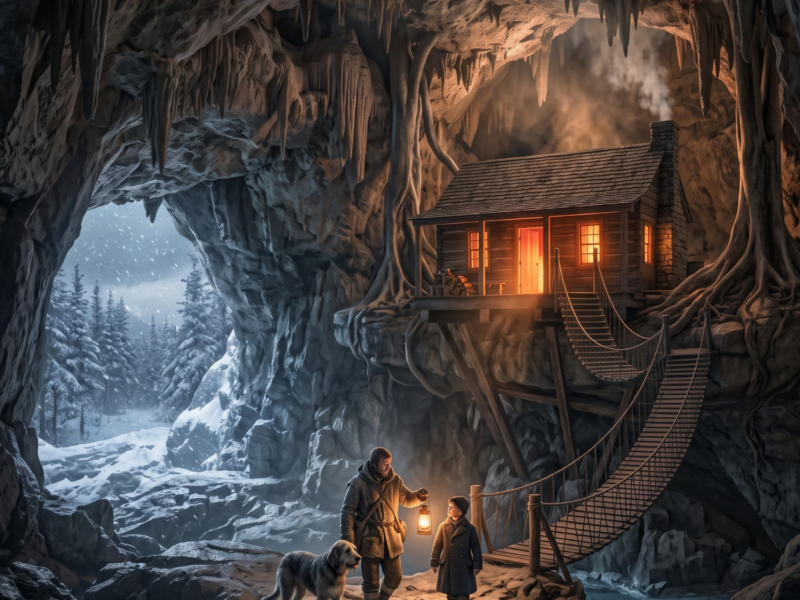
Forced Out With Nowhere to Go, Two Sisters Found a Hidden House Inside a Giant Cave
The Accumulation of Strangers
Over the next week, Petra built systems.
She built them the exact way her father had taught her to approach any catastrophic problem down in the mines: Break it into what you can control today, and what you’ll need to control eventually. And do not confuse the two categories.
Today was water, food, and warmth. Eventually was everything else.
The firewood operation became a rigid morning task. She identified three massive deadfall trees within a reasonable, safe distance of the cave—enough timber to last for months if worked systematically. She began cutting and carrying them in manageable sections, stacking them inside the cave against the rock wall nearest the entrance to dry.
June took charge of the indoor stack beside the hearth. She arranged the split pieces with a profound seriousness, suggesting she had officially decided this was her domain and would govern it with an iron fist.
The fishing became more reliable as Petra learned the typography of the creek. There was a deep, slow pool below a particular curve where the trout congregated in the afternoon shadows to avoid the current. If she was patient, and incredibly still, she could usually take two or three before they spooked. Combined with the bitter Hawthorne berries, and later with dried yarrow seed heads she found along the ridge, they had enough calories to survive.
They were not comfortable. They were not abundant. Enough was the word she kept returning to in her mind, because it was an honest word, and it made no grand promises the situation wasn’t in a position to keep.
At the end of the first week, she used snow and a strip of cloth torn from her petticoat to thoroughly clean the grimy windows.
The light that came into the main room afterward possessed a different quality entirely—brighter, sharper, more honest. The house suddenly looked less like a haunted ruin she had stumbled into, and more like a home she was actively living in.
June noticed the change in the light, nodded her approval, and then went right back to what she had been doing: drawing on a smooth, flat piece of pine board she’d found in the storage room, using a piece of charred stick from the fire for a pencil.
It was a map of the cave. It was rough and tilted, completely lacking scale, but highly recognizable. There was the entrance passage. The spring depression. The house itself. And a small, lumpy shape near the fireplace that was clearly meant to be Flint.
“That’s good,” Petra said, leaning over her shoulder, meaning it.
June studied her own work critically, her brow furrowed. “Flint’s ears are wrong. They’re too pointy. He has rounder ears than that.” She held the board up, comparing the drawing to the sleeping dog.
Flint, who had been watching this artistic conversation with the neutral, bored dignity of a dog being discussed in his presence, did not appear to have strong opinions about the geometry of his own ears.
On the ninth day, Petra found the writing on the kitchen beam.
She had been systematically checking the structural integrity of the house, pressing on joints, testing the give in floorboards, and tapping her knuckles along the wall sections to hear the distinct acoustic difference between solid timber and hollow rot.
The massive, hand-hewn main beam above the kitchen counter was incredibly sound. She ran her hand along it, enjoying the feel of the wood. Near the wall end, where the timber met the stone and the shadows gathered thickest, her fingers brushed against a series of deliberate cuts in the wood.
They were not accidental scrapes. They were not wear and tear. They were carved.
She brought a candle closer.
A letter. A period. Two more letters. A date.
O.M. 1859.
And directly below it, in smaller, meticulous cuts made with a much finer blade:
Built for those who come after.
Petra stood perfectly still, her fingers resting lightly on the carved letters. She read the words twice, then a third time.
The cave was profoundly quiet around her. June was somewhere behind her in the main room, rearranging the firewood by some complex geometric system that made sense only to her. Flint was sleeping, his paws twitching.
Whoever O.M. was, they had not built this incredible house and then simply abandoned it to the elements. They had built it with the specific, monumental understanding that they were not the last desperate people who would ever need it.
She took her hand off the beam and looked down at the second kitchen drawer. It was stuck, jammed tight, which was why she hadn’t managed to pull it open during her first sweep.
She wedged her knife blade into the gap and pried. The drawer popped open with a scrape of dry wood.
Inside, lying flat, was a folded piece of heavy paper.
She opened it. It was a list, written in a careful, slanted, elegant hand.
Materials: Oak peg sizes and counts. Pitch pine for the roof. Clay quantities for the chimney seal.
It was a builder’s inventory.
But at the bottom of the list, below a dark double line that ended the technical section, someone else had written a message. It was in a lighter ink, a finer hand, entirely different from the first. Six words.
North wall soft near floor. Reinforce.
Same place. Different person. Different time in history.
Someone had come along years after O.M., found the house, found the inventory list he’d left, and added a critical structural warning to it for the next person.
Petra read the note twice. She put it on the counter, grabbed a candle, and walked over to the north wall of the house. She would check it tomorrow.
No, she thought. She checked it that same afternoon.
She knelt near the floorboards. She pressed her thumb hard against the plaster. It gave slightly, crumbling under the pressure where it should have been rock-hard. She pressed in three different places and found a section roughly eighteen inches wide where the backing had softened significantly and separated from the raw stone behind it.
It was classic frost damage. Water had worked its way through a microscopic fissure in the rock over many severe winters, expanding into ice and contracting, until the protective seal cracked and failed.
She spent an hour that afternoon remaking the seal. She hauled wet clay from the spring depression, mixed it aggressively with fine white ash from the fireplace—the exact same clay-ash combination she’d watched old Sam Hartley use to waterproof his root cellar walls back in Sweetwater County.
It wasn’t an elegant repair. It was ugly and gray. But it was highly functional, which was exactly what the situation called for.
She did not yet know who had written that warning note. She did not yet know whether they had stayed in the cave for a decade or a week. But they had been here. And they had cared enough to think about the safety of the next stranger.
The heavy quilt on the bedroom mattress was old, but it was exceptionally well-made. It was pieced together from squares of thick wool in dark blue and faded, rusty red, stitched with the dense, perfectly even hand of someone who had a great deal of time, and took immense care with it.
Petra had been using it exclusively for June since the first night, doubling it over so that it covered the small girl properly.
One morning, taking it outside to the porch to shake the dust out of it before remaking the bed, she found something she’d missed in the dim light.
In the lower right corner, half an inch from the edge binding, two letters and a date were worked into the fabric in thread. The thread had once been dark, but had faded to a pale gray, barely visible against the blue wool.
A.P. 1874.
Not O.M. A completely different initial. A completely different year. Fifteen years after the beam inscription.
Someone else had been here. Someone else had slept shivering under this heavy quilt, and had sewn their mark into its corner before they left it behind.
She turned the corner of the quilt over in her rough fingers. She thought about the elegant handwriting in the kitchen drawer, and the repaired north wall, and the medicinal herbs she hadn’t found yet, but knew intuitively she would.
There was something accumulating in this cave, a powerful force she didn’t have a specific word for yet. It was a chain of desperate strangers. People who had each arrived at the end of their rope with nothing, found a miracle, taken only what they strictly needed to survive, left whatever they could spare, moved on, and in their leaving, had actively thought about whoever might come next.
She walked back inside, put the quilt back on the bed, and tucked the edges tightly around the mattress.
That night, the fire burned exceptionally well. The house was warm in a deep, radiant way it hadn’t been during the first few days. The massive stone of the fireplace had finally absorbed enough thermal energy to radiate it back into the room through the cooler hours of the night.
June had fallen asleep sitting at the table, her head resting on her wooden board map. Petra had lifted her and carried her to the bedroom without waking her—a small, logistical feat that felt, in the quiet moment, like a massive victory.
She sat alone by the fire with a tin cup of cold water. She listened to the ancient sounds the cave made in the dark: the faint, groaning creak of the old Ponderosa roots shifting under the weight of the snow overhead, the distant, rhythmic drip of the spring, the occasional, muffled whump of small snow collapses from the upper fractures.
Flint lay entirely across the threshold of the bedroom door, acting as a physical barrier. It was a tactical choice he’d made independently, and one which she had long ago stopped questioning.
She was not done with her Uncle Gideon Winslow.
She knew that fact as clearly and coldly as she knew the temperature outside, or the depth of the creek pool. Gideon was absolutely not the kind of man who left loose ends untied. And Petra Winslow—living somewhere unknown in the vast Elkhorn country, possessing her father’s dog and a nine-year-old heir who hadn’t cried once in three days—was a legal loose end of the most troublesome kind.
But Gideon was not tonight’s problem.
Tonight’s problem had been food, and fire, and the failing north wall, and the quilt, and the letters A.P. and O.M. carved and stitched into things by people she would never have the honor of meeting, but who had thought about her safety in their leaving.
She reached down and rested her hand heavily on Flint’s warm flank. He shifted slightly in his sleep, his paws twitching the way dogs do when they’re running something down in a dream.
She let the fire burn down to glowing red coals. She did not add more wood. The stone held the heat long enough now that it didn’t need constant feeding through the night, which was a crucial thing she had learned.
She stood up, went to the dark kitchen, and opened the second drawer. She read the words at the bottom of the list one more time in the low, red light of the coals.
North wall soft near floor. Reinforce.
“Fixed,” Petra whispered to the empty room.
Then, she went to bed.









