Forced Out With Nowhere to Go, Two Sisters Found a Hidden House Inside a Giant Cave
The Map on the Wall
Outside, Laramie was still doing exactly what it had been doing before—being a loud, working town in spring, completely unconcerned with the monumental shift in the universe that had just occurred inside the land office. The sun was high enough now that the deep mud on the main street was baking dry at the edges, leaving a hard crust that crunched loudly underfoot.
Silas stood beside her on the wooden porch.
He looked out at the bustling street, making absolutely no comment on the confrontation that had just happened inside. It was the response of a man who understood intimately that some victories didn’t need to be cheapened with gloating.
“I’ll stop by the Deputy Recorder’s office this afternoon,” Silas said, lighting a cheroot. “Make sure Callaway has everything he needs to countersign for tomorrow.”
Petra turned to look at him. He had done vastly more than simply act as a witness. He had stood in that terrifying room and been exactly the immovable wall she needed him to be, without ever once being asked to be anything more than that. She thought that was a rarer quality in a human being than most people allowed.
“Thank you, Silas,” she said softly. It was an insufficient phrase, but it was brutally honest.
He nodded once, touched the brim of his hat, and walked down the steps toward the recorder’s office.
She started the long walk back to the mountain.
The trail was significantly easier going up than she’d expected. Or perhaps she was simply less tired, running on adrenaline, which amounted to the exact same thing. The mud on the lower section of the trail had dried slightly in the afternoon warmth, and the footing was solid.
She walked steadily, falling into a rhythm. She thought about very little except the specific, beautiful details of the path: the placement of her boots, the way the Ponderosa country thickened and darkened as the altitude came up, and the way the delicate Aspens began to appear in their thin, white trunk clusters, shimmering brilliantly in their first green leaves of spring.
She reached the base of the cliff in the early evening. The light was going a rich, honeyed amber through the trees.
She slipped through the hidden passage and into the cavern.
June was sitting at the kitchen table. Flint was at the door, already on his feet, tail wagging. When Petra came through the gap, the massive dog walked over to her and pressed his heavy head firmly against her hand, a silent greeting, before trotting back to his post at the door.
June stayed at the table. She watched Petra cross the dusty cave floor. She watched her come up the wooden porch steps. She watched her walk through the front door.
Petra stopped in the center of the room. She reached inside her coat, pulled out the officially stamped, filed claim, and held it out across the table.
June took it with both hands. She read it with the intense, careful concentration she brought to any written thing, her small lips moving slightly as she parsed the formal language of the legal survey description.
Then, she found the specific line she was looking for, and she stopped reading.
Petra Anne Winslow. Elkhorn Ridge. 40 Acres.
June looked up, her amber eyes wide. “Is this ours?”
Petra pulled out the heavy wooden chair across from her sister and sat down, her legs trembling slightly now that the adrenaline was fading.
The fire in the hearth was low, but deeply present. The coals were good, the stone radiating a comforting warmth. Outside the cave, the evening was coming into the Ponderosa country with its particular, deep blue quality. The rich blue of high Wyoming evenings in May. The blue that meant the killing cold was not coming back tonight.
“It’s ours,” Petra said.
June put the document flat on the table. She smoothed it out with both hands, carefully, the exact same way she smoothed her charcoal drawings when she was finally satisfied with them.
Flint moved from the door to the hearth and lay down with a heavy sigh.
June was quiet for a long moment. And when she finally spoke, it was in the highly practical, settled voice she used for things that were absolutely decided.
“I’m going to draw the house,” June announced.
“On what?”
June looked at the white plaster of the kitchen wall. She looked at the sprawling, chaotic map she’d been building since December. The winding creek, the fish, the Hawthorne stand, the dotted line to the timber, and Flint with his correctly rounded ears.
She looked at a massive section of plaster to the right of it, clean, white, and completely unused.
“On the wall,” June said, her eyes shining with determination. “So whoever comes next knows exactly what it looks like.”
Petra sat with that for a moment.
The fire cracked once in the hearth—a small, definitive sound in the quiet room.
Petra thought about Obadiah Morrow, carving Built for those who come after with a careful knife into a massive beam he knew he would leave behind. She thought about Agnes Pallister, folding a beautiful quilt she wouldn’t keep, and leaving medicinal herbs in a drawer for a desperate woman she would never know. She thought about Caleb Pallister, eleven years old, learning to carve a dog’s ear the right shape, and leaving the clumsy proof of his existence on a dusty shelf.
And she thought about June. Nine years old. A girl who had not shed a single tear in six months of freezing terror. A girl who sorted rusted nails by size, fixed drawings until they were perfect, and had just put her initials in a leather notebook that had been keeping its silent record for twenty-four years before she even arrived.
Petra got up from the table. She went to the kitchen drawer and took out the thick piece of charred stick June used for drawing.
She walked back to the table and held it out.
June took it. She walked to the wall, considered her blank canvas with the eye of an architect, and began to draw.
Petra walked to the bedroom and sat on the edge of the bed. She pulled the heavy leather notebook from under the straw mattress and opened it to her last entry. The one that said, Still here. Still deciding.
She looked at the words for a moment. Then, she took the small pencil from her coat pocket and drew a single, dark line through the sentence. Not to erase it—it had been agonizingly true when she wrote it. She drew the line through it because it was simply not true anymore.
Below it, she wrote in a clear, bold hand:
P.W. May 1883. Filed the claim. Silas Drum witnessed. June is drawing the house on the wall so whoever comes next knows what it looks like.
She paused, biting her lip. Then she added the technical record.
Fixed the roof. Rebuilt the water pipe. Added bracing to the storage room. The north wall held.
She looked at what she’d written. Then, she wrote one final line below everything else, sealing the pact.
For whoever comes after.
She closed the notebook. She didn’t shove it back under the mattress this time. She carried it into the storage room and set it gently on the middle shelf, in plain, obvious view, right beside the extra iron hinges, the neatly coiled rope, and the three small tins of sorted nails.
Beside the notebook, she set the Morrow land documents, carefully wrapped in their protective oilcloth. And beside those, she placed the heavy tin box with the 1856 gold coin still resting inside it. Because the coin had been placed there by Obadiah as a kind of proof, and she believed it should stay where proof lived.
From the kitchen, she could hear the soft, focused sound of June’s charcoal scratching against the plaster.
Petra walked to the doorway and watched her sister work.
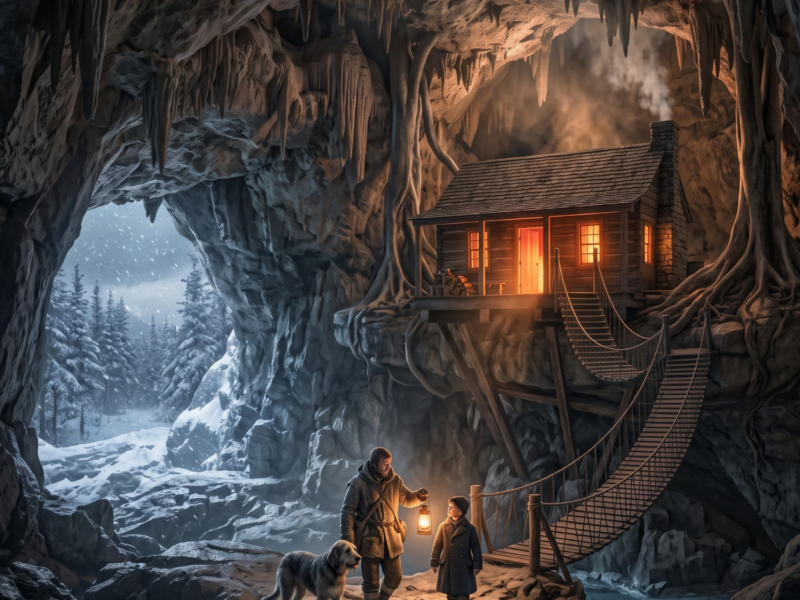
June had the proportions right from the very start this time. The house was sitting properly in the immense space of the cave, the massive tree roots coming correctly through the ceiling above it. She was working on the porch now—the two steps, the railing, the exact angle of the roof eave, capturing it exactly as it actually was.
She was going to be incredibly good at this, Petra thought.
Not just good at drawing. She was going to be good at the particular, vital skill of seeing a thing exactly as it really was, and putting it down accurately so that someone else could understand it, without ever having been there.
That was a profoundly useful thing to be able to do. That was the kind of thing that outlasted the person doing it.
The fire needed wood.
Petra went to the stack, added two heavy splits of pine to the coals, and adjusted the iron damper slightly.
Outside, through the cracks in the cave ceiling, the last of the evening light was doing what it always did—finding the specific, beautiful surfaces of the stone, making them momentarily clear, and then gently letting the dark have them back.
Flint was asleep on the hearth. The house was warm. The claim was filed.
And June kept drawing.









