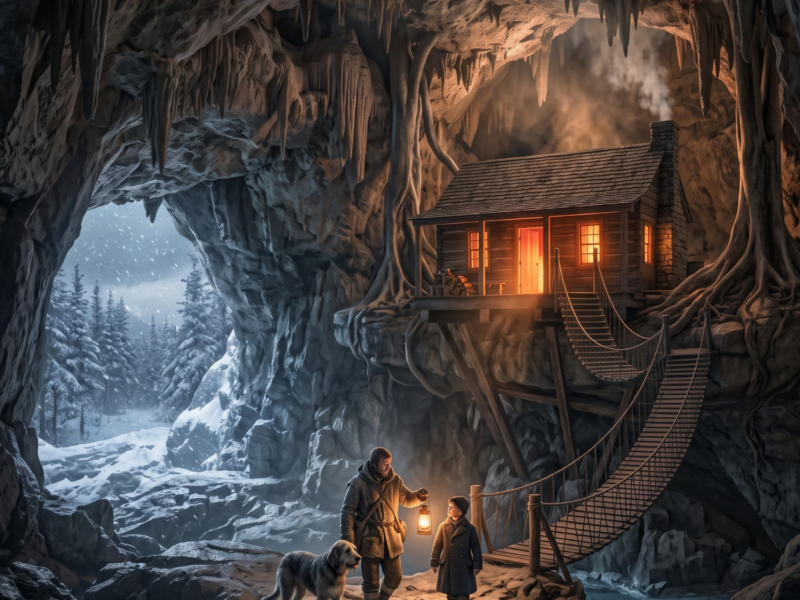
Forced Out With Nowhere to Go, Two Sisters Found a Hidden House Inside a Giant Cave
The Tin Box and the Choice
On the thirty-fourth day of their exile, she found the tin box.
She had been reinforcing the north wall properly. She was not doing the hasty surface patch from earlier, but a deep, structural repair, pulling the soft, rotted plaster all the way back to the raw stone and relaying it with a heavy clay-ash mixture she had scientifically refined through four test patches on less critical surfaces.
Working close to the floorboards in a lower section, she felt the clay give differently under the blade of her knife.
It wasn’t the soft, mushy give of frost-damaged backing. It was the hard, echoing, hollow sound of something resting behind the plaster that wasn’t solid stone.
She worked carefully around the perimeter, removing the plaster in small, neat pieces rather than large chunks. She uncovered a void in the rock. It was not natural; it was distinctly shaped, roughly cut out with a chisel, and sealed across its face with a flush clay plug that had been painted over to perfectly match the surrounding plaster.
Someone had made and concealed this deliberately. They had done it so incredibly well that she had walked past it a hundred times and nearly missed it entirely.
She pried the plug loose. Inside the dark void sat a heavy tin box, roughly the size of a thick novel. It was sealed completely around its lid with a thick ring of melted wax, dried hard as stone.
She cracked the wax with her knife and pried the lid open.
Inside the box lay a folded document and a single gold coin. A five-dollar piece, dated 1856. The gold was worn smooth from heavy handling.
The document was a second, identical copy of the land survey. It was not the exact same piece of paper as the one she had found in the cabinet—it had slightly different margins and a different clerk’s stamp in the corner—but it contained the exact same property lines, the same legal description, and the same sweeping signature at the bottom.
Obadiah Morrow had paid for two official copies. And he had hidden the second one behind the wall. He had kept the first one accessible in the cabinet, and he had put the second one somewhere only a very careful, diligent person undertaking serious structural repair would ever find it.
She unfolded the heavy paper and read the property description again.
Forty acres, Elkhorn Ridge. Including the feature described as rock formation with interior accessible from East Face, approximately one-quarter mile north of Creek Junction.
The cave.
He had legally described the cave in a government document. He had claimed the house implicitly by claiming the rock that held it.
She sat back on her heels on the floorboards, holding the heavy gold coin in her palm. She thought about the impossible weight of it.
The land had belonged to Morrow. He had left in 1863 without ever filing a formal abandonment or legal transfer. Wyoming Territory had been organized in 1869, which meant an entirely new set of land laws had applied to every acre in the territory, presumably including this one.
She didn’t know precisely what those new laws said about a claim that predated the territory’s very existence. But she knew one monumental thing she had not known before she cracked that wax seal.
The land had a history. The history had legal paper behind it. And paper mattered. It mattered in ways that Gideon Winslow had demonstrated violently by using it to steal her father’s house.
Paper cut both ways.
She put the gold coin deep in her coat pocket. She placed the document inside the notebook, wrapped them both securely in the oil cloth, and shoved the package deep under the straw mattress in the bedroom, where it was not visible and could not be easily found.
That night, by the fire, she made a list in the back of the notebook, right behind Caleb Pallister’s entry.
It was not a list of things she had accomplished. It was a list of things she desperately needed to know.
What does Homestead Law say about prior territorial claims? What does the six-month residency provision cover? What is the process for filing at the federal land office in Laramie? How long have I been here?
She counted the days on her fingers. November 3rd, the day she had left the Sweetwater house. Thirty-four days in the cave. That put her at the 7th of December.
Twelve weeks until the middle of March. Sixteen weeks until the middle of April.
If six months was the legal threshold to prove a claim, she needed to be standing in the land office in Laramie by the first week of May.
She added that deadline to the list, closed the notebook, and stared into the fire.









