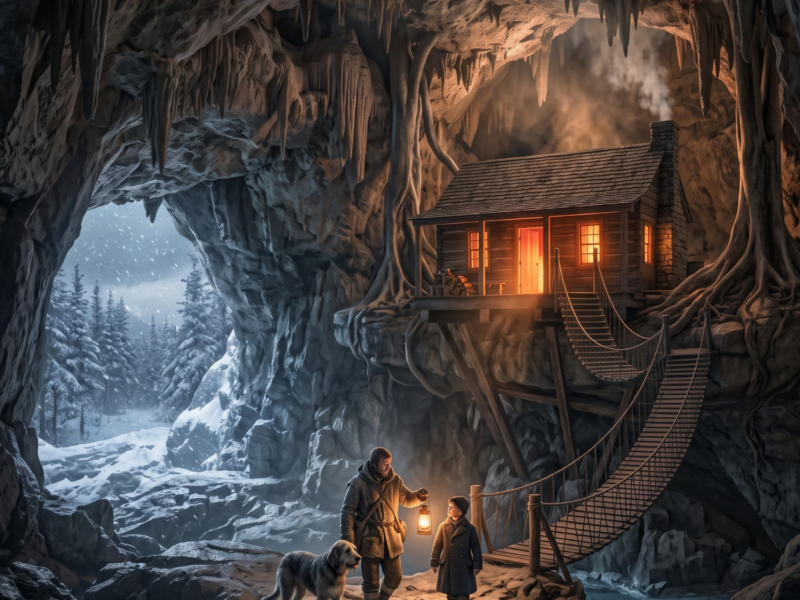
Forced Out With Nowhere to Go, Two Sisters Found a Hidden House Inside a Giant Cave
The Paper War
They left the cave before first light.
The trail down out of the mountains toward Laramie was vastly longer than Petra had mentally compressed it to be during the long winter months, when she’d run the route in her head over and over as a planning exercise. In her head, sitting by the fire, it was a four-hour hike. On foot, fighting through the thick, sucking May mud of the thaw, it was closer to six.
Silas set a brutal pace that covered ground without ever appearing to hurry. It was the relentless, eating pace of someone who had walked long distances for most of his working life. He didn’t talk much, which she appreciated.
What conversation they did have was entirely practical. They spoke of the state of the trail in two places where the spring melt had completely washed out the lower path. Silas pointed out the location of a reliable, clean water source three miles from town, where they stopped briefly to fill their canteens.
He told her the federal land office opened promptly at eight o’clock and closed at five. He noted that today was Wednesday, which meant they would get the afternoon clerk—a man he’d dealt with once before, whose manner was refreshingly business-like and fair.
Laramie announced itself first as a smell. Coal smoke. Sweating horses. The particular, sharp chemical edge of a massive tannery operating somewhere on the south side.
Then it announced itself as sound. The roar of a locomotive. The clatter of wagons.
Then, as they crested the final hill, the specific visual density of a working frontier town in spring. It was mud-streaked, chaotic, and incredibly busy. The streets carried the compressed, explosive energy of people who had been trapped inside small wooden boxes for four months and were now settling their accounts with the outdoors all at once.
The federal land office was a two-story frame building on the north side of the main street. It was unassuming, with a painted wooden sign and a covered porch that desperately needed a coat of paint.
Inside, two clerk’s desks faced a long public counter. At the nearer desk sat a man in his early thirties. He possessed the highly organized desk of someone who thought systematically, and the slightly ink-stained fingers of someone who did his fighting on paper.
Petra walked to the counter. She placed the tin box document, and the original document from the cabinet, flat on the wood.
The clerk looked at them without touching them. Then he looked up at her, and then at Silas Drum, who was standing like a bodyguard slightly behind her right shoulder.
“Homestead filing. Prior territorial claim, with a six-month residency,” Petra said, her voice clear and ringing in the quiet office. “I need to know whether those are legally separate filings, or one.”
The clerk reached out and picked up the Morrow survey document. He read it with the focused attention of someone who knew exactly what he was looking at. He flipped it over and examined the raised territorial seal. He set it down, picked up the copy from the tin box, and compared the wording.
“These are both Obadiah Morrow,” the clerk stated.
“He left in 1863 and didn’t return,” Petra said.
The clerk set both documents down in precise alignment. He turned to the massive shelf of bound, leather ledgers behind him and pulled the heavy 1869 volume. He opened it, ran his finger down a page, then another. He closed the ledger with a thud and put it back on the shelf.
“There is no transfer of deed on record. And no official abandonment filing,” the clerk said, adjusting his glasses. “The land automatically went into unregistered status when the territory was officially organized.”
He looked directly at her. “That makes the parcel eligible for a homestead claim under the 1862 Act, as modified by territorial incorporation. Your six months of residency, with documented improvements to the property, would satisfy the primary condition.”
He paused, tapping his pen. “But I will need a sworn witness statement for the residency.”
Silas stepped forward. He placed his own folded piece of paper on the counter.
His written statement, painstakingly prepared in his freezing camp, stated that he had observed clear signs of continuous habitation at the Elkhorn Ridge property beginning no later than January of the current year. It further stated that the habitation was consistent with a much longer period of occupation, based on the extensive extent and character of the physical improvements visible on the property.
The clerk read it. He looked up. “You’re a surveyor.”
Silas reached into his coat and produced his credentials. He had, it turned out, a formal, highly coveted Territorial Surveyor’s License—something Petra had absolutely not known until this exact moment.
The clerk looked at the official license, looked at Silas, and looked back at the license.
“A licensed surveyor’s attestation satisfies the federal witness requirement,” the clerk said smoothly.
He pulled a blank, crisp form from the drawer under the counter, dipped his pen in ink, and began writing.
“I’ll need your full legal name, miss.”
“Petra Anne Winslow.”
He wrote it with a flourish. He copied the property description meticulously from the Morrow documents: the survey bearings, the creek reference, the ridge reference, the forty acres. He wrote the date of the filing. He asked her three specific questions about the physical improvements she had made to the structure, and recorded her answers. He asked Silas two technical questions about the condition of the property as observed, and wrote those answers, too.
Then, he dated the form, stamped it with a heavy brass stamp from the stand at the corner of his desk, and slid a carbon copy across the counter toward Petra.
“Ward Callaway is the Deputy Land Recorder,” the clerk said. “He will countersign this document tomorrow morning when he comes in, and the claim will be officially on record by Thursday afternoon.”
He looked at her across the counter, a faint smile touching his lips. “Congratulations, Miss Winslow. The property is yours, pending the standard sixty-day confirmation window.”
She took the paper. Her hands were shaking so badly she could barely hold it. She stared at her name written on the line.
Then, the door behind her burst open.









