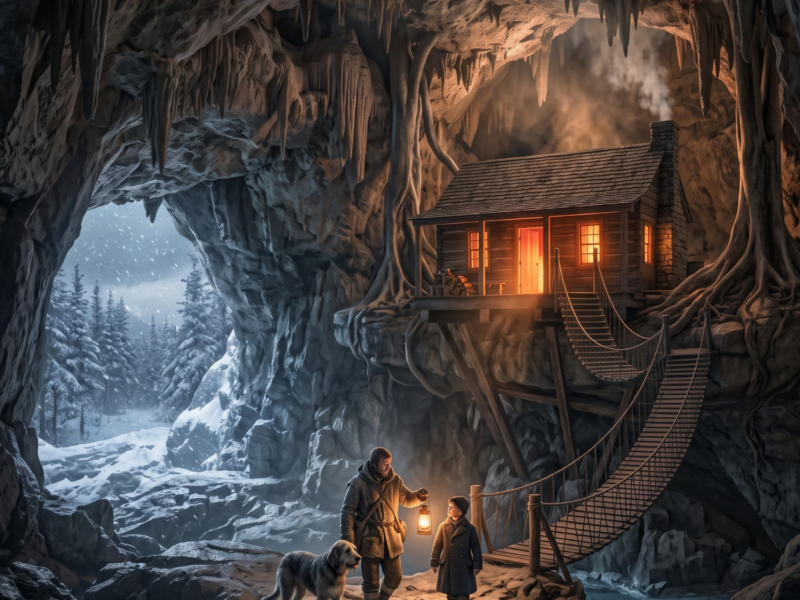
Forced Out With Nowhere to Go, Two Sisters Found a Hidden House Inside a Giant Cave
The Surveyor's Price
The cold in February possessed an entirely different character than the cold of November.
November cold was aggressive, wet, and angry. It was a cold that actively attacked you. February cold was settled. It was established. It was terrifyingly certain of itself, in a way that suggested it had absolutely no particular need to prove anything to anyone. It simply existed at a temperature that made every breath visible, and made the bare metal of the saw handle physically painful to touch without wrapping it in thick canvas first.
She managed the brutal February cold by managing her mornings. She went out before full light to collect heavy chunks of ice from the spring basin, which had frozen solid at the surface but still moved freely beneath. She hauled wood from the indoor stack before the outdoor temperature dropped below the threshold where she could safely spend more than thirty minutes outside without risking frostbite.
The fishing was significantly harder in deep winter. The trout had gone sluggish and deep into the darkest pools, conserving energy. But she learned to weight her line further with a small pebble, and she learned to wait longer. And waiting was a skill with a technique—a survival mechanism she had become exceptionally good at.
June had started singing.
It wasn’t constant, and it wasn’t loud. But while she worked at her drawings or arranged the firewood, she hummed fragments of things. Hymns, mostly. Songs their mother had sung while doing the laundry. And occasionally, something that didn’t seem to be from anywhere at all—melodic phrases with no words, which June repeated and modified the exact same way she modified her charcoal drawings incrementally, endlessly seeking the absolute right shape.
Petra listened from the other room and didn’t say a word about it. Saying something would have made the singing self-conscious, and she didn’t want to kill the fragile bird that had finally decided to sing.
It was during one of these freezing mornings—Petra violently swinging the axe at the chopping block near the creek, and June’s faint, melodic voice audible from inside the cave as a thin thread cutting through the cold air—that Petra looked up mid-swing and found she was not alone.
He was standing about thirty yards downhill, near the base of a towering pine cluster, silently watching her.
He was past middle-aged. Thickset, wearing a heavy, brown wool coat and a wide-brimmed hat that had been of excellent quality once, and was now simply battered and serviceable. He had a canvas prospector’s pack strapped to his back, and he possessed the unhurried, grounded way of standing that marked men who had spent a great deal of time in dangerous terrain where sudden movements caused fatal problems.
Petra set the heavy axe down slowly, resting the blade on the wood, the handle pointing up. She did not reach for the knife in her pocket.
He watched her do this, noting the restraint.
“Gideon Winslow is paying me two dollars a day to find his niece,” the man called out.
His voice was a working voice. It was dry, flat, and entirely accustomed to being practical. “Brown hair. Traveling with a young girl and a gray-white dog.”
Petra said absolutely nothing. She stood still and waited.
The man looked up toward the cliff face. The cave entrance was completely invisible from where he stood, hidden by the angle and the brush. He looked back at her.
“I’ve been working this ridge since January,” he said, shifting his weight. “Found some sign. Enough.”
She kept her hands loose at her sides.
He looked at her the way a cattle buyer looks at a steer—trying to accurately price it. It was not an unkind look. It was an appraising one.
“What I can’t figure,” he said, his breath pluming, “is why a man would pay two dollars a day in the dead of February to find a girl he claims owes him simple paperwork. Usually, when someone owes you paperwork, you wait for the spring thaw.”
The bitter cold was making Petra’s eyes water. She didn’t blink.
“Name’s Silas Drum,” he said. “I worked survey crews through this entire country back in ’68 and ’69. I know it better than most men alive.” He looked at the jagged ridgeline, then back at her. “You’ve been here a while. That’s not an accident. That’s management. Someone managed to survive this place in winter, which is not a simple thing to do. Which means either you knew exactly what you were doing when you came out here… or you learned it exceptionally fast.”
He looked pointedly at her bare hands, chapped, bleeding, and heavily work-scarred, her coat cuffs riding up to expose her wrists.
“Looks like you learned it.”
She had absolutely nothing to offer this man. She had no money, no leverage, no negotiation she could name. She had an axe four feet away, a nine-year-old sister singing inside a cave, and a notebook hidden under a mattress.
“What do you want?” she asked, keeping her voice perfectly level.
Silas Drum appeared to consider this as a genuine, philosophical question, rather than a threat or a plea.
“I want to finish my coffee before it freezes solid in the cup,” he said mildly. “Which I cannot do standing here in the wind.”
He looked up at the ridgeline again, adjusting his pack. “There’s a massive seam of lignite coal running north of this creek, about half a mile up. I’m going to go look at it. That’s what I’m actually being paid to do, really. Geological survey work for a railroad company. Winslow just added the finder’s request on after the fact.”
He hitched his pack frame more squarely onto his broad shoulders. “I haven’t found anyone today.”
He turned and walked north along the creek bank, without hurrying, his boots crunching in the snow.
Petra stood frozen in the snow until he was completely out of sight. She stood there a while longer, her heart hammering against her ribs, listening to the forest settle back into its ordinary, indifferent sounds.
Then she picked up the heavy axe and went inside.
June was drawing intently on the plaster wall. Flint was asleep by the hearth. The fire was burning well.
She set the axe inside the door and leaned heavily against the cold stone wall beside it, her knees suddenly weak.
June looked over her shoulder. Something in Petra’s absolute stillness made the little girl put down the charred stick.
“Was someone out there?” June asked.
“Yes.”
“What did they want?”
Petra looked at the fire, staring into the deep, red heat radiating steadily from the coals. “He wanted to tell me something, without technically telling me something.”
June looked at this cryptic answer from several angles, tilting her head the way she looked at a drawing she was unsure about. “Did it work?”
“Yes,” Petra said, pushing herself off the wall. “I think it did.”
She walked to the bedroom, pulled the leather notebook from under the mattress, sat on the edge of the bed, and opened it to her list. She read what she had written months ago. 6 months. Laramie. Homestead Law. Prior claim. Land office.
She took her pencil and added one more line in the careful, precise hand she used when she wanted to be absolutely sure she’d read it correctly later.
Silas Drum. Surveyor. Knows the ridge. Not working for Winslow… not entirely.
Then she closed the notebook, shoved it back under the mattress, and went to help June build up the fire.
That night, unable to sleep, she found the last entry in the notebook.
It was the one she had completely missed, because it was written not on a page, but on the inside of the heavy cardboard back cover, in tiny letters, easy to overlook unless you held the cover at a specific angle to the lamplight.
Agnes Pallister had written it. The handwriting was smaller and far more deliberate than her previous, hurried entries, as though she had come back to the notebook at a specific, poignant moment to write down a truth she’d been chewing on for a long while.
There will come a day when the person reading this has to decide whether this place is a shelter, or a home. Those are not the same thing. A shelter is somewhere you survive. A home is somewhere you choose. I chose. I hope whoever reads this gets to choose, too.
Petra held the notebook open. She read those words in the flickering firelight until she had them memorized. Not because she was trying to, but because the words bypassed her defenses and settled into her bones—the way profound truths do when they arrive at exactly the right moment, and you have no armor up because you weren’t expecting to be hit.
Outside the cave, the brutal February wind worked its way along the ridge, howling. The giant Ponderosa overhead shifted its immense weight, the sound groaning through the roots that ran deep into the stone ceiling.
Inside, the fire was steady. The house was warm. The walls were holding back the sky.
She had been here 91 days. She needed 183.
She turned to the very first blank page in the notebook, picked up her pencil, and wrote the date. Then she wrote a single sentence, the only thing that felt entirely accurate.
Still here. Still deciding.
Then she went to bed.









