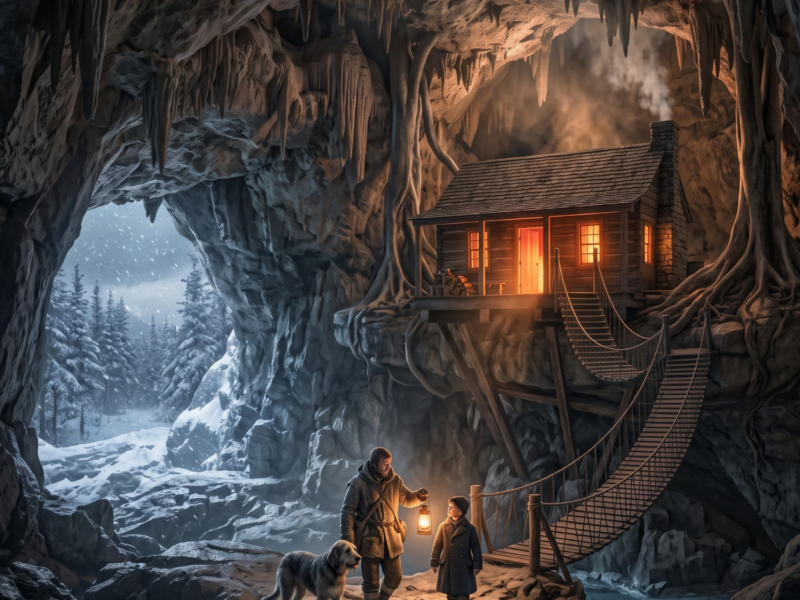
Forced Out With Nowhere to Go, Two Sisters Found a Hidden House Inside a Giant Cave
The Geography of Time
The second week began with an infuriating problem she hadn’t anticipated.
The heavy cast-iron skillet had developed a hairline crack along its base. It now leaked hot animal fat directly into the fire whenever she cooked in it. This meant the skillet was mechanically unreliable, the fire smelled constantly of burning grease, and the situation required a metallurgical solution she didn’t possess.
She set the useless skillet aside. She spent the entire morning thinking about the physics of cast iron while sharpening the handsaw blade with the heavy whetstone from the storage room.
She drew the stone along each metal tooth in turn, displaying the absolute patience of someone who has learned the hard way that tools only fail you if you let them get dull.
The whetstone was of exceedingly good quality—much harder and finer than the cheap, porous ones sold at the general store in Sweetwater. And it had clearly been used extensively before she found it. Its surface possessed a particular, smooth concavity worn deep into the center by someone else’s rhythmic hands.
She thought about that concavity as she sharpened. Whose hands? What had they been sharpening? How many brutal winters ago?
The cave had a strange way of making her perceive time differently than she was used to. Time outside, in the town, moved in frantic weeks, changing seasons, and urgent payments coming due. Time in here moved in the slow, geological accumulation of things done, and things still requiring doing.
She solved the skillet problem by digging through the storage room. Underneath the lowest shelf, partially buried by decades of old pine needles, she found a heavy iron trivet she had previously overlooked.
The trivet was perfectly intact. It fit flawlessly over the fireplace’s ember bed. This allowed her to use the cracked skillet suspended above the direct, concentrated heat rather than resting directly in it. This reduced the thermal stress on the fracture just enough to make it functional.
It was not a repair. It was an accommodation. She was learning to tell the difference.
June had graduated from the small pine board to the plaster of the kitchen wall itself. Using a charred stick sharpened to a fine, precise point, she was extending her map across a blank section of plaster that Petra had confirmed was not load-bearing.
The map had grown considerably in scope. It now showed the winding creek, with fish marked as tiny, perfect squares. The Hawthorne stand was a dense cluster of stippled dots. The safe route to the deadfall timber was a bold dotted line. And in the upper corner, entirely out of geographical proportion to the landscape, was a massive, highly detailed rendering of Flint.
With correctly rounded ears.
Petra stood in the kitchen doorway, wiping her hands on her apron, and looked at it.
“You fixed his ears,” Petra noted.
June stepped back, examining the drawing with the cold, professional detachment of an art critic. “I had to do them three times.” She pointed a charcoal-stained finger at faint, smudged marks beneath the final version. “Those are the wrong ones.”
The drawing was getting exponentially better. And the true thing deserved acknowledging.
June had always possessed their mother’s precise eye for the shape of things—the intuitive understanding of the way a detail sat relative to what surrounded it. Watching that delicate quality survive the trauma of the last few months entirely intact… watching it not just survive, but actively develop… was something Petra turned over in her mind. She turned it over the way she turned over a difficult mechanical problem, looking for what the data was telling her.
The curio cabinet along the hall wall, which Petra had initially categorized as purely decorative and therefore low-priority, turned out to hold something vastly more useful than decoration.
She had been methodically working her way through every fixed and built-in element of the house, pressing on wood panels and pulling on trim pieces to check for rot. The cabinet had three shelves behind glass doors that didn’t latch properly anymore.
The lower shelf held a broken ceramic ring she couldn’t identify a purpose for, and a folded square of heavy canvas. It was a carpenter’s apron, heavy-duty, still structurally sound along its seams.
But when she reached her hand further back into the dark recess, her fingers found a narrow gap between the shelf base and the cabinet’s back panel.
And wedged tight into that gap was a folded piece of paper. A list this time, but a completely different kind of document than the builder’s inventory.
She pulled it free, took it to the window for light, and opened it carefully. The heavy paper was stiff and reluctant after years of being folded in the dark.
The writing was executed in two different inks, clearly at two different times in history.
The first was a dark, brown-black ink. The handwriting was highly formal, with the careful, looping hand of someone who had been taught penmanship in a strict school and taken the teaching very seriously.
At the top, a terrifyingly official header: Territorial Surveyor’s Office. March 1858. Wyoming Territory.
Below it was a dense plot description. Metes and bounds. Compass bearings. The creek reference. The ridge reference. Forty acres.
At the bottom, above a sweeping, elegant signature, was a line she read twice, her heart stopping.
Obadiah Aaron Morrow. Owner of Record.
This was not a diary entry. This was a legal land document. Not a copy, not a casual reference. It was an original survey claim. She turned the stiff paper over. The reverse held a raised, stamped wax seal, partially legible, from a government office in Cheyenne.
The second ink, added much later in the margin, was in a lighter, fading blue. The handwriting was rushed.
O.M. gone to Oregon, 1863. Left the house. Left this. Left it for what it’s worth to someone.
Petra sat down heavily on the cold kitchen floor, the document resting in her lap.
Obadiah Morrow had owned this land. He had owned it properly, legally, with a surveyor’s math and a government seal in 1858. He had left in 1863—not burned out by Indians, not lost to the winter, simply departed. And he had left the official document behind with a marginal note that acknowledged, without an ounce of sentimentality, that he was giving it up.
He had known he wasn’t coming back. He had known someone else might come after him, and he had left them the legal ammunition to fight for it.
Wyoming Territory had been officially organized only in 1869. She didn’t know precisely what had happened to land claims that predated the territory’s existence. She didn’t know whether they transferred legally, expired, or dissolved back into the federal surveys.
But the land was here. The house was here. The document was here.
She put the document flat on the counter. She weighted it down with the tin cup. Then she picked up her tools and went back to work.
Because the alternative was to sit down with the document and fully face the terrifying, massive question it raised about her future. And she wasn’t ready to do that yet.
She had learned in the grueling year since her father died to place certain, overwhelming problems in a specific, locked box in her mind, and leave them there until she had acquired enough actionable information to think about them usefully.
The document went into that box.









