Forced Out With Nowhere to Go, Two Sisters Found a Hidden House Inside a Giant Cave
The House in the Mountain
The snow was mid-calf deep by the time they reached the base of the towering cliff.
Up close, the rock face was vastly more complex than it had appeared at a distance. The massive, serpentine roots of the Ponderosa pines had worked their way deep into the stone over what must have been centuries, wedging and levering with relentless hydrostatic pressure until entire sections of the cliff face had shifted, groaned, and cracked apart.
There were jagged, black gaps where the rock had moved apart, most of them too narrow to be useful for anything larger than a marmot. Petra was scanning the fissures with the frantic attention of someone who had completely run out of alternatives, when Flint walked directly to a low, horizontal fissure hidden behind a curtain of frozen pine boughs, and pushed his muzzle into the dark.
Then, he went through.
He didn’t squeeze through, or struggle. He simply walked forward, head down, and was entirely swallowed by the absolute shadow between the stone.
For one long, terrifying moment, there was only the sound of the wind, the hiss of driving snow through the Ponderosa needles high above, and June’s quiet, ragged breathing at her side.
Then, Flint barked. Once.
It came from somewhere deep inside the rock.
“Stay behind me, hold my coat,” Petra commanded.
The gap was incredibly tight. Petra had to turn completely sideways, duck her head, and press her chest and face flat against the freezing, abrasive stone. She kept one hand extended behind her for June the entire way through, feeling the young girl’s small, icy fingers locked around hers with a grip stronger than it had any right to be.
It was eight feet of pure, suffocating darkness and the distinct, mineral smell of cold stone.
And then, it opened.
The cave was enormous. It wasn’t the darkness or the cold that struck Petra first; it was the sheer, breathtaking scale of it. The acoustics of their breathing changed the instant they stepped clear of the passage, becoming rounder, more contained, echoing gently off smooth surfaces much further away than her eyes expected.
Petra stood perfectly still and allowed her pupils to adjust.
Thin, razor-like seams of gray light entered through high, invisible fractures in the ceiling. It was not enough to illuminate the space clearly, but enough to see by in the slow, careful way of a winter afternoon. The floor beneath her boots was dry, smooth stone, mostly flat, littered with a soft carpet of old, brown pine needles that must have blown through the upper fractures over many decades.
And at the far end of the cave, she saw it.
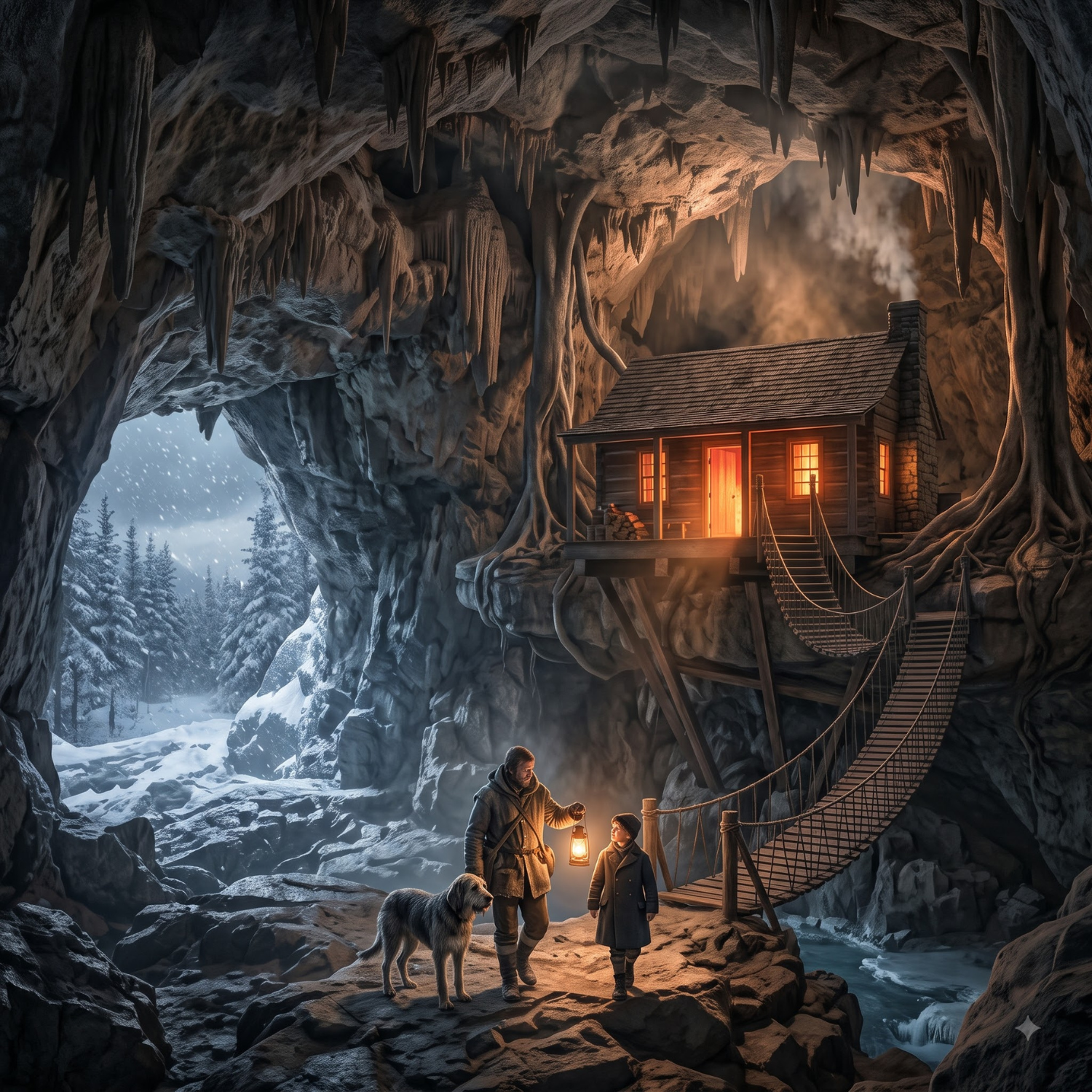
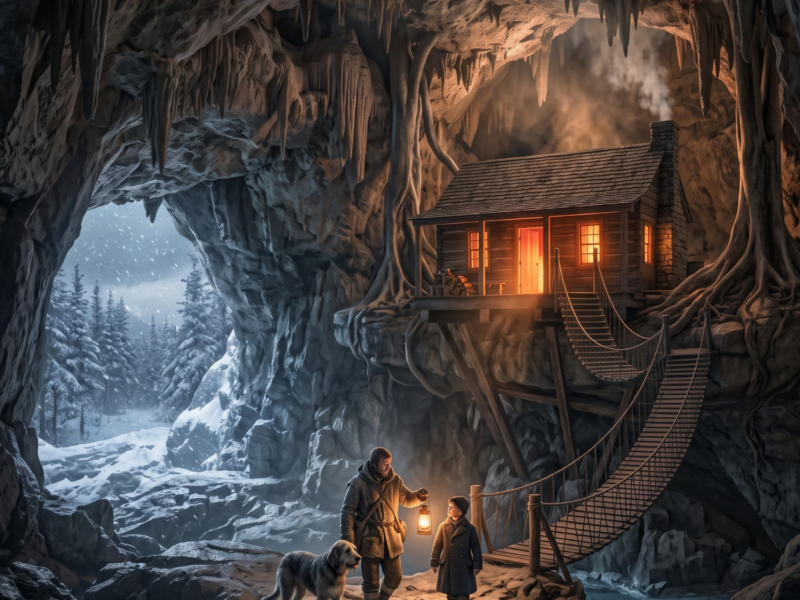
Beneath the largest cluster of roots she had ever seen—roots that had punched straight through the cavern ceiling, not in thin cracks, but in great, ropey, muscular bundles, as though the ancient Ponderosa above had decided to grow a second home underground—stood a house.
A wooden house. A real one.
It was not a pile of salvage. It was not the desperate, fevered nailing together of industry scraps. It was not a collapsed shell.
It had four solid walls, a properly pitched roof, and a covered porch with two wooden steps. It had windows fitted with actual glass—dark with years of grime, but entirely intact. The structure stood perhaps twelve feet tall at its peak. It was built with a meticulous care and deliberateness that made absolutely no logical sense to Petra, until she forced herself to stop trying to explain it and simply looked at it.
There were no footprints in the thick dust on the cave floor, except the chaotic ones they were making now, and the neat pad-marks of Flint’s paws leading directly toward the wooden porch steps.
Petra’s hand moved instinctively to the pocket of her heavy wool coat. Her fingers wrapped around the bone handle of her father’s folding knife. Old habit from the mining camps. She held it there without opening the blade, and she listened.
No sound from inside the house. No sound at all, beyond the faint, white noise of the blizzard outside, which reached them here only as something distant and abstract, like violent weather happening on another planet entirely.
June squeezed her shoulder. “Is someone in there?” her voice was a fragile whisper, barely above a breath.
Petra didn’t answer, because she honestly didn’t know.
Flint was already on the porch. He sniffed methodically along the base of the heavy wooden door, unhurried and calm. Then, he sat down heavily and looked back at them with his pale, wolf-like eyes, as though he had been waiting quite some time for them to catch up and open the door. His thick tail moved once, sweeping across the wooden planks.
That was all the tactical assessment she was going to get.
Petra walked forward. Every board in the porch remained solid underfoot; there was no soft rot. She pressed her hand flat against the door and pushed. It opened without resistance. The heavy iron hinges groaned with a particular, high-pitched complaint of metal that hadn’t moved in a very long time.
A cloud of fine dust drifted out through the beam of gray light spilling from the nearest dirty window.
The smell that followed the dust was nothing like she expected. It smelled of old wood, yes. But also of dry herbs—faintly medicinal, faintly sweet. It smelled of the ghost of woodsmoke from a fire that had gone cold years ago.
But it did not smell of rot. It did not have the wet, cloying, moldy smell of true abandonment. It smelled, strangely, like a place where people had once been exceedingly careful.
Flint walked confidently inside, circled the center of the main room exactly once, and laid down with a heavy sigh in front of a massive stone fireplace on the far wall, resting his chin on his paws. He was done making decisions.
June walked in close behind him. She stopped dead in the center of the room. She turned slowly in a full, wide-eyed circle, looking up at the heavy, hand-hewn ceiling beams, the towering stone chimney, and the dusty windows letting in their anemic, gray winter light.
Then, she turned to look at Petra.
For the first time in three days—longer, if Petra was being brutally honest with herself—fear was not the loudest emotion written on her little sister’s face. It was awe.
Petra stood at the threshold, keeping her hand on the knife, and forced herself to be methodical. The fireplace was magnificent; built of heavy river stone, large, with a swinging iron arm for a cast-iron pot, and a proper, functioning metal damper handle.
The floor was made of wide, thick wooden planks. It felt incredibly solid; there was no terrifying spring or give of hidden rot when she walked her weight across it. The windows were intact against the weather.
Along the near wall sat a functional kitchen: a sturdy wooden counter, shelves that were mostly bare, a heavy cast-iron stove with a pipe running into the main chimney, a dry sink carved from stone, and iron hooks where tools had once hung.
A narrow hall led to a small bedroom containing a heavy wooden bed frame and a folded, patchwork quilt resting on a mattress of old, but remarkably dry, straw. A second door off the hall opened into a storage room lined with empty wooden shelves.
She checked every corner. She looked up into the dark rafters. She stood in the bedroom doorway, her heart pounding, and listened to the silence.
There was no one here. There had not been anyone here for a very long, long time.
Whoever had been here last had left the front door unlocked. They had left the quilt neatly folded on the bed. And they had not, in whatever mysterious circumstances had caused them to leave, chosen to destroy what they had so painstakingly built.
Petra crossed the room to the fireplace. There was ash in it, cold and pale as flour. The heavy wooden woodbox beside the hearth was completely empty.
She would desperately need to find firewood before the dark set in completely, but the overriding reality hit her with the force of a physical blow. They were inside. They were out of the snow. The walls were standing, the roof was holding back the mountain, and Flint was already asleep.
That night, Petra didn’t sleep a wink.
She sat rigidly in the heavy wooden chair nearest the door, the folding knife open and resting on her knee. She listened to the blizzard work itself into a frenzy against the rock face outside, the sound muffled and distant.
Across the room, June slept deeply on the straw mattress with the heavy quilt pulled up to her chin, and Flint pressed securely against the back of her knees.
Petra watched them both breathe. She thought about the lock that didn’t exist on the door. She thought about the footprints they hadn’t left outside, erased instantly by the driving snow. And then, as the hours ticked by, she let herself think about absolutely nothing at all for a while, which was the closest she had come to true rest in three agonizing days.