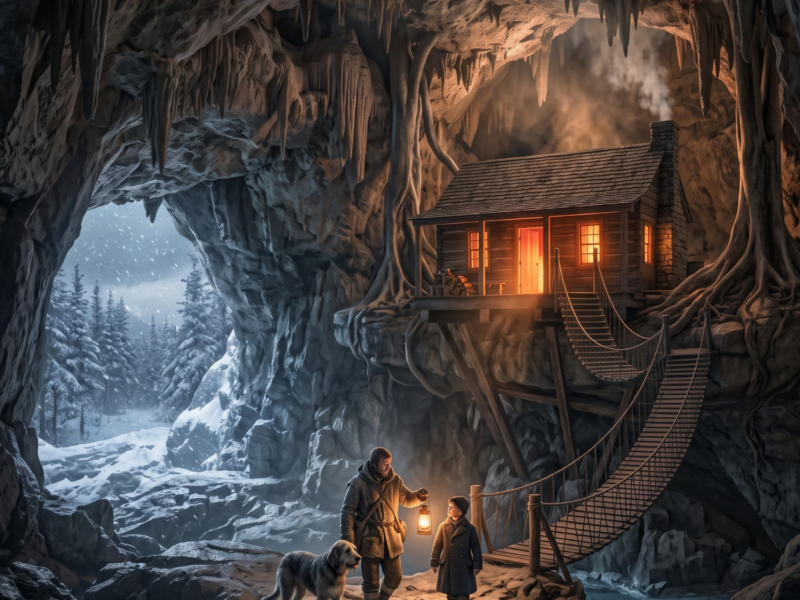
Forced Out With Nowhere to Go, Two Sisters Found a Hidden House Inside a Giant Cave
The Woman Who Saved Them
That evening, after June had gone to sleep, Petra found the notebook.
She had been looking in the dark storage room for another length of rope. She pulled the lowest, heaviest shelf away from the wall to check whether anything had fallen behind it over the years.
There it was. A soft-cover notebook, ledger-sized, wrapped tightly in a piece of oiled cloth that had dried and cracked, but had done its job of keeping the paper dry.
She carried it out to the firelight.
The first twenty pages were written in the same formal, elegant hand as the land document. Obadiah Morrow. It was highly technical content: roof pitch mathematical calculations, chimney draw air ratios, depth requirements for the clay seal on the water pipe to prevent freezing, species of wood preferred for each structural application, and specifically why.
It was not a diary. It was a master construction manual. Morrow had written down not just what he did to survive, but the engineering of why he did it, and exactly how someone might maintain or replicate it if it failed. The sheer precision suggested a man who believed his hard-won knowledge had immense value, and he absolutely didn’t want it lost to the dust.
Then, abruptly, the handwriting changed.
The new hand was smaller. It was less formal, slightly hurried, with occasional cross-outs that Morrow’s perfect hand never allowed itself.
There was a name at the top of the page. Agnes Pallister. Winter 1873.
A brief, stark entry arrived in November. Husband lost at Powder River that spring. Two boys. Nowhere to go. Found the house. Found the notebook. Used the clay method for the window frame on the east side. It works. Morrow knew what he was doing.
The entries continued through the long winter in brief, highly practical observations. What the creek water level did in a deep freeze. Where the best, driest deadfall was located on the ridge. Which direction the wind came from during a norther, and how that specific pressure affected the chimney draft.
Then, in April 1874, a final, hurried entry. Leaving for my sister’s place in Cheyenne. Boys are well. Left the quilt on the bed. Added herbs to the kitchen drawer. Yarrow, thyme, willow bark, for whoever needs them. Fixed the north wall as best I could. This house saved us. I hope it saves whoever comes next.
Petra read this entry three times. Her vision blurred.
She had drunk Agnes Pallister’s yarrow tea to stave off the chill. June had slept warm and safe under Agnes Pallister’s heavy quilt. Petra had repaired the exact same wall Agnes Pallister had identified and partially fixed nine brutal years before her. She had read Agnes Pallister’s warning note in the kitchen drawer without knowing who had written it.
And now she knew. A widow. With two boys. With nowhere to go, in a winter that must have looked very, very much like this one.
She closed the notebook. She sat with it resting on her knees and stared into the fire.
There was a word for what this was, though it wasn’t a word she’d been taught to use for this kind of situation. Inheritance was the word.
But not in the ugly, grasping way Gideon used it. Not as a greedy claim on someone else’s accumulated luck and labor.
It was something older than that. It was the kind of inheritance that moved relentlessly forward instead of looking backward. That accumulated not in gold or bank notes, but in vital knowledge, in necessary repair, and in the profound habit of leaving things better than you found them, for terrified people whose names you would never know.
She opened the notebook to the first blank page immediately after Agnes Pallister’s entries. She looked at the blank paper for a long time.
Then, she closed it, set it on the shelf beside the fire, and went to bed.









