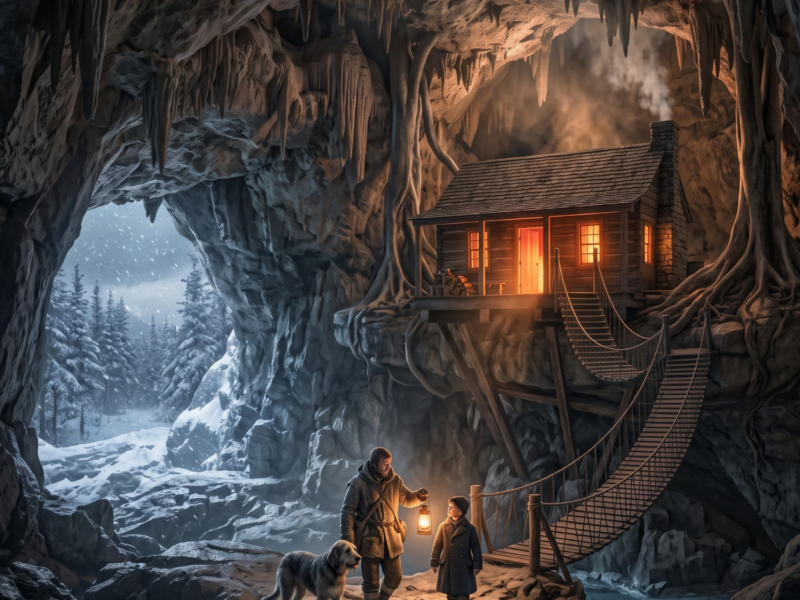
Forced Out With Nowhere to Go, Two Sisters Found a Hidden House Inside a Giant Cave
The Footprints in the Frost
The morning she found the footprints was a stunningly clear morning. It was the kind of morning Wyoming produced after a long run of hard, brutal weather—a sky so purely, aggressively blue it looked artificially constructed. The new snow reflected the sun with a flat, blinding, indifferent brilliance.
Flint was at the cave entrance before she was even fully awake.
She heard him. He wasn’t barking. He wasn’t growling. He was producing the low, continuous, vibrating sound deep in his chest that he made when something required her immediate attention, without yet requiring her absolute alarm.
She pulled on her heavy coat and boots, her heart accelerating, and looked out through the narrow passage into the blinding light.
On the fresh snow outside lay one distinct set of footprints.
Men’s boots. Medium-size. Flat-heeled. They were not heavy work boots or miner’s boots.
The prints came from the east, tracking along the base of the cliff face. They slowed considerably near the gap she and June and Flint had squeezed through weeks ago. They stopped. The boot marks were perfectly parallel and close together—someone who had paused deliberately to study the rock.
Then, the prints turned around and went back the exact way they had come.
They had not come through the passage. Either the man hadn’t found the gap behind the brush, or he had found it and made the tactical decision against entering a blind cave. But he had been here. Close enough that she could count five distinct pressure marks from the right boot heel. And he had been here recently enough that the top half-inch of new, powdery snow in the prints was still sharp-edged and had not yet blown away in the wind.
She went back inside without touching anything, her mind racing.
June was awake, sitting at the kitchen table with her board and charred stick, working on something new. She looked up. Whatever raw emotion she read in Petra’s pale face made her instantly set the board down.
“Someone was outside,” Petra said, fighting to keep her voice level.
June looked at Flint, who was still sitting very still at the entrance, his ears swiveled forward. “Did they come in?”
“No.”
“Do you know who it is?”
The honest answer was that she didn’t know for absolute certain. But she knew exactly what she thought. There was only one person with both a financial reason to find her, and the resources to pay a man to do it.
She had been gone more than two months. The county records for the Winslow property back in Sweetwater would show a glaring gap—a transfer transaction without the legally required signature of the living adult heir. Gideon could not complete that theft without Petra’s signature on a piece of paper. And every month that passed without it made the problem vastly more likely to be examined by a judge or someone with legal authority.
“Get dressed,” Petra commanded. “And stay close to the house today.”
June dressed without a single word of argument. She spent the entire morning sitting cross-legged in front of the fire, keeping Flint on one side of her and her drawing board on the other.
Petra spent the morning in a state of hyper-vigilance, checking every structural element of the cave entrance area. She dragged two massive deadfall branches across the outer face of the gap, wedging them at a low angle, deliberately positioned so that the new snow would catch on them and build a natural-looking drift across the opening.
It was not a lock. It was misdirection. And misdirection was the only defense the situation offered.
Three days passed without another set of prints appearing.
She did not relax her guard, but she consciously redistributed her attention. She knew that vigilance that doesn’t vary its focus eventually becomes a dangerous blindness in a specific direction.
It was during those tense three days that she worked her way back through the notebook more carefully, reading every page, and found what she had completely missed the first time.
There was a third hand. Just two pages at the very back of the book.
It was a child’s handwriting. The letters were large, uneven, and heavily pressed into the paper, not yet fully controlled but highly legible.
There was a boy’s name at the top. Caleb Pallister, Age 11. Winter 1873.
A single, heartbreaking entry: Mama says we are leaving in the spring. I do not want to leave. This is the best house I have ever seen. There is a dog carved on the shelf in the bedroom, and it looks like a real dog. Mama said I can leave this here. So I am leaving it.
Petra slammed the notebook shut. She went immediately to the bedroom and looked at the high shelf above the bed, which she had quickly registered as empty during her initial, frantic survey months ago.
She had been wrong about empty.
At the far end of the shelf, pushed hard against the wall where the shadow was deepest and dust had gathered, was a small carved figure, perhaps four inches tall.
She picked it up, her hands trembling, and brought it out into the light of the main room.
It was a dog, carved from a single piece of soft pine, sitting at attention with its ears pricked forward. The proportions were rough and approximate, and the tool marks were clearly the work of a learner—someone who had been shown how to hold a knife, but was still physically developing the fine motor skill.
But the essential, soulful thing was exactly right. The ears were round, not pointed like a wolf’s. The chest was broad and proud. The tail rested flat on the ground rather than curling up over the back.
It was a sled dog. The specific breed that had worked the Northern Territories for generations. The kind her father had chosen specifically for pulling heavy equipment through deep country drifts. The exact kind of dog that Flint was.
She set the carving on the bedroom windowsill where the morning light reached it, and went to find June.
June turned the small, wooden figure over in her hands, giving it the careful, analytical attention she gave to anything she intended to draw later. She held it up next to Flint’s face and compared them. Flint endured this intense physical examination with sleepy dignity.
“A boy made this,” June announced.
“How can you tell?” Petra asked.
June considered the wood. “The ears are right. But the paws are way too big. Boys always make the paws too big.” She set it gently on the table and studied it from a foot away. “He was practicing.”
Petra thought about Caleb Pallister. Eleven years old in the brutal winter of 1873. Learning to carve with a knife in a hidden house under a Wyoming ridge, while his widowed mother frantically fixed walls, dried herbs, and wrote practical survival notes in a ledger for strangers. Learning to do something real and difficult, and leaving the clumsy, beautiful proof of it behind.
She understood, suddenly and clearly, exactly why the figure had stayed on the shelf. Some things were absolutely not meant to be taken. Some things were meant to be a permanent part of the place.
She took the carving and put it back on the dusty bedroom windowsill.









