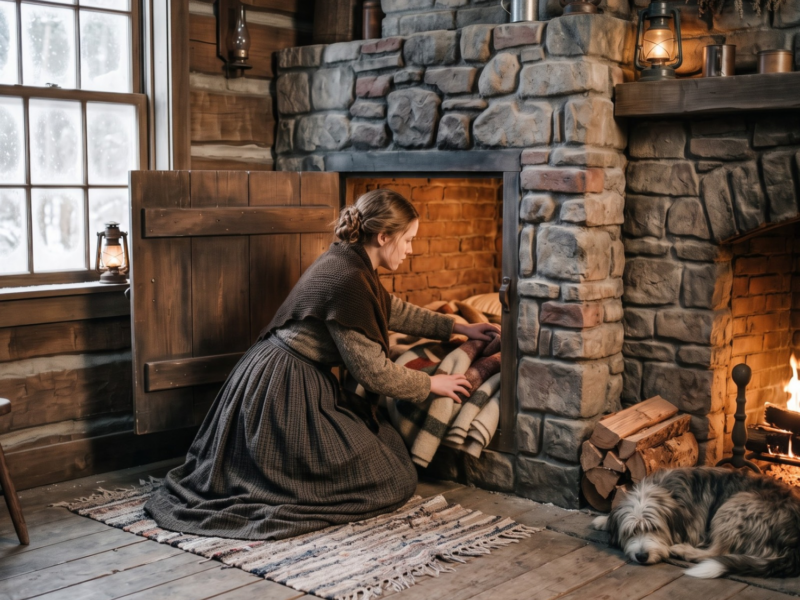
Her Cabin Had No Bedroom — But the Bed Hidden in Its Chimney Survived a 43°F Winter
The Midnight Knock
The Ashford House—the largest and best-built in the valley, two full stories of timber frame with plastered walls and two heating stoves and a proper fireplace in the parlor—did not fail the way the smaller cabins fail. It was too large and too well-made for that.
What it did instead was slower, and in its way it taught a harder lesson, because it showed the exact place where money and good building reached the end of what they could do against a cold of that depth and that patience.
Edward Ashford had both stoves running day and night from the start of it, and a woodpile laid in at better than twice what any normal winter asked, because he was a man who measured his standing partly in the size of his reserves. His barn held eighty-two head of cattle, and the heat of their bodies rose through the planks of the loft and made that one space more reliably warm than anything he had built from lumber.
With the fireplace and both stoves and the warmth of the stock all working at once, the main floor of the house held at a temperature that was unpleasant, but survivable.
What could not be held was the upper floor. The bedrooms over the main rooms, with only a single plank ceiling between them and the heat below and their own thin walls open to the air on three sides, went cold past the point where a person could sleep in them. By the second night, Margaret Ashford moved her household down.
She did it with the brisk competence of a woman who had run the social life of a community long enough to know that keeping up appearances in a crisis was a luxury the crisis would not allow. She brought her three children and her husband and the two big dogs into the kitchen, and she laid out pallets in front of the stove, and she set the order of them herself: the children nearest the warmth, then the dogs along their feet, then the grown people at the cold outer edge of the row.
She managed it all without letting herself think too long about the bedroom above, where she had slept for four years in a bed that had been her mother’s, under a quilt that had crossed the ocean folded at its foot.
On the third night of lying on the hard kitchen floor, her cheek against a folded coat and her husband breathing slow beside her and a dog’s weight across her ankles and the ceiling close enough overhead that she could have touched it from where she lay, Margaret Ashford let herself think about the woman on the hill.
She thought about it carefully—the way a person approaches a thought she has been holding off for months because she already suspects where it leads. She thought about the thermometer the widow was said to keep inside that cupboard door, and she found herself wondering what number it might be showing on this very night, while the one outside the most sheltered window of the finest house in Birch Hollow read 43 below.
She did not say any of this to Edward. She was not ready for that, and she was honest enough with herself to know that what held her back was not doubt, but pride—which was a harder thing to put down than doubt had ever been.









