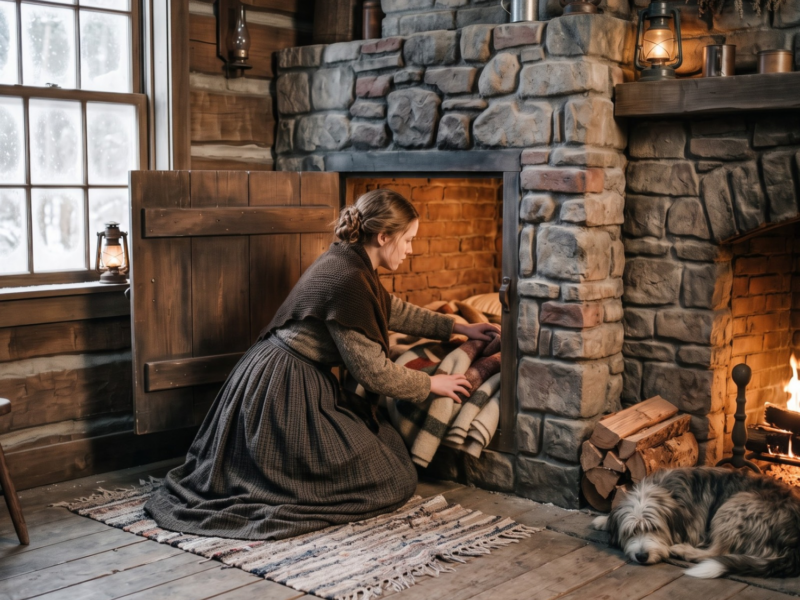
Her Cabin Had No Bedroom — But the Bed Hidden in Its Chimney Survived a 43°F Winter
The Veland Kitchen
The Veland place stood a mile and a half down the wagon road, and it was there that the cold first found a way in that mattered.
Hannah Veland had a boy of not quite three named Samuel, a child at the age where he had opinions about everything and words for almost none of it. And he had spent the turn of the year fighting a small cold—the ordinary kind, loose in the chest and fussy, but nothing to frighten a mother who had nursed worse.
She had moved his pallet out near the cook stove rather than leave him in the back room where the family slept, and she had taken it on herself to keep the stove fed through the nights, because she had always slept lighter than her husband, and because the keeping of it felt like a thing she needed to hold in her own two hands.
On the worst of those nights, her body simply gave out from under her. She had been going on broken scraps of sleep for the better part of two days—the way the mother of a sick child sleeps, twenty minutes caught here and half an hour there, never once letting go of her listening.
Somewhere in the deep middle of the night, the listening let go of her, and the stove she had set for a slow burn ran low, and the room that had held at a tolerable warmth began to give its heat up to the dark.
She woke to a change in Samuel’s breathing: a tightness in it the ordinary cold had not put there.
She was on her feet and across the cold floorboards before she was fully awake, gathering him up against her. She did not stop to be afraid. She built the fire back with quick, sure hands. And when the stove began to throw heat again, she held the boy close in front of it and worked the warmth back into him, rubbing his small back through the blanket, keeping him upright so the breathing could ease.
It eased. Within the hour the tightness had loosened and his color had come back, and he had slipped into a true sleep against her shoulder, worn out but whole. He had not been in the cold long enough for it to do more than frighten them both.
But Hannah Veland sat on the floor of her own kitchen with her son breathing steadily against her neck, and she understood with a clarity that unsettled her more than the cold had, that the house she lived in could not be trusted to keep him. She had done everything right. She had moved him to the warm room and kept the fire and slept light, and still the walls had very nearly given out beneath her care because the house was a wooden box, and a wooden box held no heat it was not actively being given.
Her husband Peter woke to find her there on the floor with the boy, and the look on her face was one he had seen only once before in their marriage, and it moved through him like a current. He pulled his coat on over his nightshirt and went out toward the barn, meaning to harness the horse and ride for the doctor at the river settlement.
And he got as far as the barn door before the cold stopped him. The air seized the chest in his breath and turned it to knives. He stood in the doorway of his own barn and understood that the three miles to the settlement in that air in the dark was not a ride a man made and came back from whole, and that the boy was sleeping now and warm and did not need a doctor so much as he needed the morning.
He went back inside. He sat with his wife and his son in front of the stove. They would not let go cold again, and he kept the fire fed until the gray light came. And he did not say the thing they both now knew: which was that their house had been built for an easier country than the one they were living in.
Act IV: The Test of the Iron Month
Chapter 13: The Proof in the Ledger
The Harmon place failed in its own way the same night.
Caleb had built it himself the summer before, with help from his father and brother—a good cabin by the measure of the valley, with a proper stone chimney and a partitioned bedroom, and room enough for the family he and Greta meant to have. On an ordinary winter night, it was more than sound.
This was not an ordinary winter night.
He woke near two in the morning to his wife shaking beside him. Not the small restlessness of a person who has pushed her blankets aside in sleep, but the deep, whole-body shaking of someone whose own warmth is being drawn out of her faster than her body can make it.
He put his hand to her shoulder and felt the tremor coming up through the quilts and the buffalo robe and the whole weight of everything they had piled on the bed against the cold. And the cold had come through all of it. The bedroom wall at her back was four inches of plank and chinking and his own pride in his work, and against the air outside it that night, four inches was nothing.
He carried her out to the main room and built the stove as high as it would take, and he sat with her on the floor in front of it, her back against his chest and his arms around her, because the floor by the stove was the one warm place in the house he had made. He held her there until the shaking stopped. And it took the better part of an hour.
And in that hour, Caleb Harmon sat on the boards of his own cabin with his wife in his arms and did a kind of thinking that had no comfortable shape to it. He had stood in the store and told the whole valley that the widow on the hill would be killed by her own cleverness. He had been so certain. Certainty had come easy to him his whole life, because nothing he had ever been certain about had cost him anything.
It was costing him now in the shaking of the woman he loved, in a house he had built with his own hands and believed in when the first gray light came. He left Greta by the stove and rode the mile and a half to his father’s larger house, where there was more wood and more wall between a sleeping body and the air, because he wanted her somewhere that would not fail her.
The next morning, he rode fast, because fast was warmer than slow, with his coat buttoned to the throat and his scarf wrapped across his face, and still the cold found the rim of his left ear where the scarf had slipped and worked at it the whole way. He did not know until he was warming by his father’s fire that it had been nipped past mending, that the edge of it would stiffen and change in the weeks to come into something a little different from what it had been. He would carry the mark the rest of his life in a place where everyone could see it—a small, plain reminder, worn where he could not hide it, of the night he learned the size of what he had not known.









