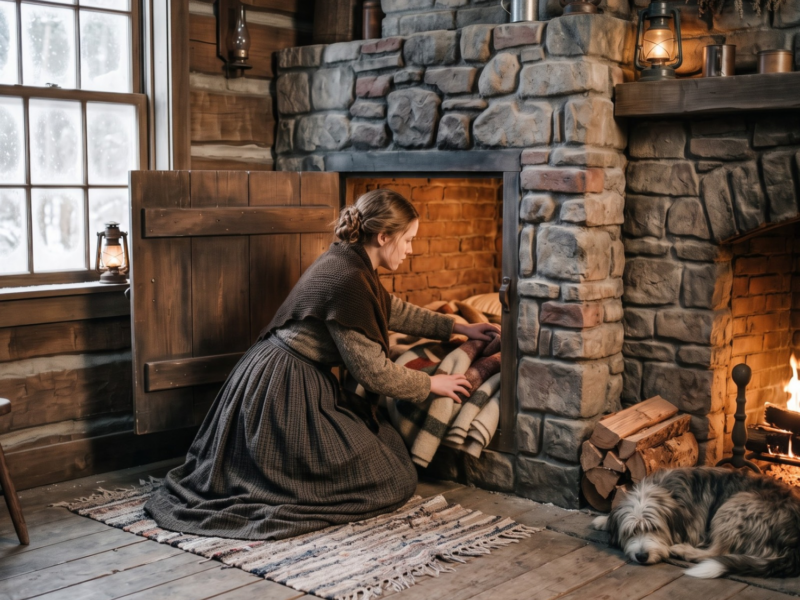
Her Cabin Had No Bedroom — But the Bed Hidden in Its Chimney Survived a 43°F Winter
The Abundant Shelter
That was the heart of the thing, though she had not yet found words plain enough to explain it to anyone who asked. An American log cabin was a beautiful and dangerous kind of shelter. It assumed an endless woodpile. It assumed a fire burning through the night. Most of all, it assumed someone awake to feed that fire until morning.
Anders had been that someone for three winters. Now Anders was under the burr oak, and she was alone, and the winter was coming for her the way it came for everyone eventually. The house had been built for abundance, and the abundance was buried in the cornfield.
For three weeks after the funeral, the valley had sent food up the hill—covered dishes, mason jars, and loaves wrapped in cloth carried along the wagon road by women who left their offerings on the porch and went away again when she did not come to the door. She had been grateful in a distant way, the way a person is grateful for weather she cannot change. She simply had not been ready to speak.
She fed the two milk cows and the dozen hens. She walked the half-mile to the well twice each day with the wooden yoke across her shoulders, leaning into the weight of it because the weight was something she could understand. She did not go to the small Lutheran church the Norwegian families had raised the autumn before. She did not go to Thorson’s store. She moved through the days like water through a channel it has carved for itself over long years, without effort and without any real choice in the matter.
What the valley did not know—because she had told no one—was that she was thinking. She was thinking the way her father had taught her to think when she was a girl in the high mountain country across the ocean: working a problem from its conditions to its requirements to its answer with a pencil and a sheet of paper and no patience for anything that could not be proved.
Her father, Johan Vold, had been a man of little schooling and great seriousness. He had left her three sheets of paper covered in his cramped, deliberate hand, sewn into the lining of the trunk she had carried across the Atlantic. She had kept them through the crossing and through three Dakota winters without once needing them, because Anders had been alive, and the notes had belonged to a problem she did not yet have.
Now she had the problem, and the notes were the only thing she had been left to meet it with. She read them every evening by lamplight at the trestle table in the main room while the spring nights cooled around her.
Her father had written about a thing the old people in the mountains had called the stone heart of a house. In the oldest homes of the high country, the central chimney was not merely a passage for smoke. It was the thermal center of the whole structure—a great mass of masonry that drank in the heat of the morning fire and gave it back slowly through the day and the night that followed. It dried wet wool. It warmed the rising bread on the hearth bench.
And in the broadest of those chimneys, built by men who had learned over generations what a long winter could do to a family, there was sometimes a sleeping cupboard set directly into the warm stone: a wooden box where the smallest child or the oldest grandmother could pass the worst nights of January in genuine warmth long after the fire had been banked to coals.
Ingred had slept in such a cupboard once. She had been seven years old, and her mother had died of fever three days before Christmas, and the cold had settled into every room of the house like a second occupant—something with weight and presence and a will of its own. She remembered her father lifting her into the wooden box set flush against the chimney wall, the feather tick that smelled of lavender and old smoke, the wool blanket tucked close.
She remembered turning over in the dark and pressing her back against the rear wall of the cupboard, which was not wood, but stone, and feeling that stone give back a warmth that had nothing to do with any fire, because the fire had been banked hours before. The stone had simply remembered.
She had thought, in the way a child thinks things that stay with her for the rest of her life, that the world was sorry, and that it was telling her so in the language stone knew how to speak. She had carried that memory for sixteen years without understanding that it was also an instruction. Reading her father’s notes now, alone at the table with the lamp burning low, she understood both things at once. The warmth she remembered was not comfort alone. It was engineering. And the engineering was the only answer she had to the question the coming winter was preparing to ask.









