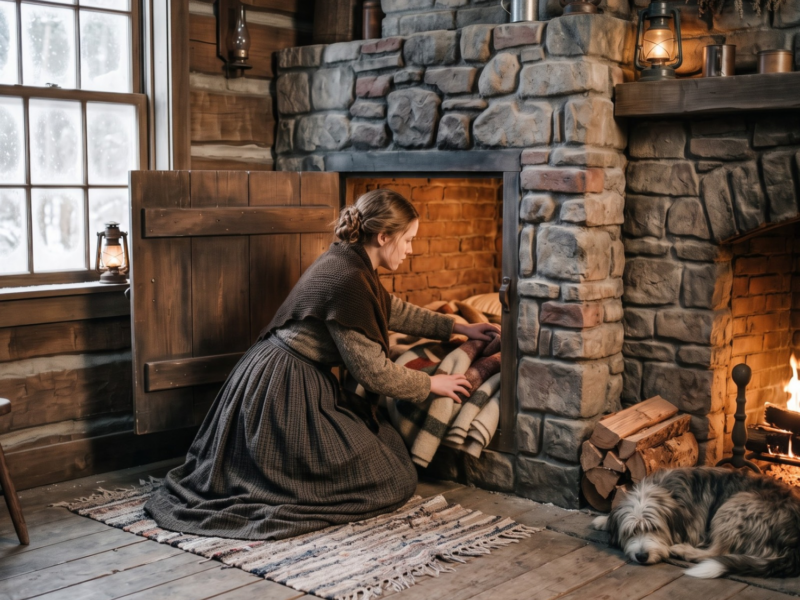
Her Cabin Had No Bedroom — But the Bed Hidden in Its Chimney Survived a 43°F Winter
The Inheritance of Stone
The thing did not stay in the valley. It traveled the way useful things travel once they have proved themselves: by word and by letter, and by the slow spread of people telling other people what had kept them alive.
A correspondent for the weekly paper down at the river settlement—a four-page sheet that ran mostly to grain prices and church notices—heard of it from his sister, who had built a simplified cupboard in her own cabin after a December cold snap, and had kept, in the way these women kept such things, a record of how it performed.
He came up the hill in the spring with a notebook of his own and sat at Ingred’s table and asked his questions, and the piece he wrote ran that April and named Mrs. Halverson of Birch Hollow. It was reprinted three weeks later in a larger paper, and from there in the Norwegian-language press that served the Scandinavian settlements from the lakes clear out to the territories.
By autumn, the design was turning up in homestead cabins across a stretch of country that had not yet seen the kind of winter that would teach it why. The papers called it an “innovation in winter sleeping,” which made Ingred smile in a tired way when she read it—the smile of a woman watching something older than anyone’s grandmother described as though it had arrived out of nowhere.
She did not write to correct them. She kept her notebook twice a day through that winter, and the ones that came after, building a record she was privately aware was the most thorough account of such a thing anywhere in that country. Though she would never have put it in those words, she continued to walk down to Thorson’s store once a week, and to break the trough ice morning and evening, and to read her father’s three sheets some evenings—not because she needed them, but because reading them was a way of sitting with the man who had carried her through the winter her mother died, and had reached across the years and the ocean to carry her through this one.
Lars Ecklan came to Birch Hollow in the summer to lead the building of the new schoolhouse, the settlement having grown at last large enough to want a building set aside for nothing but learning. He was a man of forty-one with hands that showed the whole history of the work they had done, and a way of looking at a thing a good while before he decided what he thought of it.
He had buried his wife four years before and had not remarried, and he had no particular expectation of it when he came north for a season’s work. He came to Ingred’s door in the autumn after the schoolhouse was finished and the first frost had come, with a proposal he had plainly turned over in his mind for some time.
He did not dress it up. He said he had watched her through the summer at the schoolhouse raising and at the harvest and at Sunday service, and he had come to understand that she was a person who valued what was true over what was merely pleasant, which suited his own way of thinking. He was not proposing sentiment. He said he was proposing a practical arrangement between two people who had each shown they could stand alone in a hard country and who might find that standing together let each of them do things they could not do apart.
She told him she would think on it.
She thought on it for three weeks with the same care she had once given to the proportions of a smoke channel, and she made no list, because the things that mattered here were not the kind that went into columns.
What she found when she looked at it honestly was that the life she had built on the hill was complete in everything a life required: it was warm, it was productive, it was sufficient. And sufficient, she understood, was not the same thing as full.
She had known the difference since the night she had written in her notebook that she did not feel alone, because that line had not described the satisfaction of a woman who had made herself adequate; it had described the feeling of one evening when something more than adequacy had reached her and she had recognized it at once, because the difference between the two was considerable.
She told him yes in November, in the same plain manner he had used to ask.
They were married the following spring in the small Lutheran church where she had once sat in her old pew and heard a sermon on the wise woman who builds her house, in the same churchyard where Margaret Ashford’s mouth had tightened against her. She wore the white dress, washed soft and careful for the day—the same dress that had gone gray with mortar dust on the scaffold and stiff with cold on the road down to the store.
And it struck more than one woman in the church that there was something fitting in that, though none of them could have said precisely what.
Most of the valley came, the Ashfords among them, with a gift of preserves and a courtesy that was real, if not entirely without effort. Margaret took Ingred’s hand after the ceremony and held it a moment, and said, choosing her words with the care of a woman who had learned the cost of careless ones: “You’ve built well.”
She did not say what she meant by it. She did not need to.
Epilogue: The Hearth in the Stone
Lars built a second cupboard that first winter on the north face of the chimney mass for guests, working from the plans she had drawn, asking after each decision as he went: Why was the floor raised the exact height it was raised? Why did the vent sit in the top corner of the door rather than the center?
She answered every question fully, because she had made each choice for a reason, and the reasons were still clear to her. When it was done, he climbed in and lay against the warm stone and said nothing for several minutes. And then he said, “Your father understood something important. He wrote it down.”
“That was the whole of it,” she said. “He understood it, and he wrote it down so that someone who came after could understand it, too.”
They had no children of their own. Some years on, an influenza moved through the Norwegian settlements and took Ingred’s sister and her sister’s husband within a week of each other, leaving behind a girl of nine named Sonia, who had her mother’s coloring and, as it turned out, her own particular stubbornness.
Ingred brought her north and raised her in the cabin on the hill, and the girl slept in the guest cupboard on the north face, which Lars had built as it happened with the slightly higher ceiling of a space meant to hold a growing child. Sonia grew up understanding the relation of stone and heat the way children understand the things they are raised inside of: not as a principle to be learned, but as a plain fact of the world, as settled as the fact that water runs downhill.
She had lost a great deal, and she had come to a house that had been built before she was ever thought of to keep what mattered from the cold, and it kept her, too.
Sonia grew, and in the way of children, left. She married a carpenter who had come to the region from the east, and she built two cupboards in the house they made together in the river town where the valley road met the main road to the settlement—one for each of the children she meant to have. And she had judged the number right. Those children grew up sleeping warm in a house in a river town, kept so by a thing their great-grandfather had set down on three sheets of paper, and their grandmother had carried up a hill in the worst of her grief, and proved twice a day for winter after winter in the columns of a small leather book that smelled by the end of nothing but paper and time.
Ingred lived in the cabin on the hill into her old age. The notebook went on, the hand growing slower over the decades, the pressure of the pencil lighter, the figures set down with a little more space between them, as though she had come to feel there was room now to be unhurried about it.
She outlived Lars by a few years, and when she went, it was in the deep of a winter, quietly, in the warm house she had built against exactly such a cold, with her sister’s grandchildren grown and warm in their own homes because of what she had kept alive.
The cabin stood after her. It passed through the hands that property passes through, and in time it came to a great-niece of the family, a woman named Ruth, who had grown up hearing the story of the chimney woman on the hill and was never quite sure how much of it was history and how much the kind of thing families tell about their remarkable dead.
Ruth gave the cabin and its parcel of land to the county historical society. Because she lived far off and had no use for it, and understood that a thing left to fall apart deserved better than falling apart, the society sent a man to look it over—a historian of the practical kind, more taken with how a thing had been built than with the dates that hung on it.
He spent three days in the cabin with a lamp and a notebook, and he found the great mass of the chimney sound, its baffled channel still clear, the coarse work of its inner stone still showing the exact careful hand that had laid it in a long-ago summer.
The cupboard on the south face stood whole. The feather tick and the quilt were long gone, but the pine walls held, and the moss in the front wall had settled without failing, and the copper pot still sat on its shelf with the grain of old copper on it, and no worse harm.
The small thermometer was still fixed inside the door, its column still legible: the plain surviving sign of a daily discipline that had outlasted the woman who kept it.
They opened the cabin to visitors the following summer. Beside the cupboard, they set a small panel explaining in words a stranger could follow how heat is stored in stone and given back slowly through a winter night. And beside that, a smaller plaque that carried a line from the notebook, from the page where she had recorded the worst morning of that first winter: The outside reading… the main room… the cupboard holding at 70 with the fire 9 hours banked. Slept the night through. Coffee good. Cows well.
And beneath those plain words, the single line she had added, smaller than the rest, in the old country speech with its English underneath: I do not feel alone.
The notebook itself they kept in the archive, in a box that held the light off it—its pages gone brittle and its ink faded to a soft brown that was still clear enough to read: winter after winter of readings, twice a day through every one of them, a record built the way she had built everything, a little at a time, without hurry and without any witness but herself.
In the summers when visitors came, the guide would sometimes take them into the cabin and light a small fire in the stove the society had put back, and let it burn an hour, and then open the cupboard door and ask them to lay a hand against the stone at the back of it.
The stone was always warm.
The visitors were always surprised, though the panel had told them and the plaque had told them, and there was nothing in it that was hard to understand—because being told a thing is not the same as knowing it, and knowing it in words is a different matter from knowing it in the flat of your own hand pressed against stone that has taken in heat and is holding it with the patience stone has always brought to the keeping of warm things.
A woman had built it alone in a single summer out of grief and three sheets of paper, while a whole valley told her she was digging her own grave. She had tested it through the hardest winter any of them had known. And she had opened its door to a cold child when the time came, and the knowledge in it had traveled out past the valley and past her own life into houses full of people who would never know her name, keeping them warm through winters they had not yet learned to fear.
The visitors held their palms to the back wall of the cupboard and felt it: the slow, steady giving back of something that had been given warmth and was returning it in its own time.
And somewhere behind the plain stone, the thing a girl of seven had once believed was still true. The world had found a way, in the only language stone knew, to say that it was sorry, and to keep on saying it, warm against the hand, long after everyone who built the walls had gone.









