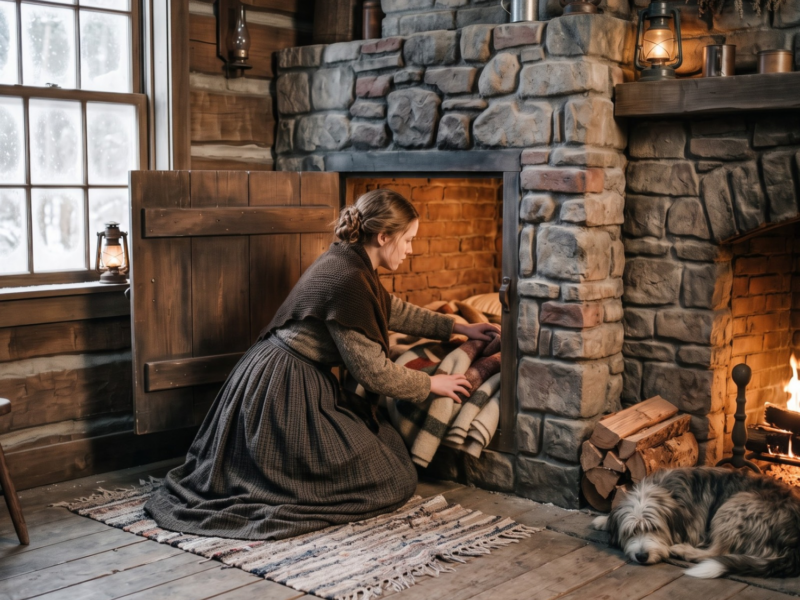
Her Cabin Had No Bedroom — But the Bed Hidden in Its Chimney Survived a 43°F Winter
The Blueprint of Stone
The following Tuesday morning, Ingred walked into Thorson’s general store with a list written in a careful schoolhouse hand on a folded piece of brown paper.
The bell above the door rang as she came in. Elias Thorson looked up from his ledger over the rim of his spectacles, and something moved across his face when he saw her—something she was too tired to name, but thought might have been relief. He had known Anders well. He had wept at the funeral, which she had registered from a great distance, the way one registers things when one’s own weather has closed over entirely.
She set the list on the counter. He read it without picking it up: Fire clay mortar. Mason’s line. A six-pound Mason’s hammer.
He read it a second time, then looked at her with the patience of a man who had learned over sixty-seven years that most questions were better answered by watching than by asking. “You’re planning to build something, Mrs. Halverson.”
“I’m planning to rebuild my chimney.”
He let that sit between them a moment. “That chimney went up two summers back. Anders laid it himself. Draws clean, far as I ever heard.”
“It does.” She did not offer anything more.
He studied her a while longer, then went to fetch the mortar and the lime from the back. When he had weighed it out and named the price, she paid him in coin counted to the exact penny—the way she had always paid—and walked out into the May afternoon without explaining herself to anyone.
He stood in the doorway and watched her load the sacks into her wagon, and he did not shake his head until she was well down the road.
The following Sunday, three women from the valley walked up the hill to see for themselves what the widow Halverson was doing. They found her on a borrowed scaffold of two saw-horses and three planks, taking the chimney apart from the outside, one stone at a time. Each stone she lifted free, she set on a sheet of canvas spread across the ground, arranged in a pattern that matched exactly the place it had held in the wall. She had made a sketch on the back of a flower sack, mapping the location of every stone, and she consulted it before setting each one down.
When one of the women asked her why, she wiped mortar dust from her cheek with the back of her wrist and said only that the chimney needed to do more work than it had been doing, and that more work required a different shape.
The women went back down the hill. By evening, the report had reached the men over their pipes, and they agreed among themselves that grief did strange things to a woman with no one left to steady her hand.
Act II: The Anatomy of a Hearth
Chapter 4: The Model in the Dark
What she was building had no name in the valley, because none of them had grown up where she had grown up.
She worked through June and July. The labor was not beyond her, for she had laid stone before alongside Anders when they built the first chimney. But the scale of this was larger than anything she had attempted, and the precision it demanded was greater. She mixed the fire clay mortar in small batches to keep it workable, and tested each batch on a scrap of fieldstone before she trusted it to the wall.
She built from the base upward, widening the firebox first, then raising the great mass of the chimney outward from the original core, keying the new stone to the old every third course so the whole would stand as one structure rather than two leaning against each other. By the end of July, the chimney had grown from a square stack two feet on a side into something her neighbors could not find a word for when they passed on the road.
It stood against the south wall of the main room like a feature of the landscape: a broad, uneven mass of stone, six feet wide across its southern face and still two feet at its narrowest, solid all through except for the firebox, the long baffled channel she had built to force the hot smoke on a winding path through the masonry before it reached the open flue, and the hollow she had left in the south face at the exact height and dimension her father’s notes described.
That hollow would become the sleeping cupboard. The eighteen inches of solid stone between the smoke channel and the hollow would become what she thought of as the battery: the mass that would take in the heat of every fire she built and give it back slowly, patiently across the long, dark hours of the night.
She did not hurry the drawing of it. One evening in June, before she committed a single joint of it to stone, she built a small model on the trestle table from kindling sticks and tubes of rolled birch bark. She set a burning sliver of pine resin at the model’s little firebox and watched where the smoke went, adjusting the proportions over three nights by candlelight.
Her father had written one line in the margin that kept her awake: Get the baffle wrong, and the chimney smokes back into the room. Get it badly wrong, and it will not draw at all on a still night.
And when at last the smoke moved through the baffled passages the way the notes said it should—curling through the channels, leaving its heat behind, and rising clean from the model’s flue without a trace of backdraft—she held the burning sliver there a long time, watching, making certain the behavior was true and not an accident of the evening air. Only then did she draw the design to scale on the back of an envelope. Only then did she begin to lay it in stone.









