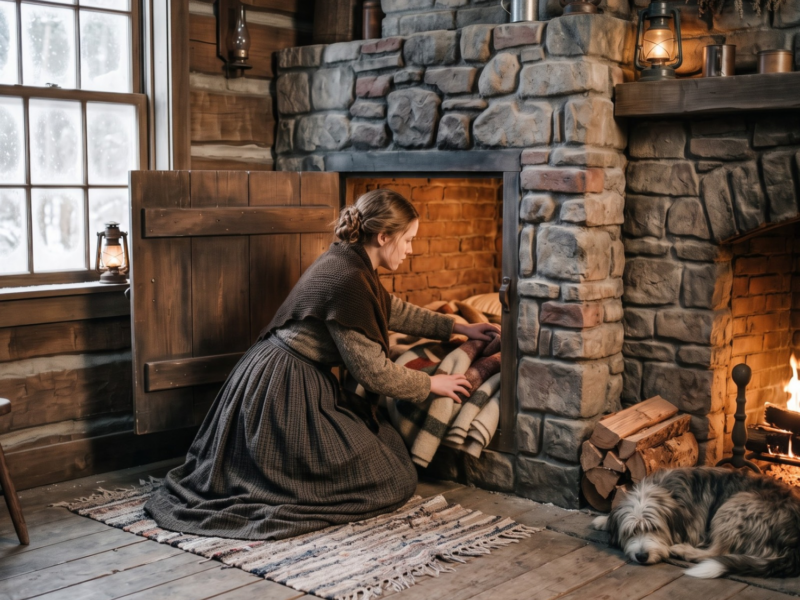
Her Cabin Had No Bedroom — But the Bed Hidden in Its Chimney Survived a 43°F Winter
The Iron Drop
The sign she had been watching for came in the first days of January, and it came the way she had feared, without a storm to carry the blame.
The temperature fell seventeen degrees between one evening and the next, which was not in itself a thing to remark on in a Dakota January. What stopped her standing at the north window with the lamp in her hand was that it kept falling, and there was nothing attached to it: no wind, no wall of cloud moving down from the north, no blizzard a person could point to in a letter and say this was the thing that did it.
The cold simply descended the way night descends, without announcement and without the courtesy of a single visible cause.
By the second evening, the thermometer outside her window read twenty-six below, and the air had taken on a quality she knew only from her father’s descriptions of the worst winters in the high country: a stillness so complete that sound carried farther than it had any right to, as if the cold had stripped the air of everything but its power to carry noise.
She did not waste the hours she had. She fed and watered the stock before dark because animals left undone on a night like the one coming would be worse than undone by morning. She broke the trough ice with the iron bar and carried four extra armloads of split oak in from the pile, stacking them near the stove where they would be dry and ready.
She filled every vessel she owned with water from the well while the well would still give it, knowing the rope could freeze in the shaft before the night was out. Then she cooked a pot of barley soup and ate it slowly at the table, and she did not read her father’s notes because she no longer needed them. She had become the thing they described.
The valley was not so ready.
What settled over Birch Hollow in those days was not a storm, and that was the heart of why it did so much harm. A storm was a thing people knew how to fear; they had words for a blizzard, for an ice storm, for the three-day cold snaps that blew in each February and broke when the west wind returned.
This had no name in their experience. It was a mass of frozen air the size of half a continent that had broken loose from wherever such things are born, come south, and simply stopped with a steadiness that suggested it had no intention of moving on.
By the fourth morning, the frost on the inside of Thorson’s front window had grown three inches thick, and he had given up heating the front of the store and retreated to the small back room with his stove and his dog and most of his blankets, wedging a rolled rug against the gap beneath the door and plugging the keyhole with a cork. He read by lamplight until the oil ran low, then trimmed the wick and read some more.
And when he went to check the thermometer through his one small window, he found a clean crack running corner to corner across the glass, opened by nothing but the difference between the warmth at his back and the killing cold an inch away.









