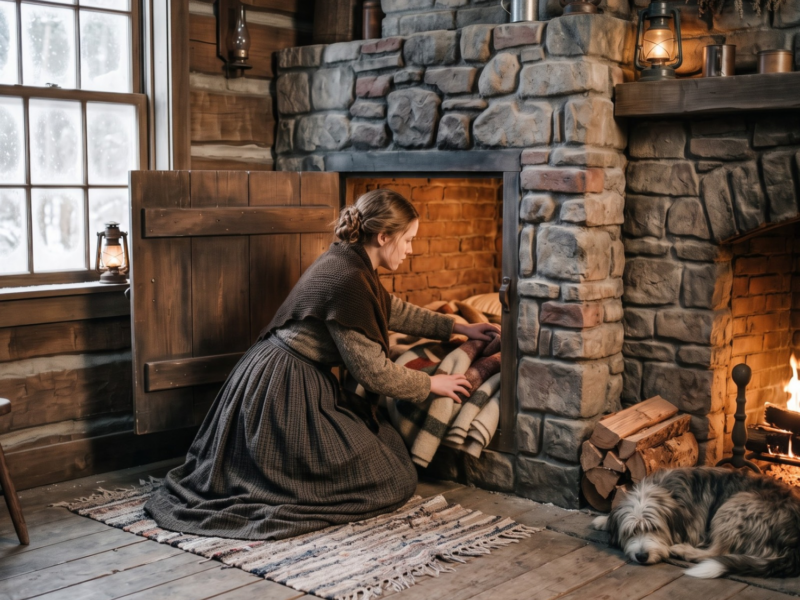
Her Cabin Had No Bedroom — But the Bed Hidden in Its Chimney Survived a 43°F Winter
The Wooden Box
Elias Thorson came up the hill in the first week of July with a basket under a cloth: cold ham, dark bread, a stoneware jug of small beer. He sat at the trestle table and ate with her, watching through the open door as she worked between bites. And he asked her almost nothing, because he was a man who trusted his eyes above his tongue.
His face moved through puzzlement and something near concern, and settled at last into a careful, respectful uncertainty. He left shaking his head, but he came back three weeks later with a second basket. And that time when he left, he did not shake his head, and she marked the difference without saying so.
The framing of the cupboard itself took most of August. She used clear pine she had bought the winter before from a water-driven mill two valleys east, choosing the boards for straight grain and close growth rings. Setting aside any piece with a knot or a check in it, she joined the boards tongue-and-groove, tapping each seam home with a wooden mallet and testing the fit by trying to slide a dry straw between the mated faces.
No straw passed.
The floor of the cupboard she raised a hand’s width above the floor of the main room, and into that gap she packed pine shavings mixed with dry oak leaves, pressing them firm enough to break the cold draw from below, but not so tight that they would hold damp and rot. She had seen floor rot before. She did not intend to live with it.
The ceiling she set low, deliberately—low enough that she had to stoop to enter. Once inside, she could sit up against the pillows, but not stand, and that was all she needed. Every inch of height above her was air that would have to be heated, air that would rise and press uselessly against the boards. She had fought enough Dakota winters to understand that warmth, like everything else worth keeping, was a matter of not wasting what little a person had.
The front wall was the most complicated surface in the whole construction, and she built it in two passes. First, she nailed up an inner layer of pine boards, shimmed out from the stone with small wooden blocks to leave a hollow two inches deep. Then, she went down to the bog at the foot of the hill where the sphagnum moss grew in dense cushions of rust and green over a patch of wet ground the size of a barn floor.
Her father had written that dry moss traps still air, and that still air does not carry heat away the way moving air does, which was why a down coat kept a man warm and a soaked coat of the same weight did not. She gathered the moss in bushel baskets over three days, carrying it up the hill on her back, and spread it on racks in the warm attic to cure for six weeks, turning it until it crumbled dry between her fingers and smelled of nothing but earth.
Then she packed it into the hollow of the front wall by the handful, tamping it gently with a dowel, working from the floor upward, keeping it light enough to hold its pockets of air and dense enough that it would never settle into a gap at the top. When the cavity was full, she nailed the outer boards over it and fixed a strip of muslin across the top to hold the moss in place.
The door gave her more trouble than any other part. It had to be heavy enough to seal, simple enough to work in the dark, and strong enough to hold against the slight pressure the warmed air would build inside. She sketched three versions before she settled on the one she built: double-planked like the front wall, the hollow between layers filled with wool cut from worn-out blankets, hung on three iron hinges she got from the blacksmith down at the river settlement in trade for two laying hens and a setting of eggs.
The inner face she padded with a heavy quilt so that no air passed around its edges when it closed. The latch was a single smooth wooden peg that turned from the inside, and she practiced finding it in the dark until her hand knew the motion without thought.
In the upper corner, she cut a small adjustable vent—two inches by six—which she could open to let fresh air in from the main room or close to seal the cupboard entirely. A sleeping space with no air was a danger; a sleeping space with too much was merely cold. The vent was the answer her father’s notes had given, and it was the answer she used.









