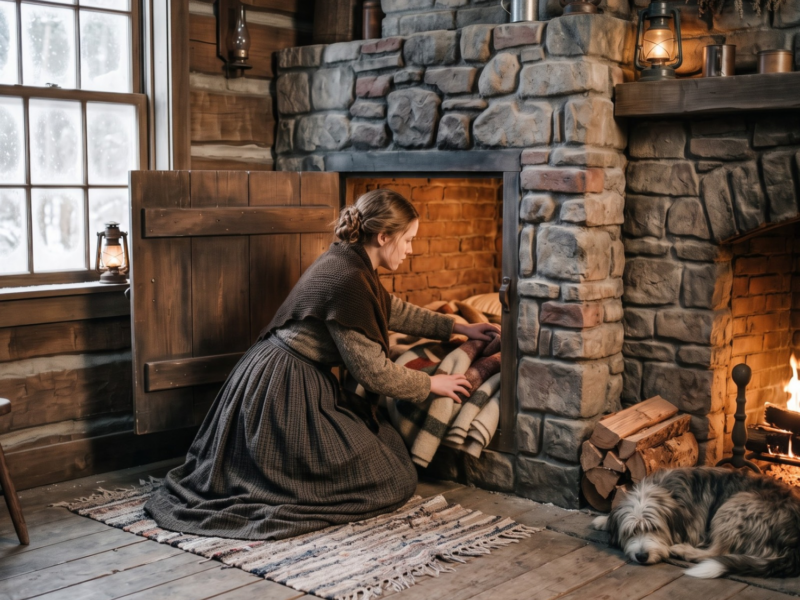
Her Cabin Had No Bedroom — But the Bed Hidden in Its Chimney Survived a 43°F Winter
The Visitor in the Gray Dress
The thing did not stay in the valley. It traveled the way useful things travel once they have proved themselves: by word and by letter, and by the slow spread of people telling other people what had kept them alive.
Margaret Ashford came on the eleventh day, driving her own buggy up the hill on a hard, bright morning. She came alone, without a driver or an escort, wearing a dark gray dress of good wool with a heavy cloak over it.
She tied her horse at the rail and knocked on Ingred’s door the way a person knocks who has decided to do a difficult thing and does not intend to let herself off it.
Ingred opened the door and found her there—the woman whose tightened mouth in the churchyard had set the whole valley to laughing, standing now on her doorstep with the wind off the snow pulling at her cloak and her chin held level in a way that cost her something.
For a moment neither of them spoke. Then Margaret said what she had plainly come to say, and she said it plainly, which Ingred had not expected, and which she respected more than any softer thing the woman could have offered:
“I said a foolish thing to you in October,” Margaret told her in front of everyone, her voice tight. “I was a woman talking about a thing she knew nothing about, and I made certain everyone heard me do it.”
She stopped, and the wind filled the pause, and she went on. “I’ve come up to look at what you built, if you’ll let me. I spent three nights this month on my own kitchen floor with my children in the finest house in this valley, and I lay there knowing you were up on this hill sleeping warm, and I could not stop thinking about it.”
Ingred stepped back and let her in. She did not make Margaret pay for the churchyard, because she had never been a woman who kept accounts of that kind. And because the walking up the hill alone had been payment enough for anyone with eyes to see it.
She showed her the firebox and the great mass of the stone, and the cupboard set into its warm south face. And she opened the door and let Margaret feel the heat that came out of it. And she answered the questions Margaret asked—which were better questions than Ingred had expected, the questions of a woman who ran a large household and understood more about keeping people warm and fed through a winter than her comfortable circumstances had ever been given credit for.
They sat at the trestle table afterward with coffee. And Margaret turned her cup in her hands and said, looking at it rather than at Ingred, that her husband had lost three head of cattle in the barn during the worst of it—the oldest cows, the ones that had stood nearest the outer wall, where the cold came through the foundation stone before morning.
Edward had not told it around the valley, and was not likely to, because Edward Ashford had built his whole picture of himself on being a man whose preparations were always enough. And the three cows were a hole in that picture he did not know how to carry.
Margaret told it to Ingred without drama—the way a person lays down a weight she has been carrying alone. And Ingred understood that she was being trusted with something, and that the trust was itself a kind of apology larger than the words on the doorstep had been.
“You built the only house in Birch Hollow that didn’t lose something this month,” Margaret said. “And we spent the autumn calling it a coffin.”
“It isn’t about the house,” Ingred set down her cup. “My father wrote these things down on three sheets of paper before I was old enough to understand them, because his father had shown him, and his father before that. People in cold country knew how to do this for hundreds of years. The only strange thing is that we came here and forgot it.”
She looked toward the window where the snow lay bright and hard over the valley that had laughed at her. “What gets lost when people cross an ocean isn’t the language or the hymns. Those we hold on to; we teach them to the children on purpose. What gets lost is the quiet knowledge—the kind that lives in a person’s hands, the kind that doesn’t know it’s worth anything, so nobody thinks to carry it across.”
Margaret was quiet a while, then she asked, the way Hannah and Peter had asked before her, whether a simpler version might be built against a chimney already standing. And Ingred wrote out for her on the back of an envelope the measurements and the materials, and the three sheets’ worth of her father’s thinking, reduced to what a carpenter could follow.
Margaret folded the envelope into her glove and thanked her and drove back down the hill. And she did not build her cupboard that winter, because Edward was not yet in a place where he could abide a second admission that his house had failed where the widow’s had held. But by the following summer, there was lumber delivered to the Ashford place for what Edward described to anyone who asked as a small storage closet he was adding off the kitchen.
And the people of Birch Hollow, who were not fools, accepted the description with the tact of a community that has learned when to let a man keep a fiction that harms no one.









