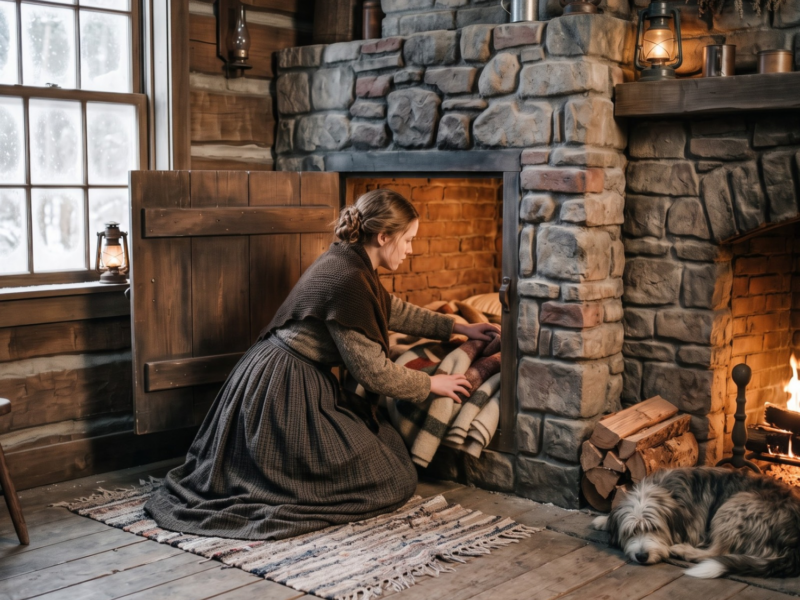
Her Cabin Had No Bedroom — But the Bed Hidden in Its Chimney Survived a 43°F Winter
The Unseen Ledger
On the hill above all of it, Ingred kept her columns.
She was not untouched by the nine days, and she did not pretend to herself that she was. She could see the smoke from the valley farms, or the gaps where it thinned too low. And on the still air she could hear things that carried too far: the distressed lowing of cattle, the sound of an axe that started too early and stopped too soon and did not take up again.
She did not go down. She had wood and food. Her cows gave milk and her hens still laid. And a woman walking the frozen road in that air would have spent herself to no purpose that a man with a horse could not have served faster and safer.
She stayed where she was useful, which was alive, inside the thing she had built.
Her readings in those days carried a weight the autumn figures never had. On the morning of the worst of the cold, the thermometer outside the north window stood at 42 below. The main room at 19 above with the stove going steadily, and the cupboard at 69.
The next morning was colder still: 43 below outside, and the cupboard holding at 71. And she sat a moment over that entry with the pencil in her hand.
71 inside, 43 below without.
The two numbers were separated by eighteen inches of stone.
She knew the physics of it. She had tested it with a sliver of burning pine on her own table. But knowing why a thing was true did not lessen the strangeness of living inside the truth of it. Warm enough to sleep under a single quilt while a mile down the road a young man held his shaking wife on the floor, and a mother sat up listening to her son breathe.
She had made one change as the cold deepened past even what she had planned for: she stopped letting the cook stove go cold through the night. Even eighteen inches of charged stone could not carry the cupboard through twelve full hours at more than forty below. And she had learned this not by calculation, but by waking one night to find the reading had slipped to 62—which was not dangerous, but was a number she did not care for.
So she rose twice in the dark, at midnight and again near four, crossing the eight steps of frigid floor to the stove, feeding it two split lengths of seasoned oak each time, and setting the damper low for a slow burn, then returning to the warmth before it could leave her.
The whole of it took less than three minutes, and in those three minutes the cupboard gave up perhaps two degrees, which it had made back before she slept again. Not once in the nine days did it fall below 65.
She wrote that down, too, because the writing of it was the work, as much as the laying of the stone had been.
On the morning the cold reached its deepest, she set down the three readings in the same even hand she had kept since October. And beneath them she wrote a short, plain line, the way a farmer notes a thing to remember: Slept the night through. Coffee good. Cows well.
Then she paused the pencil above the page, because what she felt did not fit the practical shorthand she had been keeping, and she was not certain she wanted to make it permanent. After a moment, she wrote one more line in Norwegian, smaller than her usual hand, the way a person writes a thing meant only for herself:
Jeg føler meg ikke alene. (I do not feel alone.)
She capped the pencil and set the notebook on the shelf.
Act V: The Thaw and the Inheritance
Chapter 16: The Break in the Ice
The cold held the next day and the day after, without mercy and without change. And then, on the sixth morning, it eased by a few degrees—which meant nothing by any sensible measure of the winter, yet felt to every soul in the valley who checked a thermometer that morning like the first sign that the thing was mortal, that it would end, that the world had not reorganized itself permanently around this temperature.
The true break came on the seventh day, when a gray softness moved in from the southwest, carrying with it a wind off the river that had moisture in it—the first the air had held in more than a week. By noon, the reading at Thorson’s store stood at nine below, and to every person who stepped out into it that afternoon, nine below felt like the air of a kinder season.
The nine days were over.
Ingred wrote the last of the hard figures, closed the notebook, and looked at the stove she had not let go cold in more than a week, and at the cupboard door set into the warm south face of the stone. And at the main room of her cabin, with everything in it exactly where it had stood on the first morning of the cold: nothing broken, nothing frozen that should not have been.
She dressed to go out, pulling her coat and her shawl over the white dress gone soft and gray with the winter’s wear, and she took up the basket of eggs she had been gathering all through the cold—more than she could use, because she knew, without quite being able to say, how that Elias Thorson would have need of something brought to him this morning.
The road down was drifted in places where the thin wind of the colder nights had moved the surface snow, and she walked around the drifts or through them, and the two miles took the better part of an hour. She pushed open the door of the store and the bell rang into a space she had half expected to find empty, or to find him huddled still in the back in his layered state of survival.
But he was behind the counter, dressed, his spectacles on and a ledger open before him, though he did not appear to be reading it. When he saw her come through the door, something happened to his face that she had not seen there before in all the months she had been watching it.
He made no sound. He stood very still a moment, then took off his spectacles and set them on the ledger, and pressed the back of one hand against his mouth, and his eyes were wet in a way he plainly had not expected, and was doing his best to manage without making anything of it.
She set the basket on the counter. “I’m sorry,” she said. “I didn’t mean to worry you.”
He put the spectacles back on. When he spoke, his voice was smaller than his usual voice, but it did not shake. “You didn’t worry me for one minute. Not one. A woman who built what you built knew exactly what she was doing.”
He looked at her across the counter—this old man who had never once laughed at her, who had climbed into her cupboard with his bad knees and come out speaking the language of his childhood, who had stood at the same store and spent his own good name to buy her a little quiet.
“I told them so.”
She knew it for the generous fiction it was. He had sat in his back room with his dog and his cracked window and worried for her through every one of those nights, the way a person worries for someone they cannot reach and cannot help. But she took the fiction in the spirit it was offered, because she had learned that winter that the world holds a small number of people whose kindness is built into them rather than put on for the occasion—not a thing they do, but a thing they are.
And that the only right answer to such kindness is to let it stand.









