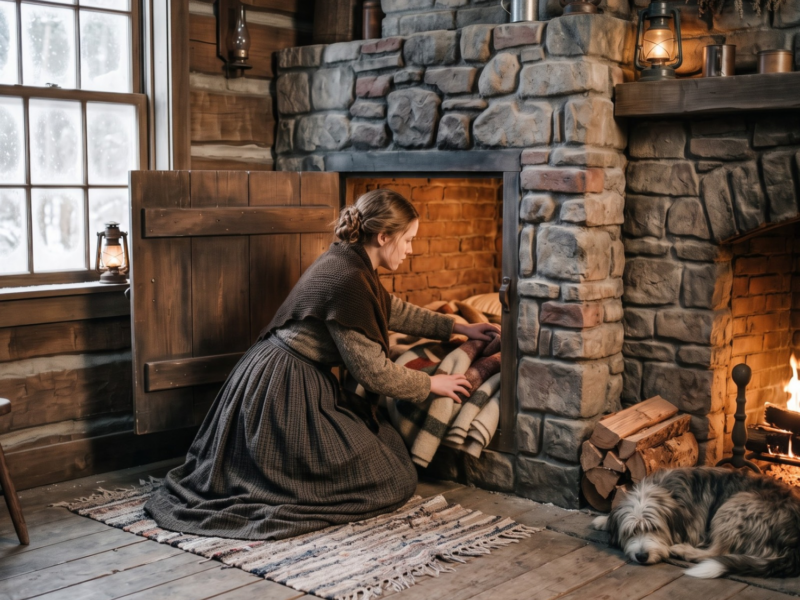
Her Cabin Had No Bedroom — But the Bed Hidden in Its Chimney Survived a 43°F Winter
The Weight of the Notebook
Ingred heard all of it. News traveled up the hill the way it traveled everywhere else.
She heard the names and the joke about the burial and the verdict Caleb Harmon had delivered on the question of whether she would live until spring. She found his pronouncement on the bad air especially instructive, because she had spent more hours thinking about the draft of her chimney than Caleb Harmon had spent thinking about anything in his life.
She knew from her father’s notes and from her own testing with the burning pine exactly why the cupboard would not fill with smoke and would not gather the killing air. The smoke channel was built to draw air out of the cupboard toward the fire, not the other way. She had tested it. She had proof.
She did not share the proof with anyone, because to share it would have meant explaining it. And to explain it would have meant they had to be willing to listen. And not one of them was listening.
So she did the only thing that had ever answered a hard question for her: she kept the notebook open on the table with a sharpened pencil laid across the spine. And twice each day—at 6:00 in the morning and 9:00 at night—she wrote down the readings from all three thermometers: the one outside the north window, shielded from the sun; the one on the main room wall; the one inside the cupboard door at the height of her head when she lay down.
The last week of October brought the first hard nights, with the outside reading dropping to 15 degrees. Fifteen outside, 52 in the main room, 68 in the cupboard. She read those numbers each morning and wrote them down.
And for the first time since she had stood at the grave under the burr oak with the spring mud cold beneath her boots, she felt something returned to her that she could only call her own competence. Not pride, exactly—she was too much her father’s daughter for pride of the kind the Americans meant. It was the quieter satisfaction of a person who has made a thing that works the way it was meant to work, under conditions that reveal whether it works or does not.
She knew the valley did not see it that way. She knew the names had not stopped, that behind closed doors, she was still the strange widow who slept in her own grave. She had made peace, or something near it, with being misunderstood. What she had not made peace with was the quality of the air.
She had begun to notice it in early November. The cold came on without a storm to announce it, settling over the valley the way darkness settles, without wind, without any of the drama a person could put into a letter to relatives in a warmer place. The smoke from the Ashford farmhouse rose dead straight on mornings when it ought to have drifted west. The animals grew restless in ways that had nothing to do with hunger.
She had learned to read such signs from her father, who had read them from his, and everything she read told her: the winter gathering itself to the north was not an ordinary one. It was not the kind of winter the valley knew how to survive by habit and goodwill.
She could not say this to anyone. The people who would not believe her about a chimney were not going to believe her about the sky.
So she carried the knowledge alone, the way she had carried the notes across the ocean, and she made what preparations she could. She brought in extra wood and stacked it close to the stove. She broke the ice on the cow’s trough morning and evening with the iron bar she kept by the barn. She stopped letting the cook stove go cold during the day, feeding it steadily so the great stone mass at her back stayed charged with heat against whatever was coming.
One evening in the middle of November, she climbed into the cupboard and lay against the warm stone, and took up the notebook that has become her one steady companion through the long autumn. The copper pot of water she kept on the shelf at the foot of the bed showed no skin of ice. The thermometer on the inside of the door read 67. Outside, the one nailed to the north wall read 11 above zero.
She did not feel triumphant. She felt the way a person feels who has built with great care and in the face of plain discouragement the exact shelter the coming weather will demand, and who understands lying inside it that the shelter is ready even if the weather has not yet arrived to prove it.
Act III: The Iron Month
Chapter 9: The Deepening Silence
The talk did not soften the way she had half-hoped it might once the work was plainly finished and standing. If anything, it hardened, because a thing completed could be judged, and Caleb Harmon had made the judgment the whole valley seemed content to repeat.
The older men who knew better kept their counsel, and their silence was its own kind of verdict. A man who said nothing in a room where a wrong thing was being said had chosen a side, whatever he told himself afterward, and Ingred understood that the very ones who understood her chimney best had decided their standing among their neighbors was worth more than her name.
She did not resent them for it, or told herself she did not. Resentment was a fire that asked to be fed, and she had other fires to tend. What she felt instead was a kind of clarified solitude: the understanding that whatever came to her that winter would come to her alone, and that she had already made her peace with aloneness in March, beside the burr oak, with the mud cold through her boots.
She gave them nothing to argue with. She did not walk down the wagon road to defend herself. She did not stand in the churchyard and explain the draft of a smoke channel to women who had already decided she was touched by grief.
She kept the notebook, and she let the numbers answer the question in their own slow time—the way her father had taught her that numbers answer every honest question, if a person is patient enough to write them down and wait.
By the second week of November, the readings had begun to tell a story even she had not entirely expected. The mornings came in colder—four and five above zero—and still the cupboard held its warmth through the night with only the banked stove to feed it. She wrote each pair of figures in the careful column she had ruled, and beneath them, some mornings, a single word about the weather: clear, still, no wind.
The stillness troubled her more than the cold would have. Cold a person could prepare for; stillness of that particular depth was a sign of something larger settling into place, and she had read enough of her father’s weather in his notes to distrust a sky that would not move.
It was in the third week of the month that Elias Thorson came up the hill a second time that season on a weekday, when the mud of the wagon road had long since frozen hard as iron under the wheels.
She let him in without ceremony and set coffee to boil. And she watched him stand in the middle of her main room and look at what she had built—the way a man looks at a thing he cannot quite place, as though it reminded him of something he had lost the word for.
“You finished it,” he said.
In October, she had crossed to the great mass of the chimney and laid her hand against the stone of the south face below the cupboard door where the heat of the day’s cooking fire had soaked outward through the masonry. She saw his fingers register the warmth and go still. He drew the hand back slowly.
“I’d like to see inside if you’ll allow it.”
She opened the door and held the lamp so the light fell into the space across the feather tick and the wool-padded walls and the small shelf at the foot with its copper pot. He bent to look, and then, at her nod, he lowered himself in with the care of a man of sixty-seven whose knees had their own opinions about the matter.
She pulled the door most of the way closed behind him, leaving the vent open, and she waited. He was inside four minutes. When he climbed out, he stood a moment with one hand resting on the warm pine of the doorframe, and his face had done something she had not braced for—a thing that moved across it quickly before he mastered it and arranged his features into the look of a man inspecting good workmanship.
When he spoke at last, it was not in English, which he always used in the store, but in Norwegian, the old country speech he kept for the things that lived underneath his American life:
“This is how my mother’s mother slept.”
He said it quietly, more to the stone than to her. “I had forgotten.”
She heard in those few words the whole distance the man had traveled: the length of an ocean and forty years, and the particular quality of a forgetting that happens not because a thing is painful, but because the new country has no place to put it, and so it slides out of the mind like water off cold stone. He had crossed as a young man and built in the American way with American lumber because that was what a man did. And somewhere in the building, he had let go of a room he had slept in as a boy without ever knowing he was letting it go.
He did not stay long after that. He drank his coffee at the trestle table and asked her several quiet, exact questions about the keying of the stone at the joints, about the depth of the moss in the front wall, about how she had sized the baffles so the smoke would draw instead of backing into the room. They were the questions of a man who understood what he was looking at. And she answered them plainly, one builder to another, and something in the room eased that had not eased in a long while.
For the space of that coffee, she was not the touched widow on the hill. She was a woman who had built a sound thing, talking to a man who knew how to see it.









