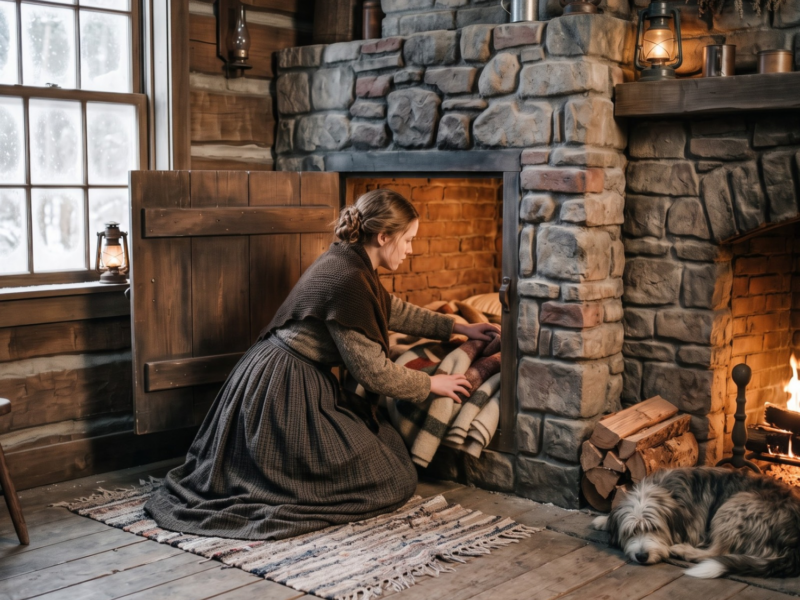
Her Cabin Had No Bedroom — But the Bed Hidden in Its Chimney Survived a 43°F Winter
The First Trial in the Dark
By the second week of October, the mortar had fully cured, the moss was packed, the door was hung.
On a cool evening, she built a fire in the cook stove and fed it steadily for four hours to drive as much heat as she could into the great mass of the chimney. Then she banked it to coals. She lit the small oil lamp on the corner shelf, pulled off her boots, and climbed in.
The space was exactly as she had drawn it. She lay down on the feather tick, and through the thin pine of the rear wall, she felt the stone against her shoulder: warm the way a hearthstone is warm an hour after the supper fire has gone down. Not hot. Warm the way the earth around the roots of an old tree is warm when you press your hand to it at dusk.
After a long afternoon of work, she took her father’s notes from her pocket and read them by lamplight. Not because she needed to, but because she wanted to read them here, lying against the wall they had helped her raise, with the heat of stone she had laid with her own hands pressing gently at her back.
After a while, she set the papers on the shelf, blew out the lamp, and slept until dawn.
When she woke, the fire had been out for nine hours. She laid her palm flat against the rear wall, and the stone was still warm. She lay there a moment in the dark, her hand on the stone, and something settled in her chest that had not been settled since March. It was not happiness—she was too recently widowed and too tired for that to be the right word. It was something quieter: the particular steadiness of a person who has staked everything on a single calculation, and discovered in the dark that the numbers held.
She dressed, opened the door, and stepped out into the main room. The thermometer on the wall read 41 degrees. She had hung a second one inside the cupboard door, and before she closed it, she checked the reading: 64. More than twenty degrees of difference, with the fire nine hours dead and the air outside sitting at 28.
She wrote both numbers in the small leather notebook she had used as a girl to record the butter yields, and she started a fresh page for the season that was coming.
Act II: The Silence of Birch Hollow
Chapter 7: The Churchyard Verdict
The mockery began the following Sunday.
She had not gone to church since the funeral, but she had decided, for reasons she did not examine too closely, that the time for that kind of hiding was finished. She walked the two miles down the wagon road in a clean white dress and a gray knitted shawl, and took her old place on the women’s side of the aisle. The building smelled of candle wax and damp wool.
Pastor Halverson preached on the passage from Proverbs about the wise woman who builds her house, and whether that was chance or intention, Ingred never learned, and decided in the end it did not matter.
Afterward, in the churchyard, with the maple leaves going gold against a sky of pale October blue, she stood among the women of the valley for the first time in seven months. The silence that formed around her was its own kind of speech—not hostile and not warm, but sharply aware of her, the way a room becomes aware of a thing that has shifted position without announcing itself.
Greta Harmon, young and newly married, in a faded blue dress with a practical apron, asked how she was managing, and Ingred said she was managing well, that she had finished the work on the cabin in time for winter.
Greta asked what work, and there Ingred hesitated, because she had not yet found a way to say the thing that would carry cleanly from what it was to what her neighbors could picture. She said she had built a sleeping place inside the chimney wall.
Greta did not understand. She said it was a cupboard of the kind her grandmother had slept in back in the old country.
Greta still did not understand.
It was Margaret Ashford who put it into words. Margaret, whose husband owned the largest farm in the valley, who had been the center of the Norwegian community since the Ashfords arrived with money enough to raise a proper two-story house, stood in a dress of dark burgundy wool with a small gold brooch at her throat. And she asked the question directly, in English rather than Norwegian, so that everyone in the yard would hear it:
“Are you telling us you sleep inside your fireplace?”
“Inside the chimney wall,” Ingred said. “There is almost always a small fire banked low in the stove through the night. The stone holds the warmth and gives it back.”
Margaret did not laugh. She was a respectable woman, and one did not laugh in a churchyard. But the corners of her mouth drew tight in a particular way, and every woman standing there understood exactly what it meant.
Within four days, the story had reached every farmhouse along the road, and the names came quickly with the creative energy small places turn against anything they find strange: The Coffin. The Widow’s Drawer. The Roasting Box.
Edward Ashford produced a joke at Thorson’s store about how the widow on the hill had decided to begin her own burial early to spare the trouble later, and several of the men laughed. But it was Caleb Harmon who did more than laugh.
Caleb was twenty-two that autumn, broad through the shoulders from work he had done since boyhood, and sure of himself in the way of a young man who had not yet been wrong about anything in a way that cost him. He stood in the store that Saturday and announced to his elders that anyone with the least understanding of how a chimney worked could see the design was a death trap. The bad air from the stove would seep through the masonry and take the woman in her sleep. The cupboard would fill with smoke the first night a west wind blew down the flue. The whole thing was certain to end badly, and he, for one, would not pretend otherwise to be polite.
The older men in the store that afternoon knew better. They had seen stonework Caleb had never seen, had lived through winters Caleb had not yet learned to imagine. But the room had settled into a particular shape over the past weeks, and the shape of it said that to question Caleb Harmon on this matter was to defend the widow Halverson. And defending the widow Halverson had become a position a man in Birch Hollow did not take up lightly.
So the older men held their peace, and Caleb’s certainty went unchallenged, and he walked out of the store with the easy satisfaction of a man who has said an obvious true thing in front of his neighbors.









