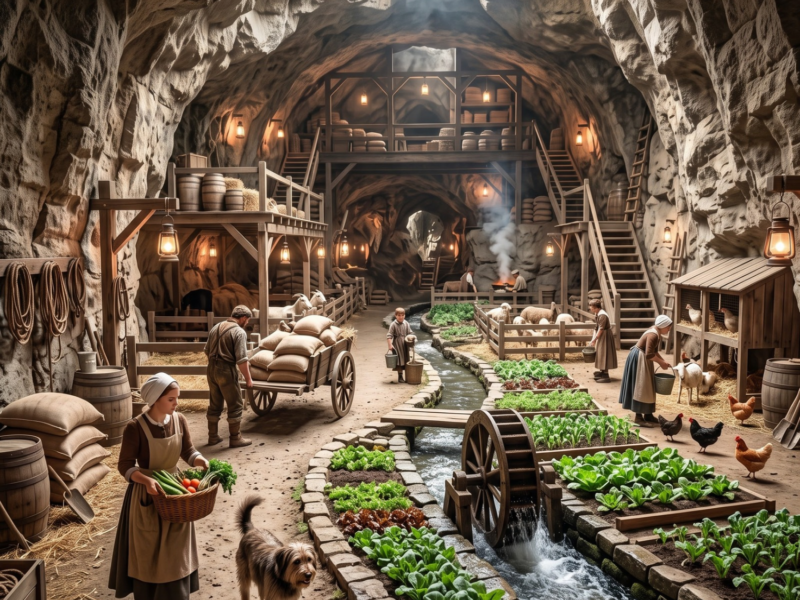
Neighbors Mocked Her Barnless Farm—Until They Saw the 52° Shelter Inside the Hill 🌾
Neighbors Mocked Her Barnless Farm—Until They Saw…
The morning I drove into Dunore to beg a bank for money, the frost had not yet burned off the ruts in the road, and my hands were so cold on the reins that I could barely feel the leather. I was nineteen years old that spring of 1884, and I carried everything I owned that mattered in a leather folder pressed against my ribs: my grandfather’s will, the deed to forty-three acres in the Blackwater Creek Valley, and a plan for a livestock operation that I had written out by lamplight the night before, my letters growing crooked as the oil burned low.
I believed, sitting on that wagon seat with a mule named Delph flicking his ears against the flies, that a plan on paper was a kind of promise. I would learn otherwise before the sun cleared the courthouse roof.
The road ran the whole nine miles beside the creek, and I had time on that ride to say my numbers over to myself until they wore smooth in my mouth: twelve dollars for fence panels, two dollars apiece for the first goats if I bought them lean, so much for straw, so much for grain to carry the animals into their first winter. I had reckoned it all in the small hours, and reckoned it low the way a person reckons when she cannot afford to be wrong. The sum total I meant to ask for came to a figure I could hold in one breath. It seemed to me, riding in that cold, that a woman who asked for little and offered good land as her surety was asking for something reasonable.
I had not yet met the man who would teach me that reason has very little to do with who gets money and who does not.
The bank in Dunore was a squat brick building with a green door, and the man who received me went by the name of Ridley Vain. He wore a wedding ring pressed so tight into the flesh of his finger that it looked as though it had been swallowed years ago and never let back out, and his collar sat high under a chin that had softened with prosperity. He took my folder the way a man takes a plate he did not order, and he turned the pages of my life for perhaps half a minute before he set them down and folded his hands.
“I’ll be straight with you, since somebody ought to be,” his voice had the flatness of a man who considered himself kind. “You’re nineteen. You’ve got no collateral a bank can touch, no history of borrowing or repaying. And you’re asking me to put money into ground that hasn’t seen a plow in seven years. There’s no barn out there. There’s no stock. There’s a fallen-in coop and a house sinking on one corner. And you want to fill it with goats and hens on the strength of your own say-so.“
I told him I had a plan. I heard how small the words sounded the moment they left me.
He smiled then, and it was the smile grown men save for children who announce they intend to sail to the moon. “Sell it. Ground like that will fetch you eleven thousand two hundred dollars if you find a buyer who likes the creek frontage. Take the money. Find yourself situated somewhere with a roof that doesn’t lean. Farming isn’t what it was for our fathers, and it was never a trade for a girl standing on her own two feet with nobody behind her.“
He slid the folder back across the desk toward me, and the gesture said the conversation had ended before I had finished being in it.
I did not argue with him. I want to be honest about that, because it would flatter me to say I stood in that office and spoke my peace, but I did not. I gathered my papers with hands that had gone steadier than my heart, and I thanked him for his time—because my grandfather had raised me to thank a man, even for a door shut in my face, on the grounds that courtesy costs nothing and is remembered longer than either of you expect.
Then I walked out into the thin sunlight with nothing but the folder in the cold, and I understood for the first time that a plan is only a promise if somebody with money agrees to believe it.
Nobody had agreed to believe mine.
Related Articles

They Mocked the Widow’s Dirt Cellar—Then the Freeze Left Every Cabin Cold but Hers Warm
They Mocked the Widow’s Dirt Cellar—Then the Freeze Left Every Cabin Cold but Hers Warm…

A Homeless Veteran and His German Shepherd Inherited a Ridge No One Wanted — 35 Feet In, They Found
Chapter 1 / 7 A Homeless Veteran and His German Shepherd Inherit… A Homeless Veteran…

Neighbors Laughed When He Built A Cabin Inside An Old Barn—Until It Kept His Home 35 Degrees Warmer
Chapter 1 / 8 Neighbors Laughed When He Built A Cabin Inside An… Neighbors Laughed…

His Sod House Had No Woodpile in January – Until the Trains Stopped and the Town Came Begging
Chapter 1 / 10 His Sod House Had No Woodpile in January – Until t……

She Built Her Cabin Over the Woodshed and Never Burned Wet Wood Again
Chapter 1 / 8 She Built Her Cabin Over the Woodshed and Never Bu… She…

The Duke Abandoned Her on Their Wedding Day—Years Later, He Discovered What He Had Lost
Chapter 1 / 7 The Duke Abandoned Her on Their Wedding Day—Years… The Duke Abandoned…

He Wedged a Tiny A Frame Into a Crevice Before Winter and His Family Slept at 75°F While Town Hit
Chapter 1 / 7 He Wedged a Tiny A Frame Into a Crevice Before Win……

He Was Too Old to Ride—So He Bought the Ruined Ranch and Found the Room Behind the Fireplac
Chapter 1 / 5 He Was Too Old to Ride—So He Bought the Ruined Ran……

Settlers Laughed at His Underground Heat Recovery Duct — Until It Kept His Cabin 71°F Warmer
Chapter 1 / 9 Settlers Laughed at His Underground Heat Recovery… Settlers Laughed at His…

A Navy SEAL Built a Home Inside a Mountain—Then His Dog Warned Him Before the Storm
Chapter 1 / 5 A Navy SEAL Built a Home Inside a Mountain—Then Hi… A…