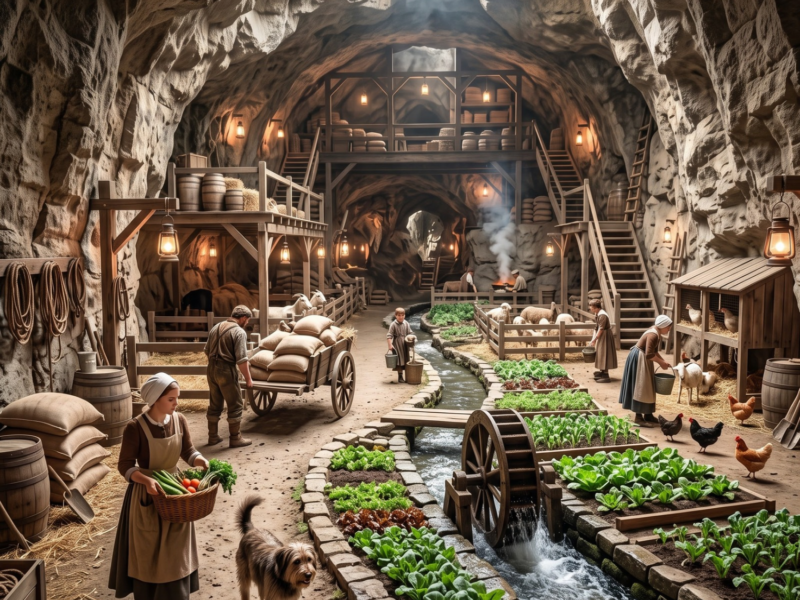
Neighbors Mocked Her Barnless Farm—Until They Saw the 52° Shelter Inside the Hill 🌾
THE HILLSIDE AND THE GREEN DOOR
There is a kind of loneliness that settles on a place like that at dusk, when the light goes out of the windows of every other farmhouse up the valley, and yours has no light in it yet because you have not decided whether to spend the oil. I felt it those first nights, sitting on the porch step with my supper on my knee, listening to Reese’s cattle low across the bottomland and knowing that every family within five miles had already agreed without malice over their own suppers that the Kell girl would not last a year.
It got into me worse than open scorn would have, because scorn you can push against, and pity only asks you to lie down. I did not lie down, but I will not pretend I was not tempted those evenings to load the wagon and take Vain’s twelve hundred dollars and go be somebody in a town where no one had already decided who I was.
What kept me those first weeks, more than pride, was the plain daily work that a ruined place demands of anyone who stays in it—work that leaves no room in the head for large decisions because it is forever asking small ones. The well rope had rotted, and I spliced a new one. The stovepipe drew poorly, and I climbed to the roof to clear a summer’s worth of birds’ nests from the chimney and came down black to the elbows. The settled corner of the house led a draft under the floor that walked cold across a room even in April, and I spent two days on my knees in the crawl space with a jack and a stack of flat creek stones, lifting the sill a half-inch at a time and packing the gap.
Not because I could make the house new, but because a person can bear almost anything in a place she is actively mending, and can bear almost nothing in a place she has given up on. I did not shore that house because I believed it was worth shoring; I did it because the doing was the only argument I had against the voice that told me to sell. And I have learned since that this is often how a life is saved: not by a grand decision made once, but by a hundred small refusals to quit, each one no larger than a stone packed under a sill in the dark.
That was how I came to be climbing the hill three days later on a raw April afternoon, with the grass wet to my knees and a cold wind coming down off the ridge. I told myself I was surveying, deciding where a person might even begin. In truth, I was walking because the house had grown too full of Ridley Vain’s voice, and the hill was quiet.
My grandfather had built a stone wall along the upper property line decades before, each rock lifted and fitted by his own hands, and I followed it because it was the one thing on the place that had not fallen down. My boot went through two rotted fence posts as I climbed, and I was watching the ground, watching for the next hole, when the wall stopped being a wall.
There was a gap in it.
Not the ragged collapse of stone gone loose with frost, but something squared and deliberate—an opening framed on both sides by rock that had been worn smooth along its edges. Smooth the way a doorstep goes smooth; the way a thing goes smooth when hands and shoulders pass over it ten thousand times across the years.
Wild roses had grown up thick across the front of it, their canes gone brown and thorned, and I had to work my arm through them to reach what stood behind. My fingers found wood. I pushed the roses aside and stood looking at a door set flush into the hillside itself—a door of heavy plank that had been painted green once and had since surrendered most of its color to weather and rust, so that only a green shadow remained in the grain. The hinges were the old strap kind, hand-forged black with age. And on the hasp hung an iron padlock, closed but not locked, its shackle swinging free where someone had left it open and never come back to snap it shut.
Something in the sight of that open lock made my breath go shallow. A locked door keeps you out and tells you plainly that you are not wanted. An open one is a different kind of thing entirely. An open one is an invitation, or a warning, or a mistake somebody made a long time ago and paid for.
I stood there with my hand on cold wood and felt the whole shape of the afternoon change around me—the way the air changes before weather when you cannot yet see the cloud, but your skin already knows.
I pulled. The door did not move. I braced my heels in the wet grass and threw my weight backward, and it gave with a shriek of iron opening the width of my hand. Then the width of my arm. And out of the darkness came a breath of air across my face.
I had expected the damp sour of a cellar left shut for years. This was not that. This air was cool and dry and clean, moving faintly like the breath of something that had been sleeping but never died.
I put my shoulder to the plank and forced it back until the gap was wide enough to slip through sideways. And then I stepped out of the daylight and into my great-grandfather’s secret, though I did not know yet whose it was or how far it went.









