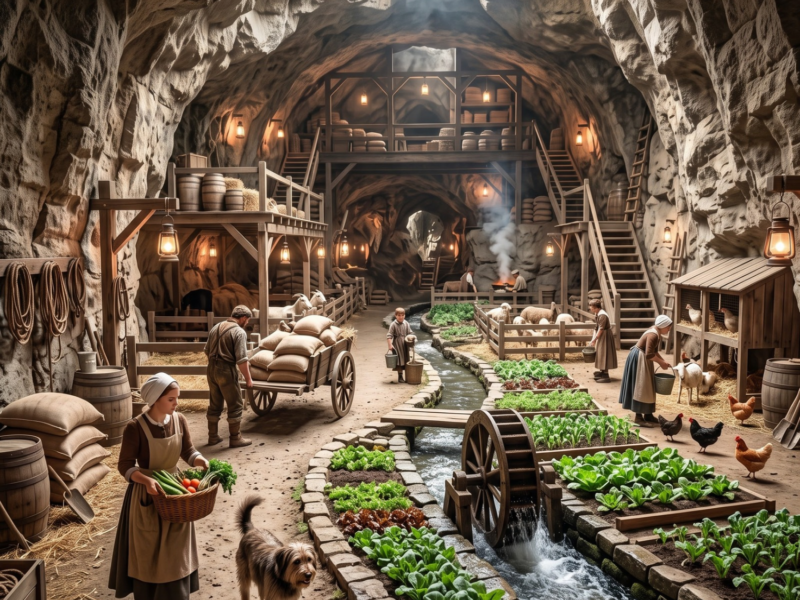
Neighbors Mocked Her Barnless Farm—Until They Saw the 52° Shelter Inside the Hill 🌾
JOSIAH PENHALLOW'S VERDICT
That was the state of things when Alton Reese came back a second time.
I heard his wagon on the gravel before I saw it, and I met him at the porch rather than let him find me anywhere near the hill. He looked older in the flat light of that afternoon, or perhaps only more certain, and he did not waste words on greeting.
“You’ve had time to think,” he let his gaze travel up the empty slope behind me, the bare hill, the unbroken ground. “There’s nothing changed out here that I can see. And there’s nothing going to change without money you haven’t got and a barn you can’t build. My offer is the same today as it was. Take the cash, and I’ll not think less of you for being sensible.”
Something rose in me then, steady and cold as the air off that inner room, and I felt the shape of a decision settle into place that I could not have made a week before. I told him I was obliged to him and that I would keep the ground.
He studied me for a moment with the particular patience of a man who believes time is entirely on his side. “You can’t do a thing with it, Verena. You’ll learn that the hard way, same as everyone learns it. And when you do, my doors are open.”
He touched his hat the way he had the first time, and he rolled off down Cold Water Road toward his own fat cattle and his own good bottomland. And he did not once look back at the hill, because there was nothing about the hill that Alton Reese thought worth a second glance.
I stood in the drive and let him go, and I did not smile until his wagon had dropped below the bend and the sound of it had faded into birdsong. Then I let myself smile alone, where no one could see and wonder at it. He had told me I could not do a thing with the ground. He believed it the way he believed the sun would come up. And his belief was the truest ally I had, because a man who is certain you will fail does not trouble himself to watch you. Every soul in the valley had already written me off. And their dismissal was a kind of wall around me, thicker than any stone my great-grandfather had ever fitted. And behind it, I meant to build a thing that none of them would see until it was too late to laugh at.
I needed an expert to confirm what my eyes told me. Three weeks after finding the vault, I sent word into Dunore, asking whether anyone in the county understood old stonework. The reply that came back named a man called Josiah Penhallow, who had built bridges and cut culverts for the railroad in his working years and had retired to a small place outside town, where he was said to look at other men’s barns for the pure interest of it when the mood took him. I sent that I would pay his way if he would come.
He came on a Friday morning, a lean old man in a canvas coat, carrying a folding rule and a spirit level in a lantern net near as long as my forearm. He walked to the hill without any wasted talk, as though he had been told only that there was something inside it worth the trip.
He was gone into the dark near an hour. I stood at the mouth in the cold with my arms crossed, listening to the small sounds of him at work: the tap of the level being set, the scrape of his boot, the long silences that meant he was only looking.
When he came out at last, he did not speak straight off. He sat himself on a stone by the entrance, took a stub of pencil from behind his ear, wrote for the better part of ten minutes on a card he pulled from his coat, and only then did he look up.
“Whoever cut this knew more than most men who called themselves engineers in my day,” he said it plainly, without the flattery of surprise. “The walls are dry-laid, no mortar, and they’re battered—which is to say they lean in a hair as they rise, so the whole load presses them tighter together instead of shouldering them apart. The ceiling timbers are hewn oak cut on this ground, if I’m any judge, and they’re not merely resting on the walls. They’re seated in pockets, chiseled into the bedrock at the back, so the mountain itself carries the weight, not the stone. This was not built for eighty years. This was built to stand two hundred, by a man who wanted it to be here long after everyone who mocked him was in the churchyard.”
He turned the card in his fingers. “It’s sounder than any barn I’ve walked into this side of the war. You can keep stock in it with an easier mind than most keep them under a good roof.”
I felt something ease in my chest that had been clenched since the day I first pulled that green door open. But Penhallow was not finished, and what he said next put a cold thread through the warmth of it.
“There’s a thing you ought to know, since you’re living with it,” he looked at the hillside as though he could see through it into some older year. “This isn’t the first hole the man dug. I heard the story from my own people when I was a boy. Before he cut this, he tried a smaller thing under an old dairy barn down the valley, meaning to keep his heifers cool through the heat. That one came down. Timbers rotted, ground shifted, the roof of it fell in one autumn night and took two animals with it. Folks called him a fool for it, and worse. A lesser man would have quit there.”
He tapped the stone beside him. “He didn’t quit. He learned what killed the first one, and he built this to cure every fault of it. What you’re standing in isn’t his first idea. It’s his second. And the difference between them is two dead heifers and a man too stubborn to stay beaten.”
I carried that home with me and could not put it down. All my new confidence in the hill had rested, without my knowing it, on the belief that Ambrose Kell had simply been right the first time, blessed with a knowledge that fell to him whole—only to learn instead that his triumph had been built on a collapse, on the deaths of animals he could not save, on a public shame. He had chosen to answer with more labor rather than less, changing the shape of the thing I had inherited. It was not a gift handed down clean; it was a wound turned into a wall.
And I understood, walking the dark interior that night with my lantern raised, checking every post and every seated beam the way Penhallow had taught me to check them, that I had inherited the failure just as surely as the success—that the drawing in my pocket was the second draft of an answer whose first draft had killed.









