Neighbors Mocked Her Barnless Farm—Until They Saw the 52° Shelter Inside the Hill 🌾
THE WINTER MEETING AND THE VALLEY'S TURN
I bore him less ill will riding home than I would have guessed. He had done me one great service without meaning to, for a person never truly knows the size of her own spine until someone leans their whole weight against it; and Reese had leaned his whole weight against mine, and it had held, and I would carry the knowledge of that holding for the rest of my life.
I did not go home and celebrate that day the note was paid. I stopped at Tully’s to settle my account to the penny, and to buy, for the first time all year, a small thing I did not need: a paper twist of hard candy, which I ate one piece at a time on the ride home the way a child does, making it last.
Then I put Delph up, and I climbed the hill in the last of the light with the deed and the receipt folded together in my coat, and I went down into the shelter and sat on the overturned pail in the corner where I had sat the first night the goats came.
The animals paid me no mind. They had no notion that anything had changed in the world above—that the ground they slept under had nearly passed to another man’s hand, and had not; that a girl in a bank had turned the whole cold weight of the law aside with a poke of a dead man’s gold. They only breathed and shifted and slept secure, the way only creatures can be secure who have never once had to know how near ruin came.
I sat among them a long while in the fifty-two-degree dark. And the thing I felt was not triumph exactly, which is a loud feeling and burns off quick, but something quieter and more lasting: a sense of having been led into a company of no longer standing outside the family I was born to, but inside it at last, one more Kell keeping one more herd alive in the belly of one more hill, in a line that ran back further than I could see, and would run forward further than I would live to watch.
The valley speaks of that morning still—I am told—the day the Kell girl poured gold across the counter of the Dunore Bank and walked out owning free and clear the ground a sensible man had told her to sell. But the morning was never the point of it. The point was every dark hour that had come before, unwashed: the panels carried up one at a time on a raw shoulder; the thermometer read at dawn while the valley slept; the flood turned back by a channel cut for it thirty years too soon. A triumph that anyone can see is only the last stone of a wall that was built where no one was looking.
Word of the hill reached the state Grange before the leaves were fully down. The Grange was the great fellowship of farmers in those years—chapters in every county meeting in plain halls to argue prices and share what worked and stand together against the powers that squeeze men who grew things for a living. A man from the state body wrote to me in October, having heard the thing described by the stock doctor who had driven a day to hold his thermometer to my wall, and asked whether I would come to the winter meeting in the county seat and tell the assembled farmers how a person kept livestock through heat and drought and killing cold in the cool, constant heart of a hill.
I read the letter twice, standing in the doorway of the shelter with the goats moving soft behind me, and I thought of Ambrose coming home in the dark with stone dust in his hair, telling no one, letting them think what they liked, keeping his answers secret because the valley had mocked him once and he had no wish to be mocked again.
I wrote back that I would come.
It seemed to me the truest thing I could do with what I had been given: to carry it up out of the dark at last, to stand in a plain hall and say aloud the thing my great-grandfather had cut into the earth in silence, so that the next person told their idea was too small or too strange or too young to matter might hear it and take heart. Some secrets you keep to protect them; others you keep only until you are strong enough not to need the keeping, and then you owe them to the daylight.
The Ackleys came by in the last warm week before the meeting near the end of that October. They farmed north of me, a middling place worked hard by decent people, and they had never once in my hardest months offered to buy my ground or warn me off my folly. They came now for no reason but to see, which is the only reason worth much.
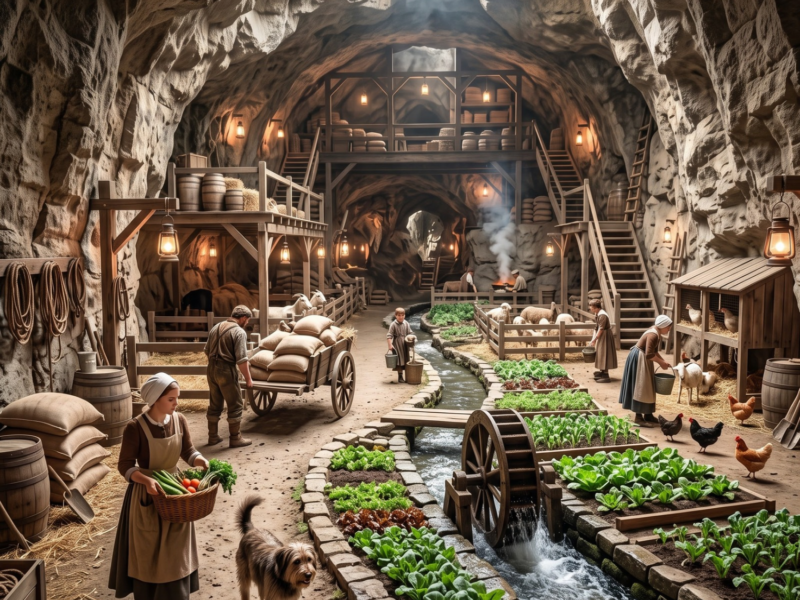
Tom Ackley walked the perimeter of the hill slow, asking how I had reinforced the doorframe against the weight of the earth, nodding at each answer like a man storing it away for a need of his own. His wife stood at the mouth of the shelter, watching the goats come and go across the threshold, in and out of the cool dark, as easy in their passage as though a hill were the most natural roof in the world for a living thing to sleep beneath.
When they turned to go, Tom Ackley took my hand in both of his, rough palm to rough palm, and held it a moment. “Your grandfather would be proud of you,” he said it plain without ornament, a working man’s whole heart folded into a single sentence. “I knew Ezra. I know he would.”
It was the only time in the whole of that long year that anyone said those words to me, and because it was the only time, I have carried it ever since the way you carry the one thing from a hard season that was pure.
Others had given me their own kind of blessing in their own coin: Penhallow had given me his refusal to forget and the thing he had told me about building for the worst day; Eleanor had given me her verdict level as a plum line and the thing she had told me about building the woman and the work at once; Boaz Tully, when I wrote in that November with money in my pocket instead of need, opened my account back up with a nod that said more than a speech; Effie Ransom, when I met her at the winter sale, looked at the two strong doelings I had raised from her stock and gave me one short, approving jerk of her chin—one keeper of clever animals to another.
Even Dosha changed her tune, though hers was the cheapest coin of all: her pity turned overnight to a pride of acquaintance, as though she had believed in me the whole time.
I took each of them as they came and valued them by their weight. And none weighed like Tom Ackley’s four plain words, because he had asked for nothing, expected nothing, and spoke only what he saw.









