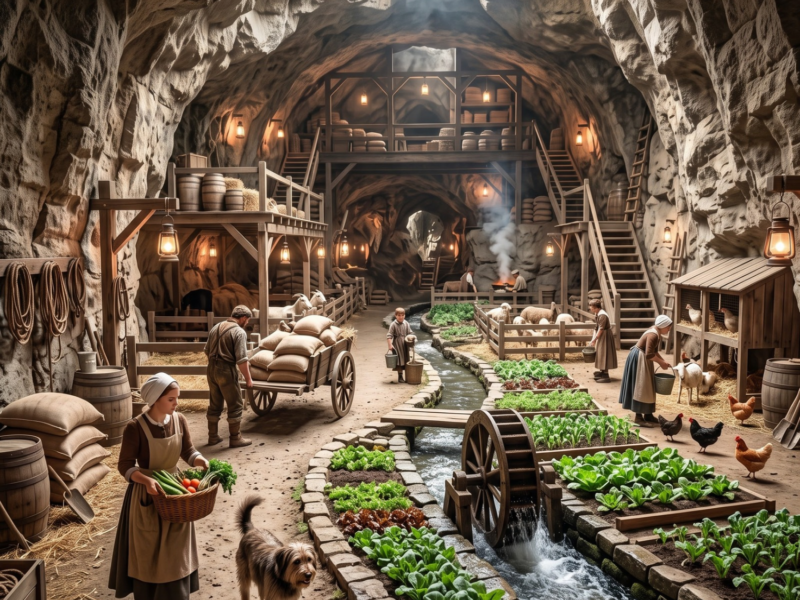
Neighbors Mocked Her Barnless Farm—Until They Saw the 52° Shelter Inside the Hill 🌾
BRAMBLE AND THE COYOTES
Through the back half of that spring, I moved the rest of my small holdings underground.
The hens came down first—all thirty-two of them—in crates I carried three at a time until my shoulders were raw with it, and within an hour of their release they had claimed the swept stone floor as though generations of their kind had scratched there before them. The pigs came after, a pair of black Berkshires I bought off a man in the next township who told me to my face I was throwing money away, that a pig wanted sun on its back and mud to wallow in, not a hole in a hill like a badger. I paid him in coin and hauled them home in the wagon bed, and they trotted into the shelter without a moment’s hesitation and set to rooting the dirt as though they had been born to the dark.
The number on my wall never moved: fifty-two degrees, morning after morning, while outside the April chill gave way to a May that ran hot in the afternoons. I had feared damp above all—feared the mold and the sour reek that ruined close-kept animals. But the slanting shafts Ambrose had cut pulled the used air out and drew clean air in by some working of warmth and stone I could feel plainly, though I could not have drawn it on paper.
I mucked the pens every second day and carried the soiled straw to a heap behind the house, and the animals in that cool, dry dark grew calmer and glossier than any I had seen penned above ground in the whole of the valley. The hens laid as though the even dark had cured them of some restlessness they had not known they carried. The goats stopped their fence-testing within a week, for there was no fence in the world so interesting as the open door they were free to use, and chose not to. Even the pigs, which the man had sworn would pine for the sun, grew sleek and content and slept in a heap in the coolest corner through the worst heat of the day, while above them the valley stock stood panting in what shade they could find.
The coyotes came in June—the very thing Alton Reese had promised would empty my pens before the second night was out.
And when they came, I learned the last worth of the green door.
I woke on the cot in the first chamber to the goats gone rigid and silent, which is worse than any bleeding, for a goat that has stopped its noise has seen a thing it is truly afraid of. Above us, muffled by feet of earth and stone, I could hear them working the slope: the yipping and the answering yip that means a pack has spread itself to hunt.
I lay in the dark with my heart going and understood that on any ordinary farm this was the hour the killing started—the hour a fence is tested and found wanting, and a morning comes with feathers and blood strewn across a yard.
I got up and stood in the mouth of the shelter with the lantern unlit. And I watched them come down the hill: three of them, then a fourth, gray shapes flowing through the dead thistle with their noses working. And I watched them cast back and forth across the very ground under which every animal I owned stood breathing, and find nothing.
There was no scent trail across open grass, because my animals left no trail across open grass. There was no pen to circle, no wire to worry, no weak board to lean a shoulder against. The whole living wealth of my farm lay behind a foot of oak and a hillside of stone, giving off no sign a hungry nose could read.
And after a long while, the pack drifted on up the ridge toward easier country, and I heard near dawn the distant commotion of someone else’s hens paying the price. Mine had been spared.
I did not sleep again that night, but I lay down easy, and I thought of Reese’s certain voice telling me the coyotes would have them by the second night. And I understood that he had been describing the only kind of farming he could imagine—the kind that happens in the open, where everything can be seen and therefore everything can be taken.









