Neighbors Mocked Her Barnless Farm—Until They Saw the 52° Shelter Inside the Hill 🌾
THE BREATHING HILL
I spent the next three days inside that hill, and they changed me. I carried down a lantern, a spool of twine, a folding rule, and a thermometer in a pot of coffee gone cold by mid-morning, and I mapped the place the way a stranger maps a country.
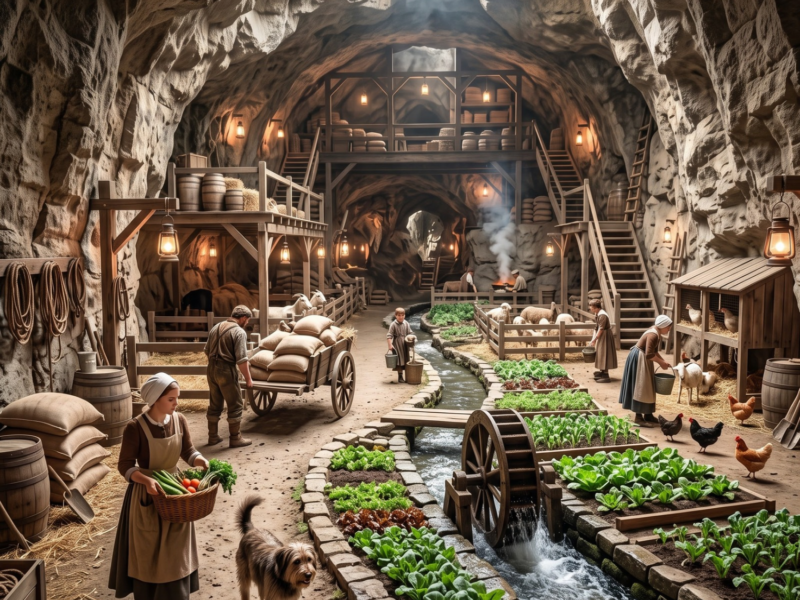
The low inner door led to a second chamber wider than the first—twenty feet across its ceiling, vaulted and dressed so smooth that the lantern light slid along it without catching. What held me there was the air. It moved. I could not find the wind, but I could feel it on the back of my neck and see it lean the lantern flame. And when I searched the walls, I found the reason: narrow shafts cut at slanting angles up through the rock, so cunningly placed that from outside on the hillside a man could stand directly over one and never guess it was there.
I held the thermometer flat against the cold stone and counted out the minutes, and the needle settled where the drawing had promised it would settle and did not stir: fifty-two degrees in an April that had frost on the grass at dawn.
There were more stalls in that second room—eight of them—and along the back wall, a row of racks built into shallow alcoves meant to hold feed up off the floor and away from the damp. In one corner stood a hand pump rising out of a basin cut from a single block of stone. I worked the handle, and for thirty strokes nothing came. And then water arrived, rust-colored at first with the memory of iron, and then running clear and cold enough to ache my teeth. I drank from my cupped hand and tasted only stone. A channel had been cut into the floor to carry water away, sloping toward a gap where the rock let it out.
Days later, I followed that runoff down the far side of the hill and found where it emerged a hundred yards off among a stand of cattails so thick that no one passing on the road would ever mark it. Whoever had made this place had thought about being seen and had decided against it.
It was the moving air that I could not leave alone, because it made no sense to me—and I have never been able to leave a thing alone that makes no sense. There was no wind in a hill. A closed room ought to hold its own stale breath until you opened a door and let the day in. Yet the flame of my lantern leaned faint but steady, always in the same direction. And the air on my face was never the dead air of a shut cellar, but something alive and turning over, as though the hill inhaled at one end and exhaled at the other without my help.
I spent the better part of a day chasing the reason, holding a lit splint up to each of the slanting shafts in turn, watching the smoke of it get pulled one way here and pushed the other way there, until at last I understood what Ambrose had understood thirty years before me.
He had cut his shafts at two different heights and on two different faces of the hill. And the sun that warmed one side while it left the other in shadow made the air on the warm side rise and pulled the cool air in behind it, so that the whole hill breathed by nothing more than the daily turning of light and dark against stone. There was no machinery in it, nothing to wear out or freeze or rust—only a man’s patient reading of how warmth and cold behave, set into rock so that it would go on working every hour of every year, whether anyone tended it or not.
I sat down on the cold floor when I saw it and felt something close to reverence—the way you feel in a church you did not expect to move you—because I had been handed proof that a mind could reach that deep into the plain workings of the world and bend them gently and forever toward the keeping of living things.
I have tried since to make people understand what it is to work inside such a stillness, and I have mostly failed, because there is nothing above ground to compare it to. There was no wind to lean against, no sun to tell the hour, no sound of the road or the creek or another human voice—only the small noises I made myself, and under them a silence so old it had a weight to it, as though the hill were holding its breath around me, and had been holding it a very long time.
I found I could think in there the way I could not think anywhere else. Problems that had knotted themselves tight in the bright confusion of the day came loose in that dark one strand at a time, and more than once I climbed out at dusk with an answer I had not possessed at noon, blinking at a sky gone the color of a bruise, having lost all track of the afternoon.









