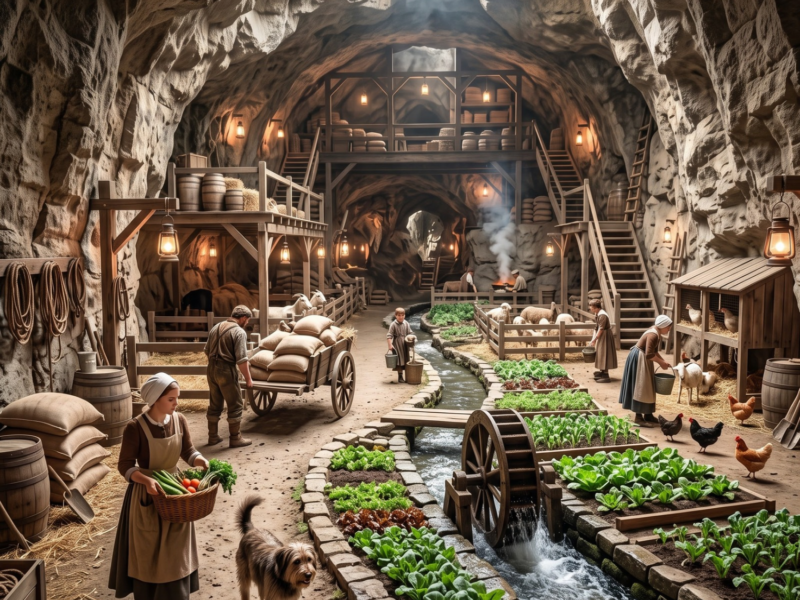
Neighbors Mocked Her Barnless Farm—Until They Saw the 52° Shelter Inside the Hill 🌾
THE SEED AND THE HILL
I am twenty now. The farm is still small—I want to be honest about that, because the truth of a life is rarely the shape of the tales men tell about it. I did not become rich. I did not buy Reese’s bottomland or build a fine house or become a person the county pointed to as it points to its wealthy. The house still leans a little toward the creek, though I have shored the corner and it leans no worse.
What I have is this: a hill full of animals healthier than any at the county fair, and an account at Tully’s that stays in the black; a name in the valley that is spoken now with a question in it rather than a smirk—the question of how and whether it would work on another person’s land, and whether I might be persuaded to come and look. People who once crossed the road to avoid the foolishness of me now cross it to shake my hand.
I did not do that by proving them wrong in a single golden morning. I did it by outlasting them one dark chore at a time, the way stone outlasts weather.
There is a thing Penhallow told me the day he came back after the flood that I did not fully understand until months had gone by. He said Kell hands had been shaping this ground since before the county had a name—that Ambrose himself had learned the trick of building into the earth from a father who had done something like it before him in a leaner, rougher way back when the valley was more forest than farm.
I did not credit it much at the time; it seemed one of the things old men say to make a young person feel part of something. But I have come to believe it, because I have come to understand that no man builds a thing as sure as that hill on his first reach for it, nor even his second. Ambrose failed once that we know of, and built once in triumph. But behind his failure and his triumph both, there had to be a lifetime of watching how water moves and how stone lies and how the cold gathers in a low place—watching he could only have begun as a boy at his own father’s shoulder.
I am the near end of that watching.
Someday, if I am given the years, I mean to be the far end of it for someone I will not live to meet, and to leave my own doors open and my own help laid by for whatever hand finally comes. When they ask me how—and they do ask now—I tell them all the same thing, because it is the truest thing I know and it was not even mine to begin with:
Start with what you have, not with what you believe you need.
I had a ruined farm in a leaning house in a hill that every neighbor on Cold Water Road had already crossed off his reckoning. And inside that hill, waiting in the dark for someone with nothing left to lose, stood the answer to every question the ground could ask.
My great-grandfather never spoke that lesson to me. He could not; he was thirty years dead before I was born. He left it instead in the batter of a dry-laid wall; in the pockets chiseled to seat a beam in living rock; in a spillway cut for a flood he would never see; in a strongbox left unlocked for a hand he would never hold. He wrote it in the one language that does not fade—the language of a thing built so well and so true that it goes on speaking long after the builder’s own voice is dust.
I think of Prudence sometimes—my great-grandmother—who wrote in her grief that her husband came home after dark and would not say where he had been, would not let her follow, hid something from her she could not name. She died believing he kept a secret from her out of coldness or shame.
I wish I could reach back across the years the way his work reached forward across them, and tell her the truth of it: that the secret he carried up that hill in the dark was not a wall between them, but a gift laid by for a girl neither of them would live to meet; that every stiff-handed night he spent underground was an act of love aimed at a future he could only trust and never touch. He hid a solution. She was right that he was hiding something; she only lacked the years to see what.
I keep her letter in the strongbox now, alongside the true deed, so that the complaint and the answer to it lie together in the dark at last, the way I think they always should have. And someday another Kell will lift that lid and read her words and understand, as I could not have told her, that she was loved the whole time she thought she was only shut out.
The winter meeting is in three weeks. I have my notes written out: Ambrose’s drawing to lay open on the table before the farmers, my own sketches beside it. I have thought a great deal about what to tell them and what to leave unsaid. I could stand up and give them the plain method—the depths and the angles, and the way the shafts must face to make the hill breathe. And I will give them that, because a thing this useful ought not to die again in one family’s silence the way it nearly did.
But I have decided I will give them the other part, too—the part that is harder to fit into a diagram: which is that the method is not the whole of it. A man mocked into hiding cut this into the earth for people he would never meet. And it worked not only because his angles were true, but because his patience was; because he was willing to labor in the dark on a thing whose worth no one would grant him in his lifetime.
I mean to tell a hall full of tired farmers that the drought will come again, and the flood, and the killing winter, and the banker who has already decided what they are worth; and that the answer to all of it is the same answer it has always been: which is to build a little deeper than the trouble can reach, and to build it whether or not anyone is watching, and to leave the door open for whoever comes after.
I am not frightened of the standing up, which surprises me—a girl who once heard how small the word plan sounded in a banker’s office. I am not frightened because I am not really the one who will be speaking. I am only the voice a silent man has been waiting three generations to borrow: the daylight end of a thing that began in the dark. And all I have to do is stand there and let what he built say what it has always been saying to anyone with the sense to climb the hill and listen.
If you have ever been told your idea is too small, too strange, too young, or that you have no one standing behind you, I will tell you what a hill full of cool air and a dead man’s drawing taught me across one hard year:
The people who count you out are not watching. That is their weakness and your whole opportunity. Build the thing in the quiet where they will not look. Build it true, and build it to last. And one morning you will carry it up into the light fully made. And the ones who mattered will see it for what it is. And the ones who laughed were never the ones you were building it for.
Somewhere near you, there may be a hill of your own—an answer already cut and waiting, left by hands you never knew for a day they trusted would come.
Go and find your green door. Pull until it opens. And when the cool air rolls out to meet you, step inside. Because whatever is waiting in that dark has been waiting a long time.









