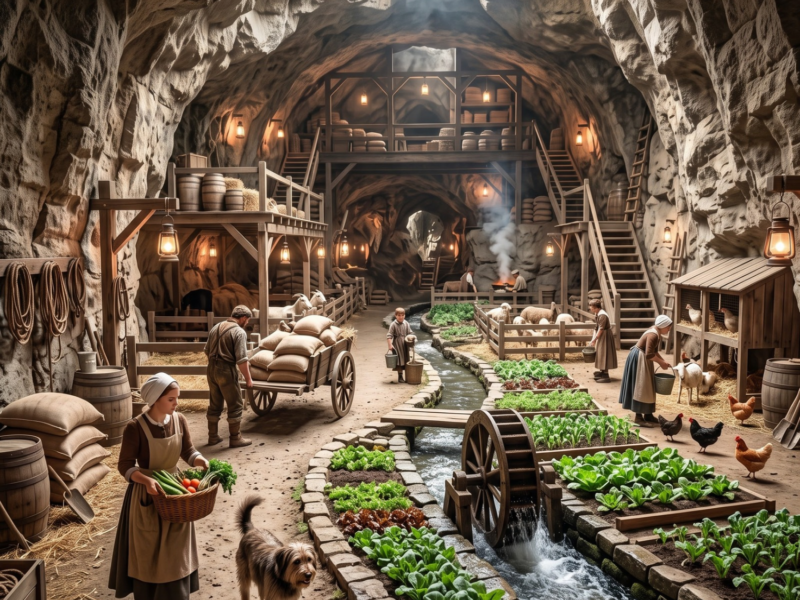
Neighbors Mocked Her Barnless Farm—Until They Saw the 52° Shelter Inside the Hill 🌾
PRUDENCE'S LETTER
I returned again and again to that drawing, and I saw that each part of it bore its own date worked in tiny numerals beside the rooms. The first chamber came first. The second followed. The pump came last of all. And the years ran through the middle of the last century—thirty years before I drew my first breath.
He had built it alone. I did not have to guess at that, because I found the proof soon enough tucked into the pages of a family Bible that had sat closed on a shelf since before the lawyer ever entered the house. It was a letter, or the leaves of one, in a woman’s hand, and I read it standing at the kitchen table with my coat still on:
He comes home now only after full dark, she had written, and there is stone dust in his hair and ground into the creases of his hands. And some nights they are too stiff for him to hold a fork at supper. He will not say where he goes. He will not let me follow.
My great-grandmother had written those lines—a woman named Prudence Kell, whom I knew only as a name inked into the front of that same Bible. And reading them, I understood that she had believed her husband was hiding something from her.
She was right. She only had the wrong word for it. He was not hiding a sin or a shame or another woman. He was hiding a solution. And he was hiding it so completely that it would take three generations and a bank’s refusal to bring it back into the light.
His name was Ambrose. I found it beneath his wife’s words, and I found the years he had labored. And when I laid the letter beside the drawing and did the arithmetic, I saw that he had cut that first chamber into the hill during the drought years of the middle fifties—the three summers everyone in the valley still spoke of as the time the creeks ran to dust.
I understood then what I was looking at. Every man in the Blackwater Valley had watched his stock stagger and die under a white sky those summers, or had sold them off for pennies to keep them from starving where they stood. And Ambrose Kell had come home each night with stone dust in his hair, saying nothing, letting them think what they liked, cutting a cold, dry sanctuary into the earth where heat could not follow and drought could not reach.
It’ll outlast the house, his wife had written that he told her once in a tone she found strange.
Standing in his kitchen thirty years on, with the house leaning toward the creek and the shelter beneath the hill sitting square and cool and unbowed, I understood at last that she had recorded not a boast, but a plain and terrible truth.
The knowledge sat on me strangely those first days, a weight and a lightness at once. I had walked into that bank in Dunore believing I owned a ruin; I walked back down that hill knowing I owned something no man in the county could see and no bank would ever think to appraise—and knowing, too, that I could tell no one, because the first soul I told would either laugh in my face or want it for himself.
So I kept it. I kept it the way Ambrose had kept it: close and quiet. And I let the valley go on believing what it wished to believe about the Kell girl and her forty-three acres of weeds.









