Neighbors Mocked Her Barnless Farm—Until They Saw the 52° Shelter Inside the Hill 🌾
THE VAULT IN THE EARTH
I stood inside and waited for my eyes to make sense of the dark. Slowly, the space assembled itself out of shadow.
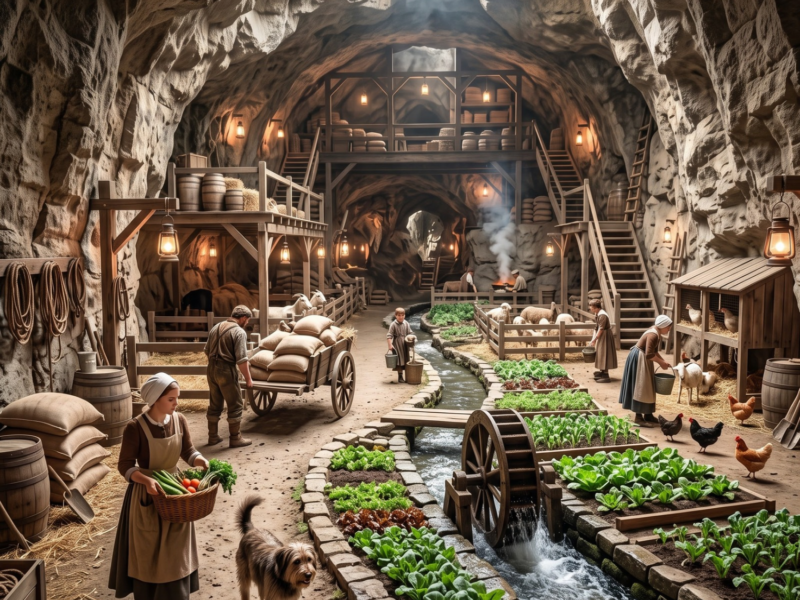
The ceiling above me was not the low crush of a root cellar, but a true vault, curved and rising to nine feet at its center. And it was stone, all of it stone, fitted so close I could not have slid a knife blade between the joints. The walls were stone. The floor beneath my boots was packed earth, swept smooth and level as a threshing floor, and it ran back into the hill thirty feet or more, carried straight into the living rock by somebody who had known exactly what he was doing.
Heavy timbers crossed the ceiling overhead—hand-hewn beams of old-growth oak, dark with the years. And when I reached up and wrapped one with my knuckles, it answered solid: no give, no soft rot, no powder sifting down.
Along the left-hand wall, set into the stone at even spaces, ran a line of iron rings—each one forged and driven deep, spaced a body’s length apart, the way you would space them to tie animals. Along the right stood four wooden stalls, their gates hung on strips of old leather that had cracked but not broken. And at the far end of that first chamber, where the light of my imagination could not yet reach, the darkness deepened into a second doorway, smaller than the first, cut low into the rock and leading away into a black that promised more.
I stood a long while looking at that inner door and did not go through it. Some part of me understood that whatever lay beyond it would ask something of me, and I was not ready that afternoon to be asked.
I want to set down plainly what that first standing felt like, because everything that came after grew from it. All my life, the world had handed me its verdict on what I could and could not have, and I had learned, without quite noticing the lesson, to accept the size of the room I was given. Then a wall opened, and behind it lay a room. No one had given me a room. Some hand had cut it in secret and left it standing.
For one long moment in the cold dark, I understood that the size of my life might not be settled after all—that a person could inherit not only debts and ruin, but possibility waiting, patient as a seed under snow. I did not have words for it that afternoon. I only knew I came down the hill a different creature than I had climbed it, and that I did not intend to sell so much as a single acre until I understood what I was standing on.
I went back down the hill, my mind running ahead of my feet, and I let myself into the house and pulled open the desk drawer where the lawyer had left my grandfather’s papers stacked and forgotten: birth records, the deed, years of tax receipts folded in thirds. And beneath all of it, near the bottom of the drawer, a single sheet of graph paper, gone soft as cloth at the folds.
I opened it under the window light.
It was a drawing done in pencil by a careful hand: a cross-section of a hill—my hill—with chambers laid out inside it like rooms in a house that had no walls above the ground. Along the top, in a script I did not recognize, ran a line of notes: Livestock shelter. Holds 52° the year around. Stone drawn from the upper field.
I read that figure three times. Fifty-two degrees, held steady through the killing heat of August and the deep cold of January alike. A number a man would only write down if he had stood in that dark with a thermometer season after season and watched the needle refuse to move. But it was the handwriting that stopped me longest, because it was not my grandfather’s. Ezra Kell had written a cramped, upright hand I had seen on a hundred receipts. This script leaned and looped—an older hand, a stranger’s hand, belonging to someone who had drawn this hill in cross-section and then, it seemed, taken his knowledge with him into the ground.
Alton Reese had told me I could do nothing without a barn. He did not know that a barn had been built beneath the hill before my grandfather was old enough to swing a hammer, by a hand that was not even his.









