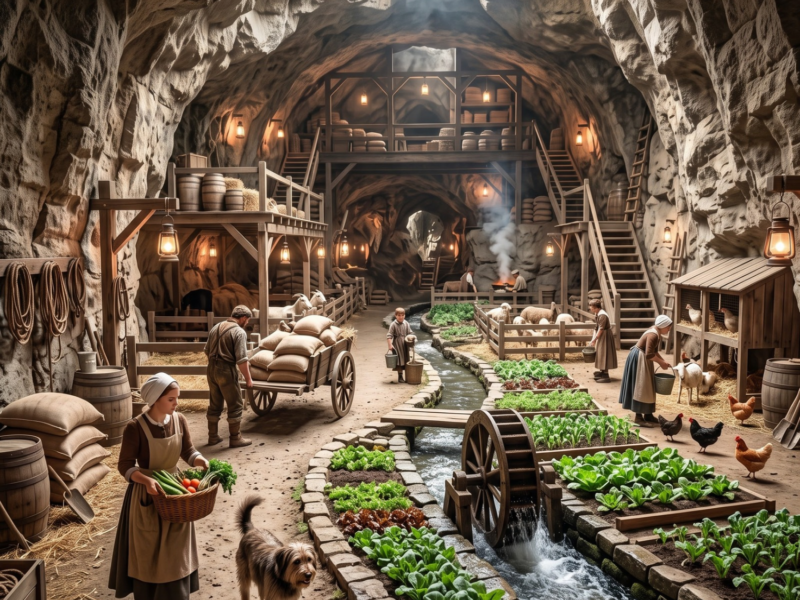
Neighbors Mocked Her Barnless Farm—Until They Saw the 52° Shelter Inside the Hill 🌾
THE RUIN ON COLD WATER ROAD
The whole ride home, I turned Vain’s words over the way you turn a stone you mean to throw, looking for the flat side, and I could not find it. A girl standing on her own with no one to answer for her. That was the phrase that lodged deepest, because it was true in every way he meant it, and false in a way I could not yet name. He had looked at the record of me spread across his desk and seen a person with no one at her back. And by the arithmetic of a bank, he was right—for there was no father to cosign, and no husband to vouch, and no money laid up anywhere a man could count.
What he could not see—what no ledger in Dunore held a line for—was the length of the thing standing behind me, which did not run backward one generation or two, but reached down into the ground itself, and would not be fully known to me for weeks.
The Blackwater Valley opened up nine miles out from town along Cold Water Road, and my grandfather’s place sat where the road bent north around a low hill. I pulled Delph up in the gravel and did not climb down right away. I sat and looked at the farm the way Ridley Vain would have looked at it, the way every soul in the valley already looked at it, and I let myself see the ruin plainly.
The house wore its white paint in curling strips, gray boards showing through like skin under a peeled scab. The north corner of the foundation had settled so that the whole structure seemed to lean toward the creek, patient and tired. The chicken coop had given up one whole side of its roof to a winter storm years before I inherited any of it. And the field—forty-three acres of it—rolled up the hill in a sea of dead thistle and last year’s grass gone to seed, unmowed since the summer of 1877, when my grandfather’s hands had begun to fail him.
There was no barn. That was the fact everyone returned to the way a tongue returns to a broken tooth. A farm without a barn was not a farm; it was just land waiting for somebody to admit it.
I had known my grandfather, Ezra Kell, only in his last quiet decade, a spare man who spoke in single sentences and kept his tools oiled long after his body had stopped needing them. My earliest picture of him is a winter one: his hands wrapped around a mug at the kitchen table, teaching me without seeming to teach that a wet stone works better wet than dry, that a fence is mended before it falls and not after, that you do not borrow what you cannot see your way clear to repay.
He had left me the ground because there was no one else. My mother had gone to a fever when I was small—so early that I keep only the shape of her and not her face—and my father had gone west after that and then gone altogether, the way men sometimes go when grief makes a stranger of the life they had. So it came down to me, the last Kell in the valley, and the lawyer in Dunore had handed me the papers with the expression of a man discharging a duty he found faintly comic. Everyone since had treated my inheritance the same way: as a burden dressed up as a gift. For those first raw weeks, I had more than half agreed with them.
My nearest neighbor made his opinion known before I had been on the place a full week. Alton Reese ran two hundred head of cattle on the good bottomland to the west of me, and he had known this valley since before I was born. He came up my drive in a spring wagon one gray afternoon and did not bother to climb down, only leaned an elbow on his knee and looked at my hill as though he were pricing it by the yard.
“I’ll take it off your hands and save us both the trouble,” he said it the way another man might offer to carry a heavy parcel. “Cash money, no waiting on lawyers. It’s a heavy load of work for a girl by herself, and without a barn, there’s precious little you can do with it but watch it grow up in weeds. No shame in selling what you can’t use.“
I thanked him and told him I would think on it. He touched his hat and rolled off down Cold Water Road. And I stood in the drive with the folder still in my hand and understood that his kindness and Vain’s kindness were cut from the same cloth—and that the cloth was contempt sewn to look like mercy.









