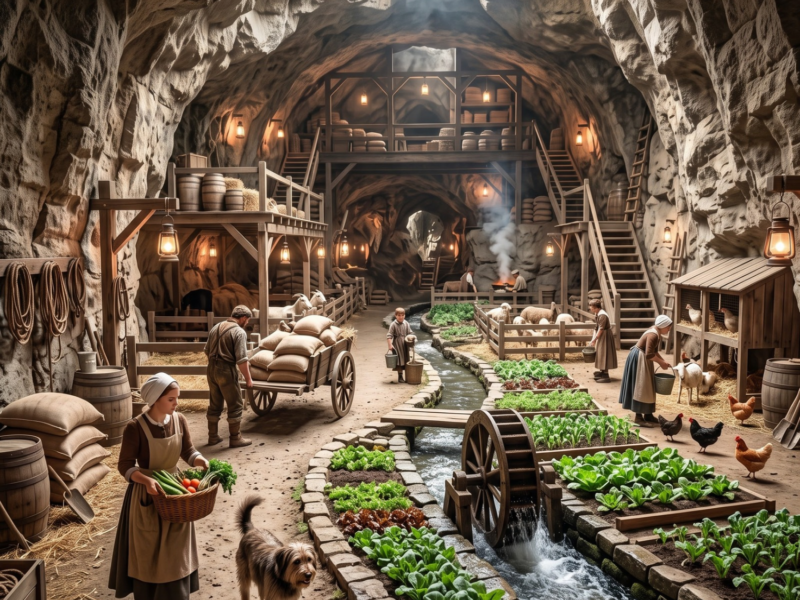
Neighbors Mocked Her Barnless Farm—Until They Saw the 52° Shelter Inside the Hill 🌾
THE RECKONING AT THE BANK
I stayed until dawn, the water by then sunk down whatever throat in the earth Ambrose had cut for it, and the floor lay wet but standing, the animals dozing at last, the storm moving off east toward Dunore, where a man in a bank slept dry and certain of his October. I had bought myself the rest of the summer. I had not bought myself the debt. But I had learned the difference that night between a thing that shelters you and a thing that saves you.
And I walked down the hill into the gray morning knowing which I had, knowing the reckoning still stood between me and October like a wall I had not yet found the door in, but knowing too that I came from people who did not stop at the first wall or the second, or any wall at all, until they had cut clean through it to the other side.
The calendar did not care how many strangers came to admire the hill. September came on with its slant of gold light and its cool mornings, and I counted my money by lamplight until the counting made me ill.
The eggs had brought in a steady trickle all summer. The two Berkshires had gone to market in August, heavy and clean, and fetched a better price than the man who sold them to me had believed a hill-raised pig ever could. Bramble had kitted twins in July, Juniper a single kidling, and I had spoken for buyers already—three families up the valley hungry for milk stock got from animals with a reputation for thriving.
I laid every coin and every promise of a coin end to end across the ledger, and no matter how I arranged them, they fell short of the note by more than a season’s work could ever close. I had thickened my wall; I had not found the money to buy back my own ground.
There were nights in that last stretch of September when the arithmetic beat me flat—when I sat at the kitchen table with the lamp low and the column of what I had beside the column of what I owed, and the gap between them yawned so wide that no honest reckoning could close it, and I would put my head down on my arms and let myself for a quarter of an hour believe that Reese would win.
It is important to say that. I have heard people tell such stories as though the person at the center never doubted, never wept, never lay awake doing sums that came out wrong. That was not how it was. I doubted every day. I wept more than once. The difference, if there was a difference, was not that I lacked the fear, but that I got up in the morning and did the work anyway with the fear riding on my back like a second sack of grain, because the work was the only thing in my power and the fear was not. And I had learned by then to spend myself on what I could move and not on what I could not.
I kept my books hard in those weeks—harder than I had ever kept anything. Every egg and every coin sat down the same night in a hand that grew neater as the columns grew longer, because a person drowning in a large fear can sometimes keep her head above it by attending fiercely to small, exact things. I knew to the penny what I had. I knew to the penny what I lacked. And knowing the true size of the gap, terrible as it was, turned out to be its own kind of mercy; for a measured enemy is a smaller enemy than an imagined one. And I found I could look at a shortfall I had counted twice with a steadier eye than I could look at a vague and shapeless doom.
It was in that low country of the mind, three weeks out from the first of October, that I finally went through the innermost door.
I had left it alone all those months: the low, dark opening at the back of the second chamber that Ambrose’s drawing showed leading deeper still—the one I had told myself I would open when I was ready to be asked something. Perhaps I had been waiting until I had nothing left to lose, until the fear of what the note would take from me grew larger than the fear of what the hill might.
I took the lantern low and went in on my hands and one knee where the passage pinched, some thirty feet of close-cut rock that opened at its end into a small, dry chamber no larger than a pantry, its ceiling near enough to brush with my raised hand.
It was empty of stalls, empty of rings built for no animal.
Against the back wall, set into a niche cut square into the bedrock, sat an iron strongbox furred with the rust of decades, its lid unlocked. Waiting. The way the padlock on the green door had waited open for whoever finally came.
My hands shook as I lifted the lid, and not from cold.
Inside, wrapped in oilcloth gone stiff as bark, lay the true deed to the land—the original patent granted to the first Kell to break this ground, the paper that proved the title ran clean and unbroken back to a time before any bank in Dunore had opened its doors, a proof of ownership no mortgage could cloud so long as it existed to be shown.
Beneath it, in a leather poke green with age, lay coin. Not a fortune, not the treasure of a story told to children—a careful summing of gold eagles and half-eagles, saved a little at a time across the years by a man who had watched the whole country’s money vanish overnight in the great panic of the seventies, when banks that had seemed as solid as courthouses shut their doors one Monday and never opened them again, and honest men who had trusted their savings to those doors were ruined between breakfast and supper.
Ambrose Kell had seen that happen. He had drawn the plain hard lesson from it that every Kell before him had drawn from every hardship: that a thing you cannot see cannot be taken from you. And he had put by what he could where no failing bank could reach it—in the belly of a hill against a bad day he trusted would come to someone of his blood, even if it never came to him.
I sat in that small stone room with a lantern beside me and wept for a man I had never met, whose face I would never know, who had reached across the whole width of his own death to set his hand on my shoulder in the hardest hour of my life and tell me without a single word that I was not alone, had never once been alone; that the very thing Ridley Vain had said I lacked had been standing at my back the whole time, three generations deep, patient as stone.
I understood sitting there why the padlock on the green door had been left open. Ambrose had not locked his gift, because a gift you must break into to reach is no gift at all. He had trusted that the right hand would come, and had left every door between that hand and the help he had laid by standing open so that when the day arrived there would be nothing to force, nothing to solve, only a lid to lift. He had trusted me—a girl he could not imagine—more completely than the bank had trusted me with my land laid down in surety.
I have never in my life been given a larger thing than that trust. And I resolved, sitting in the cold with the gold heavy in my lap, to be worth it.
It was still not quite enough.
I counted it twice to be sure—the old gold, cold and heavy in my palm—and measured against the note, it fell a little short, the way everything that summer had fallen a little short. But a little short is a different country entirely from hopeless. What Ambrose had left me closed the gap that my own summer’s labor could not close, and my own summer’s labor closed the gap his gold could not, so that between the living work and the dead man’s foresight, the two of us made together a sum that a man in a bank could not refuse.
I understood, holding it, that this was how it had always been meant to work: not the dead saving the living, nor the living redeeming the dead, but both hands on the same load, reaching across the years to lift together what neither could have lifted alone. He had left me enough, and not a penny more than enough. And I have come to believe he did that on purpose—that a man who understood the difference between a shelter and a rescue understood also the difference between a gift that makes a person and a gift that unmakes them, and left me exactly the amount that would require me to have earned the rest.
I rode into Dunore on the last morning of September, and I did not go quietly this time.
The bank was full, as I had made sure it would be—market day, bringing farmers in from three townships to stand about the counter and talk of prices—and among them, because I had let it be known through the grain store that the Kell note would be settled that day, one way or the other, stood Alton Reese, arrived to watch a thing he believed he already owned pass finally into his hands.
He gave me a nod when I came in: the small, generous nod a man gives a beaten opponent he intends to be gracious about. And Ridley Vain looked up from his desk with the patient face of a man ready to accept a deed in lieu of dollars.
I set the leather poke on the counter and untied it, and I let the gold spill out onto the wood where every soul in that room could hear it fall.
The sound changed the air. Vain’s patient face came apart at the seams. Reese took one step forward as though the coins were a thing that might vanish if he did not watch them close.
I counted it out under their eyes, eagle by eagle, and I laid beside it the notes I had taken in from my eggs and my pigs and my milk stock—the whole summer’s careful harvest—until the sum on the counter stood equal to the debt and a dollar over.
Vain found his voice, thinner than it had been the day he told me I had no one to answer for me. “This is… where does a girl come by—”
I told him it was my grandfather’s ground bought back with my great-grandfather’s savings and my own summer’s work, and that I would have his mark on the note discharged in full before I left the building, and a receipt in my hand, and the deed returned to me clean.
He looked from the gold to my face, and I watched him understand that the arithmetic he had been so sure of had never held all the figures—that he had appraised the ground and the girl both, and had failed to appraise the hill, because he had never once thought to climb it.
He drew the papers because there was nothing else he could do; a bank must take its money when its money is laid before it. He signed the note satisfied and stamped it, and I folded the receipt into my coat next to Ambrose’s true deed.
And only then did I turn to Alton Reese, who had bought my chains, and stood now holding nothing but the memory of how certain he had been.
“You told me I couldn’t do a thing with that ground,” I kept my voice level, because a thing said level lands heavier than a thing shouted. “You were half right. I couldn’t do a thing with it that you would ever have thought to do. That was always the difference between us.”
He had the grace, or the shock, to say nothing at all. He touched his hat the way he had every time he came up my drive, certain of my failure—and this time the gesture meant something else, and both of us knew it. And he went out into the market-day crowd, a man who had spent good money buying a debt that had only made a girl stronger.









