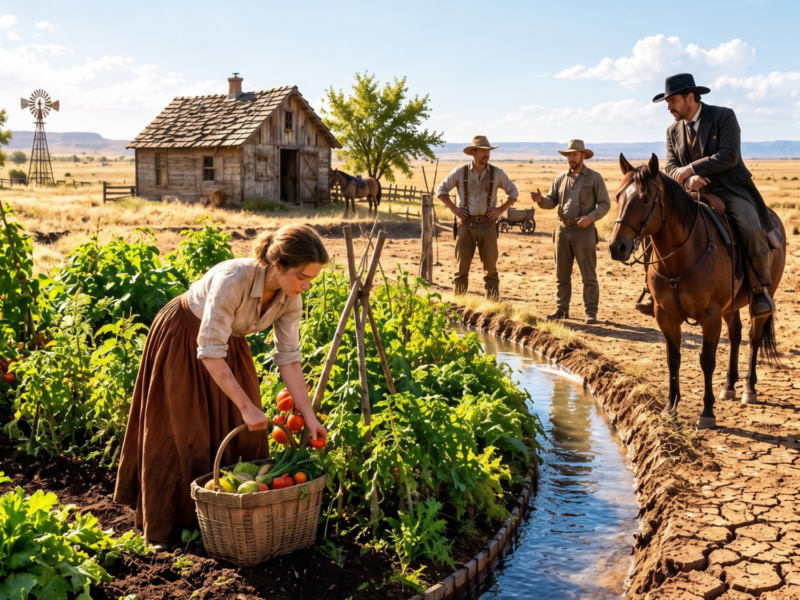
They Laughed at Her “Fool’s Furrow” — Until Her Crops Stayed Green Through the Worst Summer Drought
The Vulture Circles
In early August, as the drought tightened its death grip on the county, Denton Walls rode out to Levvenia’s claim for the second time.
This visit was fundamentally different from the first in every way that mattered.
His prized sorrel horse looked drawn and ribby. Walls’s fine wool jacket was coated in dust, and the arrogant, bulletproof confidence he usually wore like a second saddle had vanished, replaced by a tight, frantic energy.
He stopped his horse at the edge of the property, staring in barely concealed shock at the towering green stalks standing defiantly in a county that had otherwise gone entirely brown and brittle.
“Miss Hatch,” he called out.
Levvenia walked out from the shade of her porch, wiping her hands on a towel. She waited.
“I’ve lost a third of my stock,” Walls said, abandoning his usual oily charm for blunt desperation. “There’s been no water in my north pasture pond since mid-July. My cattle are dropping.”
She said nothing. The silence stretched.
Walls looked past her, staring hungrily at the deep trench, at the overflow notch, and the damp earth beneath the squash leaves. He could smell the moisture in the air.
“I will pay you for water rights,” he said, his voice tight. “Access to whatever the hell is holding the water here. Let me run a pipe or dig a channel from your trench to my property.”
He named a cash figure. It was more than twice what he had offered to buy the entire claim back in April. It was a staggering amount of money for a single woman on the frontier.
Levvenia considered it for exactly one moment. It wasn’t about the money. It was about the principle of the earth.
“This water came from the sky, Mr. Walls,” she said, her voice ringing clear across the dead grass. “It landed on this specific piece of land. I bled to build the furrows to keep it here.” She paused, her eyes locking onto his. “That is not something I am selling to a man who mocked the work.”
Walls’s expression moved rapidly through shock, disbelief, and finally settled into something incredibly cold and dangerous.
“You are making this much harder than it needs to be, little girl,” he sneered.
She didn’t answer.
Walls leaned over his saddle horn. He didn’t offer cash this time; he offered the only other currency he possessed. He mentioned his attorneys in Topeka. He mentioned county water allocation filings, riparian rights, and highly technical legal objections to her “claim improvements” that he could raise before the township board to have her homestead revoked.
He made the threats sound procedural, bureaucratic, and inevitable—which was exactly how men like Denton Walls made stealing land sound acceptable to their own consciences.
Then, he spurred his horse and rode away in a cloud of dust.
Levvenia stood alone in her field for a long moment after he disappeared over the ridge. The green leaves of the sorghum shifted around her in a faint, hot wind, whispering like conspirators. In the far distance, she saw Becket Ferris standing at his fence line. He had been close enough to hear the tone of the conversation, if not the exact words. He had heard enough.
Ten days later, the sheriff rode out and handed Levvenia an official piece of paper.
It was a legal notice. Failure to comply with standard cultivation and agricultural requirements under the Homestead Act of 1862. It was a formal objection citing Levvenia Hatch’s spring activities as “experimental, damaging, and non-agricultural in nature.” It was signed by an expensive attorney from two counties east.
A hearing date was set at the county courthouse: August 28th. If she lost, the claim would revert to the government, and Denton Walls would purchase it the very next day.
Clementine Bogs rode her wagon over that same afternoon. She marched into the cabin, sat heavily at the small wooden table, and read the legal notice twice, her lips moving silently. Then, she slammed the paper down on the wood.
“He wants this land for the creek access, and because your green crops are making him look like a fool,” Clementine spat, her face flushed with anger. “And now he’s going to try to steal it from you in a courtroom, in a room where you can’t fight him with a shovel.”
Levvenia looked at the notice. Then she looked out the open window, past the emerald green field, out toward the dry, dying county stretching endlessly in every direction.
She walked over to her bookshelf. She took down the fragile packet of letters her father had left her. She took down her own leather-bound journal.
“He thinks I only know how to use a shovel, Clementine,” Levvenia said softly, tracing the spine of her journal. “He forgot that I spent ten years teaching mathematics and logic.”









