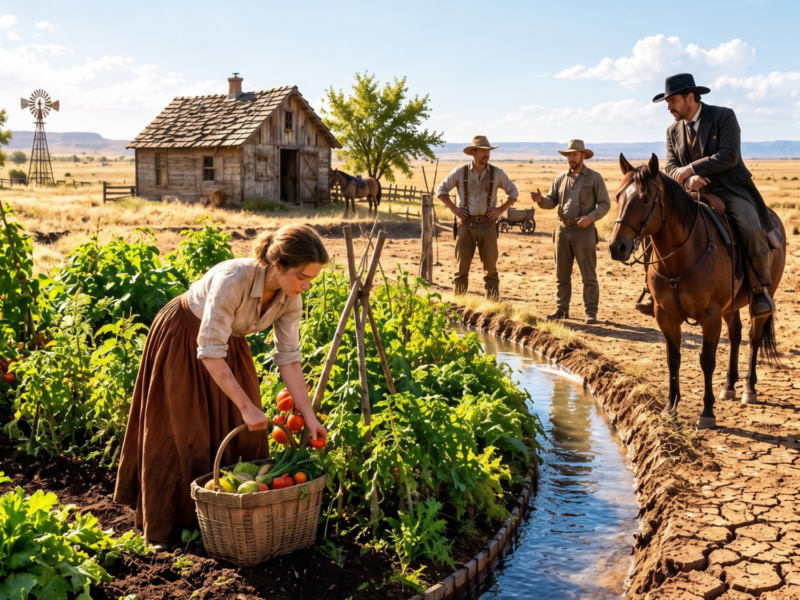
They Laughed at Her “Fool’s Furrow” — Until Her Crops Stayed Green Through the Worst Summer Drought
The Bleeding Palms
The digging started in mid-April.
It was a descent into a specific kind of physical hell that Levvenia had never known existed. The soil of Redstone Flat was not rich, loamy earth. It was a thin layer of clay baked over an impenetrable layer of hardpan. It was like trying to dig through concrete with a spoon.
She owned a heavy, iron-forged spade. She drove her boot onto the shoulder of the blade, throwing her entire weight onto it. The spade barely bit an inch into the earth, sending a jarring, agonizing shockwave up the wooden handle and straight into her shoulder joints.
By noon of the very first day, the soft skin of her hands—hands that had held nothing heavier than chalk and textbooks for a decade—was destroyed. Her palms were blistered, the blisters had popped, and she was bleeding freely through the canvas work gloves she wore.
She went into the cabin, washed her hands with harsh lye soap, wrapped them in torn strips of an old bedsheet, pulled the bloody gloves back on, and went back out.
By the third day, the agony had transformed into a dull, persistent fire. But she had learned the physics of the earth. She learned to angle the shovel blade, to slice rather than chop. She learned to use the momentum of her hips and back, utilizing her whole body rather than just her exhausted arms.
She dug a trench three feet wide and two feet deep. The dirt she removed was piled meticulously on the downhill side, creating a continuous, raised berm that followed the natural contour of the land.
The town, of course, noticed within a week.
In Redstone Flat, information traveled faster than a prairie fire. Men riding the trails saw the woman swinging a pickaxe and a shovel, digging a massive ditch across her property instead of plowing straight rows.
By the time Levvenia drove her wagon into town for her second round of supplies, the trench had already been baptized.
As she walked into Pool’s general store, the whispers were barely concealed.
“Call it the Schoolteacher’s Ditch,” one man snickered near the counter.
“Nah,” another replied, spitting tobacco juice into a brass spittoon. “It’s the Fool’s Furrow. That’s what it is.”
The reasoning among the men was entirely consistent. Rain in Kansas was a fickle, unpredictable god. The real problem with farming out here was finding water deep in the ground, not catching water from the air. Digging a massive trench during the critical spring planting season—wasting precious weeks of labor—was the kind of arrogant, catastrophic mistake only an educated easterner who didn’t know the land would make.
Denton Walls made sure to fan the flames of the mockery. He stood outside the feed store, flanked by several sycophants, picking his teeth with a silver toothpick.
“That woman is out there digging her own grave,” Walls declared loudly as Levvenia’s wagon rolled past. “By the time the harvest moon rises, she’ll be on her knees thanking me for that eighty dollars, begging me to buy her out.”
Levvenia heard this secondhand from Clementine Bogs, a stout, practical woman who owned the well down the road. Clementine delivered the town’s gossip not to be cruel, but with the urgent tone of someone delivering a vital warning.
“They want you to fail, Levvenia,” Clementine said, her hands resting on her wide hips. “Walls wants that creek access. If you don’t plant soon, you’ll have nothing to eat come winter.”
“I am planting, Clementine,” Levvenia said softly. “I’m just preparing the bed.”
She thanked the woman, slapped the reins, and drove home to pick up her shovel.









