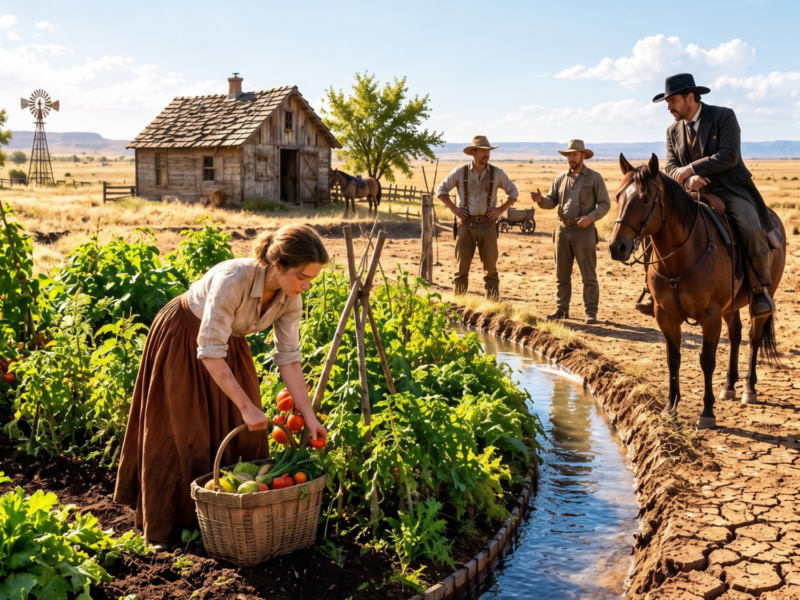
They Laughed at Her “Fool’s Furrow” — Until Her Crops Stayed Green Through the Worst Summer Drought
The Sky’s Brief Mercy
The first substantial rain of the season arrived in early May.
It did not come as a violent, destructive thunderstorm, but as a low, heavy blanket of gray clouds moving sluggishly from the west. For two entire days, a steady, rhythmic shower fell over Redstone Flat.
On the afternoon of the second day, Levvenia stood on the porch of her cabin, wrapped in a heavy wool shawl, ignoring the rain soaking her hair. She was staring at her field.
The water behaved exactly as the land dictated. It hit the baked earth, failed to absorb quickly, and began to sheet downhill toward Perdition Creek.
But then, it hit the Fool’s Furrow.
The water cascaded into the two-foot-deep trench. The raised earthen berm on the downhill side held firm like a miniature dam. The water stopped. It lost its kinetic energy. It pooled, widening into a long, serpentine lake that traced the contour of the property.
Levvenia walked out into the mud. She stood at the edge of the trench, her boots sinking into the muck, and watched.
With no dramatic announcement, no great spectacle, the magic of the earth began. The water, trapped and unable to run away to the creek, began to sink. Slowly, inexorably, the heavy clay and hardpan yielded to the persistent weight of the water. It was being pushed deep, deep into the aquifer beneath her feet.
The following morning, the sun broke through the clouds.
Levvenia walked out to the berm. She took a long, wooden stick and pushed it straight down into the soil on the uphill side of the trench. It sank easily, twelve inches deep. When she drew it out, the tip of the wood was dark, rich, and dripping with moisture.
She walked down to Perdition Creek. The draw had run perhaps a quarter-inch of water during the height of the storm. Within two days, the sun had baked it back to smooth stones and white dust.
But her trench? Her trench was still moist a full week later.
She finally began to plant. While the rest of the county’s seeds were already sprouting, Levvenia walked her meticulously designed rows. She planted drought-resistant sorghum immediately along the trench line, its roots tapping directly into the saturated earth. She planted corn in the sections nearest the berm. She sowed winter squash in the lowest topographic areas where the moisture ran deepest, and dry beans along the outer edges.
She was three weeks behind every other farmer in the county.
That fact was loudly and joyously discussed at Pool’s store, though never addressed to her directly.
Becket Ferris stopped his horse by her south fence one afternoon. He watched her methodically dropping seeds into the earth. He had already put in two massive fields of corn. His rows were mathematically straight, running up and down the hills efficiently, but his expression when he looked at his own land retained that same careful, guarded flatness.
“Late spring,” Becket called out.
Levvenia stood up, wiping the sweat from her brow with her forearm. “Late spring.”
Becket looked at her serpentine rows, curving strangely across the landscape. He was a man looking at a trench system he had never seen tried anywhere in this county, let alone by a former schoolteacher. He had the distinct look of a man calculating a massive risk that wasn’t his to take.
“I hope you know what you’re doing, Miss Hatch,” he said softly.
“So do I, Mr. Ferris.”
He almost smiled at that. The corner of his eyes crinkled. He touched the brim of his hat and rode back to his own property.









