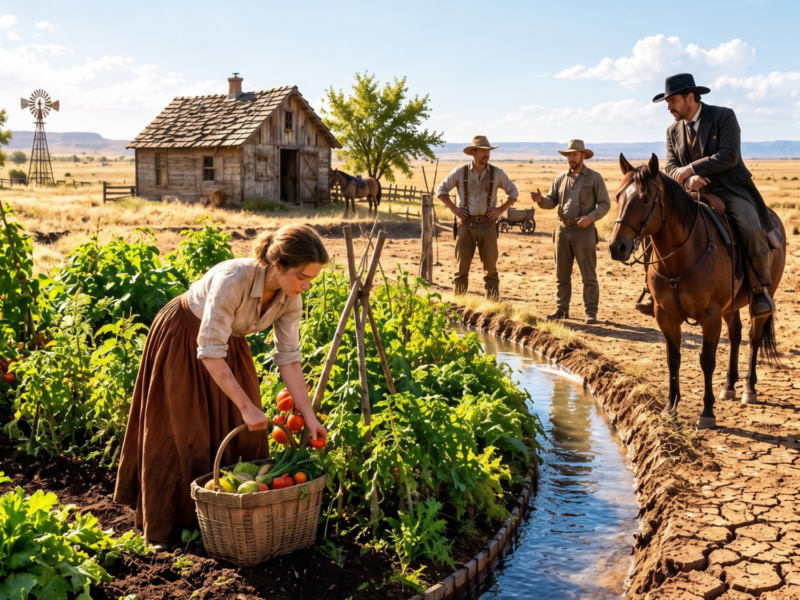
They Laughed at Her “Fool’s Furrow” — Until Her Crops Stayed Green Through the Worst Summer Drought
The Trial of the Furrow
The hearing room in the Redstone Flat courthouse was suffocatingly full.
Every wooden chair was taken. Men in sweat-stained shirts stood shoulder-to-shoulder along the walls. The tall windows were thrown wide open in a futile attempt to combat the stifling heat, and dozens of people pressed close against the outside frames just to listen to the proceedings.
Judge Cornelius Fry presided over the bench. He was a man with a shock of white hair and a face carved from granite. Crucially, before he had studied the law, Fry had been a land surveyor for the railroad. He had absolutely zero patience for procedural theater or legal grandstanding, a fact which became glaringly obvious within the first fifteen minutes of the hearing.
Denton Walls sat back in his chair, looking smug, while his expensive attorney from Topeka presented the case in full, flowery rhetoric.
“Your Honor,” the attorney pontificated, pacing before the bench, “Miss Levvenia Hatch has demonstrated a profound neglect of the duties required by the Homestead Act. She spent the critical spring planting window digging a massive, nonsensical ditch rather than cultivating crops in the legally accepted, traditional manner. These so-called ‘improvements’ are experimental, highly unusual, and frankly, destructive to the topography. They cannot be classified as standard agricultural development. Therefore, the claim is in violation of the Act, should be revoked, and returned to the public trust for immediate reassignment to a competent party.”
The argument was tidy, legally precise, and entirely detached from reality.
When Levvenia’s turn came, she did not hire a lawyer. She walked calmly to the front of the room. She wore a simple, high-collared dress, her hair pinned back immaculately.
She did not give a speech. She simply set three objects down on Judge Fry’s heavy oak table.
First, the letter from Felipe Garza to her father, detailing the ancient Mexican hydrology of the trinchera.
Second, the original piece of paper bearing her father’s margin note in his own hand: Creek goes dry July. What if we kept the rain?
And finally, she placed her heavy, leather-bound journal on the wood.
Judge Fry leaned forward, peering over his spectacles. “What is this, Miss Hatch?”
“Data, Your Honor,” Levvenia said clearly, her voice carrying to the very back of the hot, crowded room.
She opened the journal. She had not just been farming; she had been conducting a rigorous scientific experiment. She showed the judge her daily recorded rainfall dates. She showed him the precise trench water levels, measured in inches. She presented the soil moisture readings she had taken every single morning since May.
And most damningly to Walls’s case, she presented a chart detailing the crop emergence dates. She had meticulously compared the growth rates of the seeds planted near the berm’s moisture gradient versus the seeds planted in traditional, flat rows further away.
The numbers were not dramatic rhetoric. They were cold, hard, irrefutable precision.
She explained the topographical slope of the land. She explained the fluid dynamics of water movement over hardpan clay. She explained exactly what the trench did, why it worked, and how the soil now retained a massive aquifer of moisture that it had never held before.
She spoke about the earth the way she had once spoken about arithmetic to her spellbound students in Ohio. She presented the land as a living thing that behaved according to strict rules, and proved that those rules were observable, harnessable, and profitable if one simply paid attention.
Then came the witnesses.
Clementine Bogs took the stand, gripping her purse tightly. She testified, under oath, that her family, and her livestock, had survived the worst three weeks of the devastating drought solely on the water she had collected from the runoff basin near the Hatch berm.
Edmund Pool, the storekeeper, reluctantly took the stand and confirmed, producing his own ledgers, that Levvenia had purchased vast quantities of planting seed, cultivation tools, and materials entirely consistent with legitimate farm improvement from her very first day in town.
Denton Walls was scowling deeply, his attorney frantically scribbling notes.
Then, Becket Ferris stood up from the back of the room. The crowd parted to let him walk to the front.
Becket did not swear on a Bible; he simply looked at the judge. He had farmed Redstone Flat for five grueling years. He had the respect of every man in the room because he had survived the dirt alongside them.
“I watched my corn fail this summer, Judge,” Becket said, his voice a low, steady rumble. “The way it’s failed in dry years before. It burned up in the sun.” He pointed a calloused finger toward Levvenia. “I walked the length of Miss Hatch’s trench in late July. I dug into the soil with my own two hands.”
The room was deathly quiet.
“The moisture level beneath her berm, in the dead heat of July, was something I have never observed in this county in the middle of summer,” Becket stated. He said it plainly, as a matter of scientific fact, without any emotional elaboration.
He turned to look at Denton Walls, then back to the judge. He added one final sentence before taking his seat.
“I wish I had asked her more questions about that trench back in April, Your Honor. Because if I had, I would have built one, and I’d have a crop to harvest this fall.”
Judge Fry spent a very long time with Levvenia’s journal. The only sound in the courtroom was the ticking of the wall clock and the rustle of heavy paper as the judge turned the pages. He compared the entries. He looked at the rainfall columns and the sprouting dates.
He looked over his glasses at Levvenia. “What was the emergence differential, Miss Hatch, between the rows nearest the berm and the outer, traditional rows?”
“Nearly six days, Your Honor,” Levvenia replied without missing a beat. “And a forty percent higher survival rate during the July heatwave.”
Judge Fry nodded once, a sharp, decisive movement. He closed the journal with a loud thwack that made Denton Walls jump.
“The Homestead Act recognizes the productive, agricultural use of land,” Judge Fry boomed, his voice carrying the weight of the law. “This land was used. This land was mathematically and physically improved. This land produced a viable crop through catastrophic drought conditions that actively defeated every single surrounding claim in this county.”
He paused, looking directly at Denton Walls’s attorney.
“An improvement to the land is not a departure from farming, Counselor. It is farming. It is the very definition of it.”
Judge Fry slammed his wooden gavel down. “The petition to revoke is dismissed with prejudice. The claim remains the sole property of Levvenia Hatch.”
The courtroom erupted into a chaotic murmur of shock, relief, and validation.
Denton Walls sat perfectly still in his chair for several seconds after the words landed, his face flushed a dark, angry red. Then, he stood up, shoved his chair back violently, and walked out of the courtroom without speaking a single word. The crowd parted to let him go, offering him no sympathy.
Outside the courthouse, the heat was still absolute, baking the wooden sidewalks. But as Levvenia stepped out into the blinding sunlight, something in the air had fundamentally changed its character. It tasted of victory.









